Eleanor Vance had lived in that house for fifty-one years. She knew every creak of the porch boards, every draft that came through the hall window in January, every rosebush Robert had planted along the front walk for their fortieth anniversary. She knew the exact sound the screen door made when Marcus was twelve and trying to sneak in after curfew—a low, slow squeal she had never fixed on purpose.
She had not planned to lose it on a Tuesday afternoon.
“It’s just paperwork,” Arthur had said when he called Saturday morning, his voice smooth and reasonable, the same voice he used to get out of trouble as a kid. “Property transfer. Quick signature. You won’t even have to talk to anyone. I’ll drive.”
She should have known. She had always known, really. Arthur Vance had coveted everything his whole life—her mother’s pearls, Robert’s tools, now this.
The Roanoke County Courthouse sat at the center of town like it owned the place, wide concrete steps rising up from the plaza, a brick facade worn gray by sixty years of weather. Eleanor gripped her cane with both hands and tried to keep up with Arthur’s long stride. Her hip complained with every step. The August heat pressed down, no shade anywhere on the open plaza, the air smelling of hot concrete and someone’s spilled soda near the bottom step.
“Stop dragging,” Arthur muttered without looking back.
She wasn’t dragging. She was seventy-two. There was a difference.
“Arthur.” She caught up to him on the third landing. “I want to see the paperwork before I sign anything. Robert’s attorney said—”
“Robert’s attorney works for me now.” He said it like swatting a fly. “Family business. It’s already handled.”
She stopped walking. “I want to call Marcus first.”
That was when his face changed.
“You call that mechanic,” Arthur said, his voice dropping to something cold and flat, “and I will call the county public guardian’s office. Tell them you’ve been showing signs of dementia. Can’t care for yourself. See how fast they move.” He stepped close, close enough that she could smell the cheap coffee on his breath. “You know how these things go, Ellie. Crazy old lady living alone. Judge signs a paper, they stick you somewhere with plastic sheets on the bed. You’ll never see that house again anyway.”
Her voice came out smaller than she wanted. “That’s my home.”
“Not for much longer.”
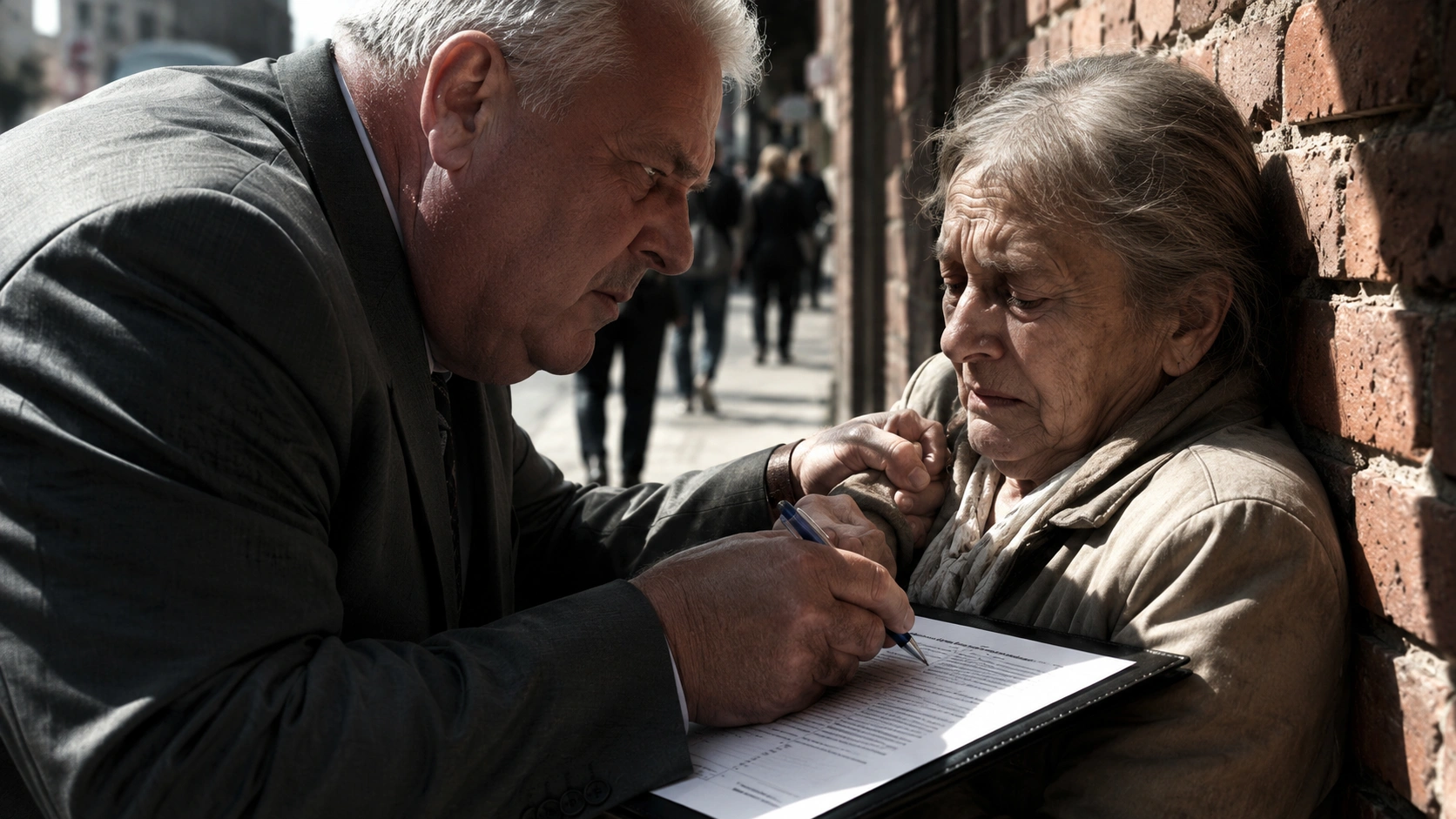
He moved fast—faster than a man his age should have. His foot shot out and caught the base of her cane. It flew from her hands in a clatter, bouncing down the steps one by one, landing in a puddle of dark soda at the bottom. Eleanor grabbed for the handrail and missed. His hand clamped around her wrist—hard, bone-grinding—and yanked her sideways into the brick wall.
The impact knocked the air from her lungs. The folder of deed papers slid from under her arm and fanned across the dirty concrete. Her shoulder blades scraped brick. Her knees buckled.
“Pick it up,” Arthur ordered.
She couldn’t. Her legs weren’t cooperating. Her wrist throbbed. A man in a blue button-down walked right past, phone to his ear, eyes straight ahead.
A woman in a pantsuit paused—half a second—then snapped her mouth shut and hurried up the steps.
A teenage boy actually angled his phone away from them. Like the scene was too ugly to document.
Twenty-three years of food bank volunteering. Casseroles when people got sick. She had waved at half these people in the Walmart parking lot.
Now she was invisible.
Arthur jammed a ballpoint pen between her fingers. He had already retrieved the folder, had it open to the deed transfer page, was forcing her hand toward the line. “Right here. You’re signing it over. Four hundred thousand easy, and I’ve got debts. Real ones. You’re not sentimental enough to be worth what this is going to cost me, Ellie.”
Tears burned in her eyes. She blinked hard. She had cried enough in eight months—quiet tears in the kitchen, silent ones in the bedroom where Robert’s side of the bed still smelled like him. Not here. Not in front of him.
“Please,” she whispered. “It’s my home.”
“Was,” he said.
Inside the lobby, just beyond the heavy glass doors, Jenna Morales stood at the intake counter pretending to sort morning filings. She had been watching for two minutes through the glass—long enough to see the cane kicked away, long enough to see the old woman slammed against the wall, long enough to see the pen forced into shaking hands.
She told herself it was just a family argument. People in courthouses argued all the time.
Then she saw the name tab on the black folder: Eleanor Vance.
Her stomach dropped.
Vance. She knew that name. Not from courthouse records. From the garage out on Route 221—the one with the big bay doors and the American flag out front. Marcus Vance’s shop. The guy who had fixed her uncle’s bike for free after the wreck. Who’d shown up at the VA hospital with a whole crew to rebuild the ramp for wheelchair veterans. Quiet, solid, the kind of man the whole county called when something needed doing.
That old woman on the steps was his mother.
Jenna’s hands started to shake. She backed away from the window until she hit the counter edge. A stack of manila folders toppled and hit the floor. She left them there.
She pulled her phone and scrolled to the number she’d saved six months ago—Marcus, after he’d jumped her car in the rain. She’d never used it.
It rang once. Twice.
Outside, Arthur’s voice carried through the glass. “Sign or I’ll have the state declare you senile. I mean it.”
“Vance Auto. This is Marcus.”
Jenna kept her voice low, steady, choosing words fast. “Mr. Vance? This is Jenna from the courthouse. Your mom’s outside on the front steps. Her brother has her against the wall. He kicked her cane away. He’s trying to force her to sign a property transfer. She’s scared.”
A long pause. The sound of metal—a wrench—hitting a concrete floor.
When Marcus spoke again, his voice was quiet, even, the kind of calm that lives on the other side of rage. “Keep him inside. Ten minutes. Don’t let him walk out with that paper.”
The line went dead.
Jenna slipped the phone back into her pocket and hit the record button on the voice memo app as she went out to meet them at the door.
Inside the lobby, Arthur had Eleanor on the long wooden bench under the community bulletin board, his arm stretched along the back of it, casual and satisfied. He was already on the phone with his lawyer.
“Yeah, it’s Arthur. We’re inside. She signed.”
He laughed, big and rolling, letting it bounce off the water-stained ceiling tiles. “You should’ve seen it, Dave. Out on the steps. Kicked that damn cane right out from under her—clatter, clatter, all the way down. People kept walking like it was nothing. Told her straight—sign or I’ll have the state declare you senile. She folded like a cheap card table.”
Jenna stood at the intake counter, her hands moving through papers, her face showing nothing. The phone in her pocket was catching every word in clean, crisp audio. Coercion. Elder abuse. Attempted fraud. She filed it mentally, the same way she filed deeds and court orders. Evidence. All of it.
“Mr. Vance? I need to verify some information before we proceed.” She held out her hand. “ID, please.”
Arthur sighed like she’d asked him to hand over a kidney. “You already checked it outside.”
“Computer’s glitching on the scan. Policy.” She kept the smile pleasant and absolutely immovable.
He slapped his license on the counter.
Jenna typed slowly. She asked Eleanor for her Social Security number even though she already had it. Eleanor answered in a whisper, eyes finding Jenna’s for half a second. Scared. Exhausted. Grateful.
Jenna gave her the smallest nod she could manage. Stay with me. Just a little longer.
The clock read 2:21.
Arthur stood. Paced. Sat back down. Checked his watch. Muttered. “Pathetic. Whole family’s been carrying her for years.”
Eleanor sat very still and counted the scuff marks on the tile floor.
At 2:26, the first vibration reached the building. Jenna felt it through the soles of her courthouse flats before she heard it—a low, steady hum in the concrete, in the glass. The loose pens on the counter trembled.
Arthur didn’t notice. He was counting money in his head.
The hum grew. Became a rumble. The overhead lights swayed on their chains.
When Arthur finally heard it, he looked up with a frown. “What’s that?”
The glass doors rattled in their frames. A car alarm in the lot beeped twice. Pigeons exploded off the brick planters outside.
Then the sound hit—full, physical, a wave of deep engine thunder that pressed against the building like a fist.
Arthur stood up from the bench.
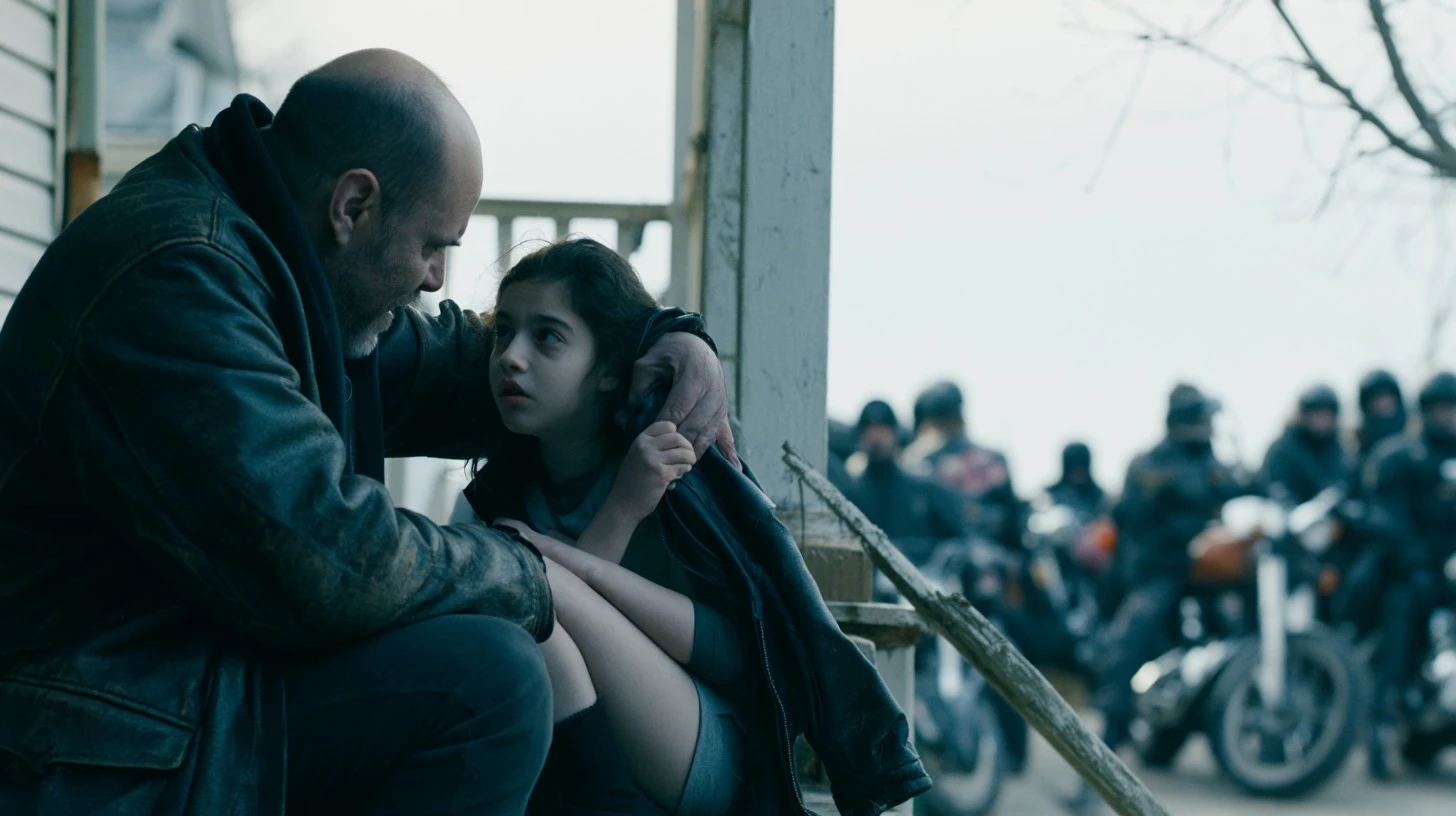
Forty Harley-Davidson motorcycles came over the hill in two-by-two formation. Chrome flashing in the August sun, leather and denim cutting sharp silhouettes against the Virginia sky. They swept into the plaza in a wide, deliberate arc and lined up in a wall that sealed every exit—every sidewalk, every parking-lane opening. Forty machines. Forty riders. The sound of them was a physical thing.
Then, in perfect unison, every engine cut off.
The silence hit harder than the noise had.
The plaza was dead quiet except for the tick of cooling pipes and the distant traffic on the county road. Forty men swung off their bikes and stood—arms crossed, boots planted, Roanoke Guardians patches worn and proud on their backs. They didn’t speak. They didn’t need to.
Arthur had come back out through the glass doors, dragging Eleanor with him, phone still to his ear. He stopped on the top step and looked down at the wall of leather and said nothing for a full three seconds.
Then: “What the hell is this? Wrong address, boys. Move your toys before I call the sheriff.”
Marcus Vance stepped forward from the center of the line.
Six-three. Shoulders like bridge beams. Salt-and-pepper beard trimmed close. Dark eyes that held no warmth at all right now, moving from Arthur to Eleanor and back again, taking inventory of the bruise on his mother’s wrist, her cane still missing, the way she stood half a step behind Arthur like she was hiding.
He walked up the steps slowly. Deliberately. Each boot fall like a period at the end of a sentence.
Arthur tried to hold his ground and managed it until Marcus was three steps below, eye level now, looking at him with that same cold, measuring quiet.
Marcus didn’t say a word to Arthur.
He turned, descended two steps, and crouched down to where the aluminum cane still lay in the spilled soda at the base of the landing. He picked it up carefully. Wiped the handle clean on the leg of his jeans. Straightened up.
He walked past Arthur like the man was furniture.
He stopped in front of Eleanor and held the cane out with both hands—the way you hand something back to someone it was taken from.
“Here, Mom,” he said. “You dropped this.”
Eleanor’s fingers closed around the grip. One tear slipped free despite everything. “Marcus.” Her voice broke around his name. “You came.”
“Always,” he said. He put his hand on her shoulder, turning her gently away from Arthur, placing himself between them.
Arthur’s paralysis cracked. “You think this intimidates me?” He jabbed a finger. “I’ve got signed papers. Legal papers. This is a courthouse. I’ll have every one of you arrested for harassment. Get out of here.”
“She signed under duress,” Marcus said. He didn’t raise his voice. “She didn’t sign anything real.”
“That’s not—she put her name—I was there—”
“You were also on the phone. Inside. Bragging.” Marcus reached into the breast pocket of his leather vest and withdrew a sealed legal envelope—thick cream paper, county clerk’s gold stamp visible through the plastic window. He held it up in the afternoon light. “You forgot to read Dad’s real will. The one he had rewritten six months before the cancer took him. The one delivered straight to my shop, not the house mailbox. Because Dad knew you’d try something like this.”
The color left Arthur’s face in one clean pull. His mouth worked. His hands went still.
“The house in that folder isn’t worth the paper it’s printed on,” Marcus said. “You walked into this courthouse today with nothing but a threat and a borrowed pen. I’ve been waiting eight months for you to show up.”
The bikers parted below, opening a lane through the formation. A tall man in a charcoal suit climbed the steps—briefcase in hand, silk tie, mirror-polished shoes, and a faint smudge of motor oil on one cuff. He had ridden here like everyone else, on the back of Big Tommy’s Harley.
Harold Whitaker, estate attorney. Robert Vance’s lawyer for thirty-two years. The man who had kept the real will in his safe for eight months and said nothing, waiting.
“Mrs. Vance,” Whitaker said, giving Eleanor a small, respectful nod. “I’m sorry it came to this. Your husband made me promise to wait until someone tried to take what wasn’t theirs.”
Arthur lunged forward, still half-crouched. “That’s a fake! Setup! I’ll have it thrown out in ten minutes!”
Whitaker didn’t look at him. He opened the briefcase on the concrete ledge, latches clicking sharp and final. Inside: a thick sheaf of documents. He lifted the top one and held it so Arthur—and the growing crowd behind him—could see the heading: Last Will and Testament of Robert James Vance – Executed October 12, 2025.
“Mr. Arthur Vance,” Whitaker read, voice carrying across the plaza, steady as a judge’s gavel. “Your brother-in-law’s original will leaves the family home, all contents, and the adjoining three acres solely to Eleanor Vance for her lifetime, with remainder to their son Marcus upon her passing. There is an explicit clause—page seven, paragraph three—that voids any subsequent attempts to transfer title without Eleanor’s uncoerced consent, witnessed by two independent parties and notarized at this courthouse. You attempted to bypass that today. You failed.”
Arthur’s face had gone the color of old concrete. Sweat ran down his neck into his collar. “She signed the deed transfer. I have it right here—” He fumbled in his jacket and yanked out the black folder, waving it.
Jenna stepped forward from the doorway. Phone out. Voice steady. “Actually, sir, you don’t. She never completed a valid signature. Her hand was shaking too hard to form a legal mark.” She pressed play.
Arthur’s own voice spilled out across the plaza, tinny but unmistakable:
“Sign or I’ll have the state declare you senile… pathetic burden… plastic sheets on the bed…”
A murmur moved through the crowd. Someone gasped. The tired mother from the lobby covered her youngest child’s ears but kept listening.
“Coercion,” Jenna said. “Elder abuse. Attempted fraud. All of it on record. All of it timestamped.”
Arthur spun toward her, face purple. “That’s illegal! You can’t use that! I’ll sue this courthouse—”
Officer Ramirez, the security guard who had turned his back earlier on the landing, now turned back around. His hand rested on the butt of his radio. He looked at Arthur the way a man looks at something he has already decided about. “Already called it in, Mr. Vance. Sheriff’s en route. They take elder abuse real serious around here.”
The second guard stepped up beside him.
Arthur’s mouth opened and closed. He looked at the bikers. At the crowd. At the phones. At Eleanor standing straight now with her cane planted firm and her chin up. At Marcus. At the closed briefcase under Whitaker’s arm.
For the first time in his life, Arthur Vance had nothing left to say.
Two sheriff’s cruisers rolled into the plaza, lights on, sirens off. The bikers split without being asked, opening a clean lane. Deputies stepped out—three of them, all business. The lead deputy, a stocky woman with a name tag that read Sgt. L. Hargrove, took one look at the scene and nodded once to Ramirez.
“Mr. Arthur Vance,” she said, voice flat and official. “Turn around. Hands behind your back.”
“I’m the victim here! She’s the one—she has lawyers, she has all these—”
She didn’t wait. She took his wrist, spun him, and the cuffs clicked shut with a metallic snap that echoed off the courthouse brick. Arthur’s shoulders jerked. The crowd didn’t clap—this wasn’t a movie—but nobody looked away. Phones stayed up. The same people who had walked past Eleanor forty minutes ago stood witness now.
Hargrove took the documents from Whitaker and guided Arthur down the steps. His expensive loafers scraped concrete—the same shoes that had kicked Eleanor’s cane. He didn’t go quietly.
“I’ll be out by dinner. You’ll all see. I’ve got debts, real debts, this isn’t—”
The cruiser door closed with a solid thunk.
The lights stayed on as it pulled away, the second cruiser falling in behind. The plaza felt lighter, even with forty motorcycles still parked in formation.
Marcus kept his hand on his mother’s shoulder. He waited until the cruisers were out of sight.
Then he shrugged out of his leather vest—the one with the Roanoke Guardians patch worn soft from years of road miles—and draped it around Eleanor’s shoulders. She was shaking, just slightly, not from fear anymore. The vest swallowed her. The patch covered her back like a shield.
Eleanor reached up and touched the leather under her chin. It smelled like motor oil and aftershave and fifty Sunday barbecues. For the first time in eight months, her spine straightened all the way. She lifted her chin.
She turned and looked at where the cruiser had been.
“You always wanted what wasn’t yours, Arthur,” she said quietly, to no one in particular. “Even when we were kids.”
Jenna came down the steps and pressed her phone gently into Eleanor’s free hand. “The full recording is on there. Every word. You can give it to the prosecutor yourself, or I can. Either way, he’s not coming back to that house.”
Eleanor’s fingers closed around the phone. She looked at Jenna—really looked at her—for a long moment. “Thank you, sweetheart. I don’t know how to thank you for calling him.”
Jenna smiled, small and genuine. “You already did. You raised him right.”
Big Tommy and Rico rolled Eleanor’s old Buick out from the side lot where it had been sitting since morning. Keys dangling from Rico’s hand. The bikers mounted up in practiced sequence, engines rumbling to life one by one until the plaza filled with deep, protective thunder. Not angry this time. Just steady.
Marcus helped Eleanor down the steps, one hand under her elbow, the other steadying the cane. He opened the driver’s door, waited until she was settled behind the wheel, and fastened her seat belt himself.
“Follow us home,” he said. “Middle of the formation the whole way. Nobody touches you.”
Eleanor nodded. The leather vest hung from her shoulders like something she’d always owned.
Marcus closed her door gently. Swung onto his Fat Boy. Raised two fingers.
The whole formation rolled out—two-by-two, Eleanor’s Buick tucked safely in the center like a queen in a motorcade. They moved slow through the county roads, chrome catching the late sun. Drivers in oncoming lanes pulled over without being asked. People in front yards waved. Word traveled fast in Roanoke County.
The ride took twenty-three minutes.
Eleanor kept both hands on the wheel, eyes forward, but every few seconds she checked the rearview mirror. A wall of leather and steel rolled behind her, steady and unhurried, going nowhere else. The rosebushes Robert had planted waited at the end of the gravel driveway, blooming late in the season—red and pink against the green. The house looked exactly as she’d left it that morning. White siding. Green shutters. The porch swing moving gently in the breeze.
She parked, cut the engine, and sat for a moment in the quiet.
Then she got out and walked those three porch steps the way you walk them when you know you almost lost everything and didn’t. Slow. Deliberate. Certain.
At the top she turned and looked out over the driveway. Forty men stood among their bikes—some leaning on handlebars, some with arms crossed, Big Tommy already passing out water from a cooler in the chase truck. Rico checking the deadbolt. The late afternoon sun painting everything gold.
Marcus came up beside her. He didn’t say anything. He just stood there, solid as the house itself.
Eleanor reached up and touched the Guardians patch on the vest. “Your daddy would be proud of you today,” she said.
“He’d be prouder of you,” Marcus said. “You stood up there even when you were scared.”
She smiled then—a real one, the kind that reached her eyes and deepened every crease around them. She put her hand on the white porch railing. Behind her, the screen door waited. Inside were the faded family photos, the worn armchair by the window, the kitchen table where she had served Sunday dinners for fifty years. Robert’s reading glasses on the side table, exactly where she’d left them. The smell of old wood and lavender and home.
No one would ever kick her cane down the steps again.
The bikers stayed until the sun went down. Some of them were already talking about building a porch ramp in case her hip gave her more trouble. Others were planning a cookout for next weekend. Nothing fancy—just burgers and stories and the kind of family you build when blood lets you down.
Eleanor stood on her porch and breathed the clean country air and let the weight she had carried since Robert’s last breath lift, finally, all the way.
She was home.
Original fictional stories. AI-assisted creative content.