Mark hadn’t slept a full night in four months.
It started small—a drawer left open he didn’t remember opening, a window latch that wouldn’t stay closed, a faint scraping sound at 2 a.m. that he always convinced himself was the house settling. He lived alone with his six-year-old daughter, Lily, in a two-story house at the edge of a wooded lot. No neighbors close enough to hear anything. No one to call who’d actually come.
When a string of break-ins hit the towns nearby, Mark stopped dismissing the sounds.
He drove to the county shelter on a Tuesday. Not looking for a companion. Looking for an alarm system with teeth.
The first dog lunged at the cage door. The second one barked so hard the floor vibrated. The third had already been adopted. Mark walked the row twice and was almost ready to leave when he reached the last kennel in the back.
The dog inside didn’t move.
Large. Dark-coated. Sitting perfectly still, watching Mark with amber eyes like he was being evaluated, not the other way around.
“That’s Brutus,” the shelter worker said, appearing beside Mark. Her name tag read Dana. She kept her voice even, professional. “He’s been here eleven weeks.”
“Why?”
She hesitated. “He’s protective. Intensely. His last placement—a family with two kids—said he kept putting himself between the youngest and everyone else. Wouldn’t let the dad near the boy at bedtime. They thought something was wrong with him.”
“Was something wrong with him?”
“We don’t know. There was nothing wrong with the family. But Brutus didn’t seem to agree.” She crossed her arms. “I’d recommend keeping him separate from your daughter until you’ve established trust. At minimum a few weeks.”
Mark looked at the dog. Brutus hadn’t moved. Hadn’t barked. Just watched.
“I’ll take him.”
The first evening, Brutus ate half his food, drank water, and lay down near the front door. He didn’t explore the house. He didn’t beg for attention. When Lily came downstairs in her pajamas and crouched in front of him with enormous eyes and said, “Hi, dog,” Brutus sniffed her once and looked away.
“He doesn’t like me,” Lily said.
“He’s just getting used to us,” Mark said. “Give him time.”
He kept Brutus out of Lily’s room that night. Put a baby gate at the top of the stairs. Fell asleep on the couch downstairs while Brutus lay near the back door, nose working in the dark.
Mark woke at 3:17 a.m. to silence.
That was the problem. It was too quiet. Brutus wasn’t anywhere downstairs.
He found the baby gate knocked sideways—not broken, just nudged out of place. He took the stairs two at a time and stopped in the hallway.
Lily’s door was open.
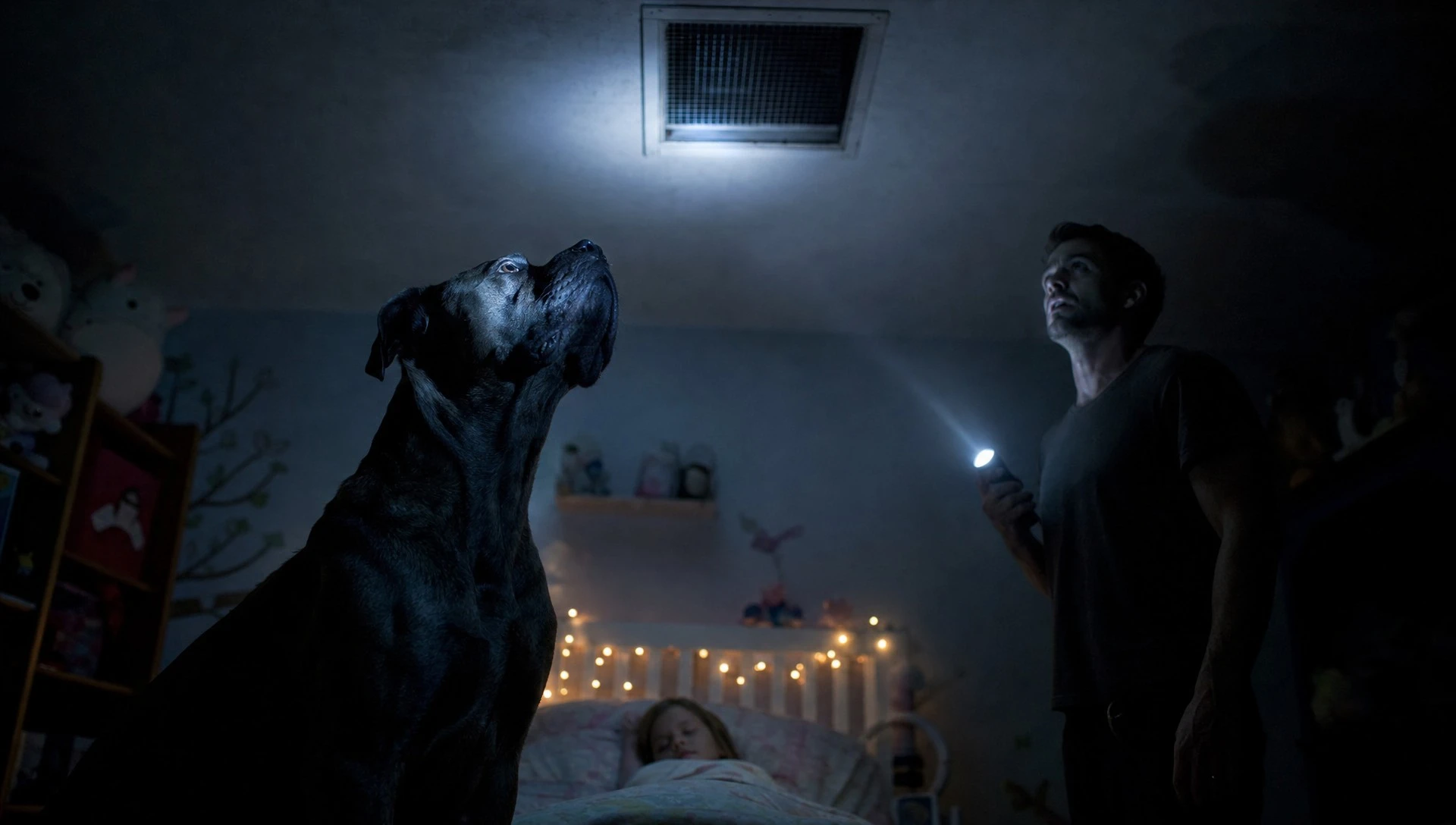
Brutus stood inside, at the foot of her bed.
Mark’s chest locked. He took one careful step forward, ready to grab the dog by the collar—
Then he saw it.
Brutus wasn’t looking at Lily.
He was looking up.
His entire body was oriented toward the ceiling. Head tilted. Weight forward. The low, steady way a dog points before a hunt. His eyes tracked something along the air vent above the closet, and Mark heard it then—a faint, rhythmic scrape. Like something shifting its weight inside a narrow space.
Mark grabbed Lily without waking her, pressed her against his chest, and backed out of the room.
Brutus stayed.
Mark locked himself and Lily in the master bathroom, called 911, and sat on the floor with his back against the tub and his daughter asleep in his arms until he heard tires on gravel.
Three officers. Two flashlights sweeping the yard. One going around the back.
He met them at the front door and pointed up.
They found him in the attic.
A man in his late thirties, dehydrated, with a sleeping bag, a week’s worth of food wrappers, and a phone with its location services disabled. He’d accessed the house through a crawl space behind the detached garage—an opening Mark hadn’t even known existed, hidden under a rusted vent cover. There were marks in the insulation showing a path he’d worn smooth moving between the attic joists and the ventilation shafts.
The lead officer came back downstairs and looked at Mark steadily. “You said you hadn’t noticed anything.”
“I thought it was the house,” Mark said. “I thought it was me being paranoid.”
“How long has the dog been here?”
“One day.”
The officer looked at Brutus, who was sitting in the kitchen doorway watching them all with those amber eyes.
“One day,” the officer repeated.
He wrote something in his notebook and didn’t say anything else.
The man had a prior. Stalking, two counties over, seven years back. The DA’s office filed for remand. The crawl space was sealed, the vent covers replaced with welded steel grates, and a locksmith spent four hours rekeying everything on the property.
Mark sat in the backyard that afternoon while Lily played on the swing set, and Brutus sat beside him in the grass.
“I almost returned you,” Mark said.
Brutus didn’t look at him.
“The shelter lady warned me. I thought she was being dramatic.”
Still nothing.
Mark put his hand on the dog’s back. “Thank you.”
Brutus finally turned his head. Looked at Mark for exactly two seconds. Then looked back at Lily.
That was six months ago.
Brutus sleeps at the foot of Lily’s bed now. He still doesn’t bark much. Still watches doorways, vents, corners—but quieter now, like a soldier in peacetime. Alert out of habit. Not out of fear.
Lily named the game she plays with him “guard duty.” She puts on a plastic army helmet and crawls around the living room while Brutus follows two steps behind, ears up, never quite believing the coast is completely clear.
Mark watches them from the kitchen and feels something he hadn’t felt in a long time.
Like someone else was finally keeping watch.
He called Dana at the shelter three weeks after the arrest. She picked up on the second ring.
“You were right about him,” Mark said. “The protective instinct. You were right.”
A pause. “What happened?”
He told her everything.
When he finished, she was quiet for a moment. Then she said, quietly: “Eleven weeks. Nobody wanted him for eleven weeks because he made people uncomfortable.”
“He made me uncomfortable too.”
“And yet.”
“And yet.” Mark looked out the window at Lily and Brutus in the yard. “I think he was waiting for the right house. The one that actually needed him.”
Dana laughed softly. “I’ll put that in his file.”
“Retired,” Mark said. “Put ‘retired, successful.'”
She laughed again. “Done.”
He hung up, went outside, and sat in the grass. Brutus immediately abandoned Lily’s game and came to sit beside him, shoulder pressed against his knee.
That was the first time Mark let himself admit, out loud, to no one in particular: “We’re okay.”
The dog didn’t respond. He didn’t need to.
He’d known for months.
The man who had been living in the walls was sentenced to four years. The prosecutor read the evidence—the sleeping bag, the food wrappers, the worn path through the insulation—and called it “deliberate, sustained, and deeply calculated.” The judge agreed.
Mark wasn’t in the courtroom. He was at Lily’s school play, sitting in the third row, with a large dark dog waiting in the car outside.
Brutus had gotten special permission from the principal. She’d read the news story.
Everyone in town had.
Original fictional stories. AI-assisted creative content.