The convenience store on Route 9 looked like every other one—buzzing fluorescent lights, stale coffee smell, rows of chips nobody really wanted.
Nobody expected anything to happen there.
Least of all the ten-year-old boy standing at the counter, clutching a loaf of bread like his life depended on it.
Because it kind of did.
“Put it back,” the cashier snapped, her voice cutting through the quiet store. “I saw you try to pocket that.”
The boy’s face went red. “I wasn’t—”
“Don’t lie to me, kid. Security footage doesn’t lie.”
His fingers tightened around the plastic wrapper. “My sister hasn’t eaten since yesterday.”
“Not my problem.” She crossed her arms. “Pay or leave.”
Three customers watched from different aisles. Nobody moved. Nobody spoke.
The boy’s jaw clenched. He was trying so hard not to cry that his whole body shook.
“I was going to pay,” he whispered. “I just needed to make sure it was enough first.”
The cashier rolled her eyes. “Sure you were. I’ve heard it all before.”
She reached for the bread. The boy pulled back.
“Please,” he said. His voice broke. “Emma hasn’t eaten anything but crackers in two days. She’s sick. She needs real food.”
“Then maybe your parents should get better jobs.” The cashier’s voice was ice.
A woman in aisle three flinched. An older man near the coolers looked down at his shoes.
Nobody stepped in.
The boy’s hands started shaking. “My dad’s dead. My mom’s working two shifts. I’m trying to help.”
“Well, you’re not helping by stealing.”
“I said I was going to pay!” The desperation in his voice made the fluorescent lights feel even harsher.
“Then show me the money.”
He reached into his pocket. Pulled out crumpled bills. Started counting.
“One… two… two fifty… two seventy-five…”
He stopped. His face went pale.
“That’s what I thought.” The cashier snatched the bread from his hands.
“Wait—” The boy’s voice cracked completely. “Please. I can come back. I can bring the rest. Just let me take it to her. Please.”
“No.”
That single word landed like a slap.
The boy stood there, frozen. Humiliated. Defeated.
And still, nobody moved to help him.
That’s when the door opened.
The rumble came first—low, mechanical, unmistakable. Then the heavy boots. Then the man himself.
Leather jacket worn soft from years of use. Gray stubble. Hands that looked like they’d built things and broken things in equal measure.
He didn’t say anything at first. Just stood there, taking in the scene.
The cashier straightened up. Put on her customer service smile. “Can I help you?”
The biker’s eyes stayed on the boy. “What’s going on here?”
“Nothing.” The cashier’s smile tightened. “Just handling a situation.”
“Situation?” The biker’s voice was calm. Too calm. “That what we’re calling it?”
“Caught him trying to steal.” She pointed at the bread she’d set back on the shelf. “Store policy is clear.”
“That true?” The biker looked at the boy directly.
The kid’s voice cracked. “My sister’s six. She’s been sick. Mom’s working a double shift at the hospital and another tonight cleaning offices. I just—I thought I had enough.”
“How much were you short?”
“Seventy-five cents.”
The biker’s jaw tightened. “Seventy-five cents.”
“Store policy,” the cashier repeated. “No exceptions.”
“Right.” The biker’s eyes swept across the store. Landed on each customer who’d watched and done nothing. “Everybody’s got policies.”
The air felt heavier.
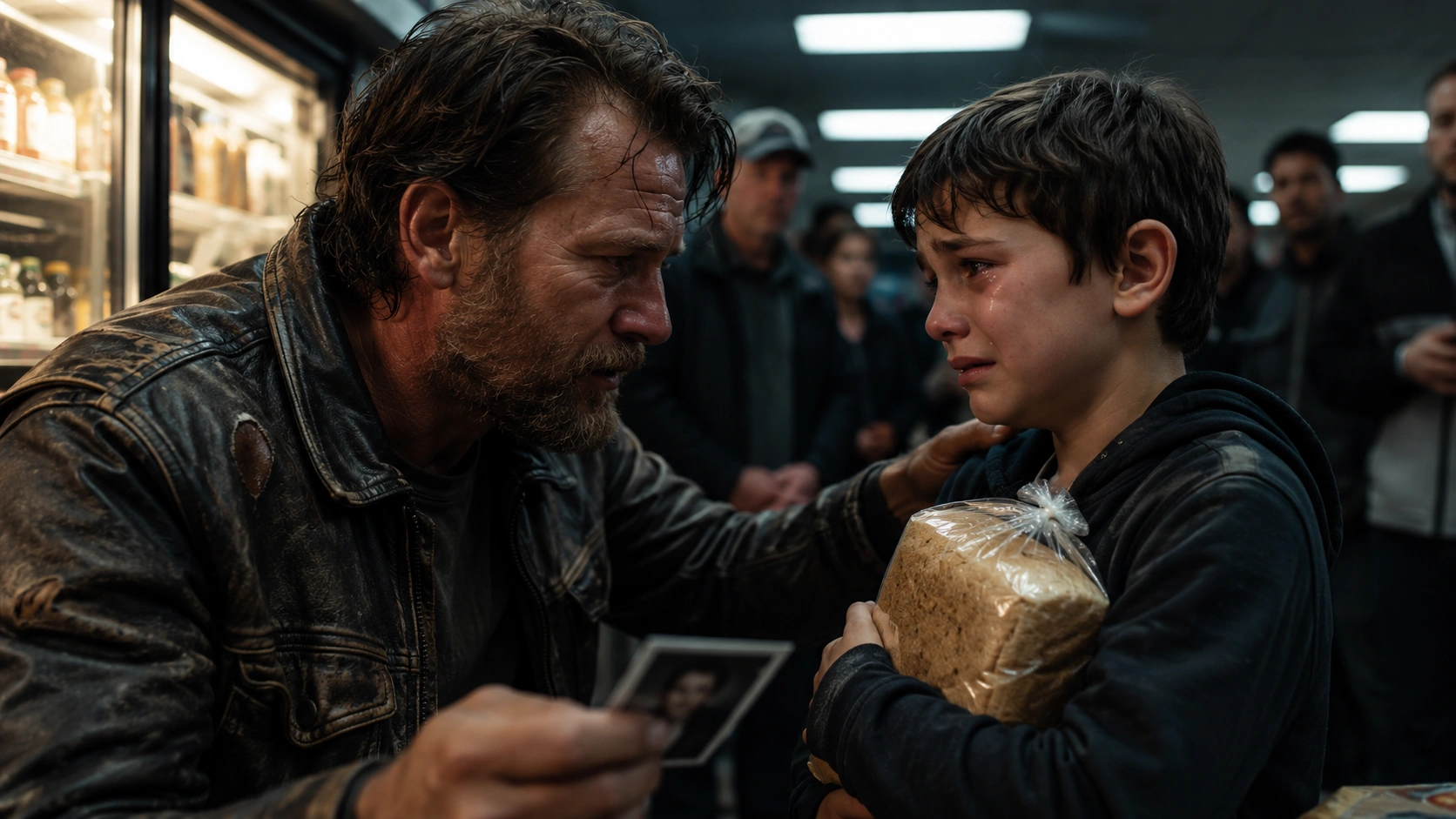
That’s when something fell from the boy’s jacket pocket and hit the floor.
A photograph. Old. Creased. Faded at the edges.
The biker bent down and picked it up.
His hand stopped moving.
The photo showed two men standing next to a Harley Davidson. One older, maybe mid-thirties, one younger, early twenties. Both in military fatigues. Both smiling. The kind of smile people have before life gets complicated.
Before deployments that don’t end well.
“Where did you get this?” The biker’s voice changed completely.
The boy wiped his eyes. “It’s my dad’s. He kept it in a box with his important stuff. His medals and letters and… and that.”
“Your dad.”
“Yeah.”
“What’s his name?”
The boy hesitated. Looked at this stranger who’d picked up something precious. “Daniel Martinez.”
The store went completely silent.
Not the uncomfortable silence from before. Something different. Something heavier.
The biker stared at the photo like it might disappear if he looked away. His thumb traced the edge slowly, carefully.
“Daniel,” he repeated. Barely a whisper. “Danny.”
“You… you know him?” The boy’s voice had hope in it now. Desperate, careful hope.
The biker looked up. Really looked at the kid this time.
Dark eyes. Strong jaw. That same stubborn set to his shoulders Daniel always had when he refused to quit on anything.
The resemblance was unmistakable.
“Yeah,” the biker said quietly. “I know him.”
The boy took a step closer. “Really? Do you know where he is? Mom won’t talk about it much. She just says he’s gone but I thought maybe—”
“Kid.” The biker’s voice was gentle but firm. “Slow down.”
The cashier shifted uncomfortably. “Look, if you’re gonna buy something—”
“How much for the bread?” The biker cut her off without looking at her.
“Three fifty.”
He pulled out his wallet and slapped a fifty-dollar bill on the counter. “Give him whatever he needs. Keep the change.”
The cashier’s mouth opened, then closed. She didn’t move.
“Now,” the biker added. Still calm. But something in his tone made it not a request.
She started bagging items silently. Bread. Milk. Eggs.
The biker crouched down to the boy’s level. “What’s your name?”
“Marcus.”
“Marcus.” He said it like he was testing how it felt. Like he was searching for Daniel in the syllables. “Your dad ever mention Tommy?”
The boy’s eyes went wide. “Uncle Tommy?”
The biker’s breath caught.
“Dad said…” Marcus’s words tumbled out. “He said if anything ever happened, if things got bad, I should find Uncle Tommy. That you’d help. But I didn’t know where you were. Mom didn’t know either. The army wouldn’t tell us anything except… except he wasn’t coming back.”
Something broke in the biker’s expression. Something that had been holding for a long time.
Years.
“Your dad,” Tommy said carefully. “Where is he, Marcus?”
The boy looked down. “Deployment went bad. Afghanistan. Two years ago. They said… they said it was quick. That he didn’t suffer.”
The words landed like physical blows.
Tommy closed his eyes. Breathed once. Twice. Fighting something back.
When he opened them, they were wet.
“He never told me,” he said. “About you. About your sister. About any of it.”
“He wanted to.” Marcus’s voice was small. “Mom said he tried to call you before the last deployment. He wanted you to meet us. But the connection kept cutting out. And then…”
He didn’t finish. He didn’t have to.
“Emma’s named after someone, isn’t she?” Tommy asked quietly.
Marcus looked surprised. “Yeah. Dad’s mom. How did you—”
“He talked about her.” Tommy stood up slowly, photo still in his hand. “All the time. When we served together. He’d say when he had kids, his daughter was gonna be Emma. No question.”
“You were deployed together?”
“Three tours. Iraq, then Afghanistan, then back to Iraq.” Tommy’s hand found Marcus’s shoulder. Solid. Steady. “He saved my life twice. I saved his once. He used to joke I owed him.”
Marcus’s eyes filled again. “He never joked much. After he came back the last time. Before… before the final deployment.”
“War does that.” Tommy’s grip tightened just slightly. “But he was still your dad. Still Daniel. Still the best man I ever knew.”
The cashier put the bagged groceries on the counter quietly. For once, she didn’t say anything.
“You said your sister’s sick?” Tommy asked.
“Yeah. Started three days ago. Fever won’t break. Mom gave her medicine but we ran out. She couldn’t afford more and still make rent.”
“Where’s your mom now?”
“Hospital. She’s a nurse’s aide. Then she’s got the cleaning job from ten to six in the morning.”
“And you’ve been watching Emma?”
“Yeah.”
“For three days? By yourself?”
Marcus nodded.
“Jesus Christ,” Tommy muttered. Then, louder: “What’s your address?”
Marcus told him.
Tommy nodded. “Here’s what’s gonna happen. You’re gonna take that bread. And that milk. And whatever else they put in there. Then you’re gonna take me to your apartment. I’m gonna look at Emma. If that fever’s not broken in an hour, we’re taking her to the ER. I don’t care what it costs.”
“We can’t afford—”
“I can.” Tommy’s voice left no room for argument. “Your dad was my brother. Not by blood, maybe, but in every way that counted. Which makes you and Emma family. And family doesn’t let family suffer over seventy-five cents or hospital bills or anything else. You understand me?”
Marcus’s face crumpled. The tears he’d been holding back for days—maybe longer—finally came.
Tommy pulled him into a hug. Let him cry into the worn leather jacket that smelled like motorcycle exhaust and Old Spice.
“It’s okay,” he said quietly. “You did good, kid. You’ve been taking care of your sister. Daniel would be proud of you. I’m proud of you.”
The boy’s shoulders shook.
Behind them, one of the customers cleared her throat. “Add this.” She put down children’s fever medicine and Tylenol. “For Emma.”
The second customer approached. An older man with gray hair. “This too.” Peanut butter. Mac and cheese. Apple juice. Crackers.
The third customer, a woman in scrubs, pulled out her wallet. “For the medical bills.” She handed Tommy two hundred-dollar bills. “I’m a nurse. I see this too much. Kids suffering because parents are working themselves to death and still can’t make ends meet.”
Tommy looked at the money. At the medicine. At the food.
“You don’t have to—”
“We should’ve helped ten minutes ago,” the man said simply. “When he was standing there begging. We just watched.”
The woman nodded. “We’re helping now.”
Tommy looked at them. Then at the cashier, who had the grace to look ashamed.
“Thank you,” he said.
Marcus pulled back, wiping his eyes. “There’s so much…”
“It’s what people do,” Tommy said. “When they remember how to be human.”
Outside, the afternoon sun was starting to set. The parking lot was nearly empty except for Tommy’s bike.
A newer Harley, well-maintained, with a sidecar attachment that looked custom-built.
“This is how we’re getting to your place,” Tommy said. “Unless you’re scared of bikes.”
Marcus shook his head hard. “Dad showed me pictures. He loved bikes. He said… he said someday we’d get one and ride together.”
Tommy’s throat tightened. “Yeah. Yeah, he did love them.”
They loaded the groceries carefully into the sidecar’s storage compartment. Marcus climbed in, looking small in the seat built for an adult.
Tommy handed him a helmet. “Buckle up.”
“Uncle Tommy?”
“Yeah?”
“Thank you. For… for everything. For remembering my dad. For helping us.”
Tommy looked at him. This kid who’d walked into a store hungry and scared and desperate, and come out with something he didn’t even know he was searching for.
Family.
“Thank you,” Tommy said. “For finding me. For keeping that picture. For being brave enough to ask for help even when it was hard.”
Marcus clutched the photograph carefully.
The bike roared to life. The rumble that had announced Tommy’s arrival now carried them forward.
And as they pulled out of the parking lot, Marcus held the photograph tight.
The same photograph that had connected two generations.
That had survived a war and a death and two years of grief.
That had brought a lost uncle and two desperate kids together at exactly the right moment.
The apartment building was exactly what Tommy expected. Run-down but clean. Flickering hallway lights. The smell of a dozen different dinners cooking.
Third floor. Unit 3B.
Marcus unlocked the door. “Emma? I’m back.”
A small voice called out. “Marcus?”
The apartment was tiny. One bedroom, barely. Cramped living room with a couch that had seen better days. Kitchen the size of a closet.
But it was clean. Organized. Someone was trying hard.
Emma sat on the couch wrapped in a blanket, her small face flushed with fever. When she saw Tommy, she shrank back.
“It’s okay,” Marcus said quickly. “This is Uncle Tommy. He’s Dad’s friend.”
Tommy knelt down slowly. Kept his distance. “Hey, Emma. Your brother’s been worried about you.”
She looked at Marcus, then back at Tommy. “You knew our dad?”
“Yeah. He was a good man.”
“He’s gone now.”
The matter-of-fact way she said it broke something in Tommy’s chest. Six years old. Already understanding loss.
“I know,” Tommy said gently. “But I’m here now. And I’m gonna make sure you feel better. Okay?”
He reached for her forehead. Emma let him.
Burning up.
“When did it start?”
“Three days ago,” Marcus said. “She said her throat hurt. Then the fever came.”
Tommy pulled out his phone. Made a call.
“Mike? Yeah, it’s Tommy. I need a favor… House call. Kid with a fever, sore throat, three days running… Yeah, I’ll pay cash… Twenty minutes? Perfect.”
He hung up. “Doctor’s coming. Friend of mine. Retired but still makes exceptions.”
“We can’t afford—”
“Already told you. I’ve got it.”
Marcus looked like he wanted to argue. But he was too tired. Too relieved.
Tommy unpacked the groceries. Made Emma toast with peanut butter. Got her to drink apple juice. Gave her the fever medicine.
Within fifteen minutes, she was leaning against him on the couch, tiny and fragile.
“Uncle Tommy?” Emma’s voice was small.
“Yeah?”
“Are you gonna leave? Like Dad did?”
The question gutted him.
“No,” Tommy said. He meant it. “I’m not going anywhere.”
Dr. Mike arrived twenty minutes later. Examined Emma. Prescribed antibiotics for strep throat.
“She’ll be fine,” he said. “Keep her hydrated. Medicine twice a day. She should perk up in 48 hours.”
Tommy walked him out. Pressed five hundred dollars into his hand.
“Tommy, that’s too much—”
“It’s not enough for what you did.” Tommy’s voice was firm. “Thank you.”
Back inside, Marcus was sitting next to Emma, who’d finally fallen asleep.
“Mom gets home at seven tomorrow morning,” Marcus said quietly. “She’ll be so scared when she sees all this. The food. The medicine. You.”
“Then we’ll explain.” Tommy sat down across from them. “Your mom’s been doing this alone for two years?”
“Yeah. Dad’s military benefits help some. But it’s not enough. She’s always working. Always worried.”
“Not anymore.”
Marcus looked up. “What?”
“I meant what I said. You’re family. Daniel would’ve wanted me to look after you. And even if he hadn’t…” Tommy paused. “I lost my brother. I’m not losing his kids too.”
“We’re not your responsibility—”
“You are now.” Tommy’s voice was gentle but absolute. “And here’s what’s gonna happen. Your mom’s gonna cut back to one job. I’ll cover the difference until she’s stable. Emma’s getting proper medical care. You’re both getting regular meals. And if anyone gives you trouble—at school, in this building, anywhere—you call me. Understood?”
Marcus stared at him. “Why? You don’t even know us.”
“I knew your dad. That’s enough.” Tommy pulled out the photograph. “This was taken in Kandahar. 2018. Right before a mission that went sideways. We got ambushed. I took shrapnel in my leg, couldn’t walk. Daniel carried me two miles to the extraction point. Two miles. Under fire. He wouldn’t leave me.”
Marcus’s eyes were wide.
“He said, ‘Brothers don’t leave brothers behind.'” Tommy’s voice roughened. “So I’m not leaving his kids behind. Not when I can help. Not ever.”
The boy’s face crumpled again. But this time, it wasn’t despair.
It was relief.
Pure, overwhelming relief.
“Thank you,” he whispered.
Sarah came home at seven-fifteen the next morning, exhausted and terrified.
She’d gotten Marcus’s text: “Mom, come home. Emma’s okay. But you need to come.”
She burst through the door expecting the worst.
Instead, she found Emma asleep on the couch, fever broken, breathing easy.
Marcus at the table eating actual breakfast.
And a stranger in her kitchen making coffee.
“Who the hell are you?” Her voice was sharp with fear and mother-tiger protectiveness.
Tommy turned. Put down the coffee pot. Raised his hands slightly. Non-threatening.
“My name’s Tommy Reeves. I served with Daniel.”
Sarah went very still. “Daniel.”
“Yes, ma’am.”
“What are you doing in my house?”
“Helping.” He gestured to Marcus. “Your son came to a convenience store yesterday trying to buy bread. Ran into some trouble. I stepped in.”
“What kind of trouble?”
Marcus spoke up. “I was seventy-five cents short. The cashier was gonna kick me out. Uncle Tommy paid for everything.”
“Uncle Tommy?” Sarah looked between them.
Marcus showed her the photograph.
Sarah’s hand went to her mouth. “Oh my God. Daniel talked about you. He… he tried to call you before…”
“I know.” Tommy’s voice was gentle. “I’m sorry I wasn’t there.”
“You didn’t know.”
“I should have. I should’ve checked on him. On you. On them.” He looked at Emma, still sleeping. “I’m sorry.”
Sarah sank into a chair. Looked at the full refrigerator. The medicine bottles on the counter. Her daughter breathing peacefully.
“You did all this?”
“They’re Daniel’s kids. That makes them family.”
She started crying. Not sad crying. Relieved crying.
“I’ve been so scared,” she whispered. “So tired. I didn’t know how much longer I could keep this up.”
“You don’t have to anymore,” Tommy said. “Not alone.”
Six months later, Sarah was down to one job. A better one. Better hours. Better pay.
Marcus had stopped looking like he carried the world on his shoulders.
Emma was healthy, happy, and obsessed with motorcycles.
Tommy came by three times a week. Sunday dinners. Wednesday game nights. Random afternoons when Emma wanted to go to the park.
He wasn’t trying to replace Daniel. Nobody could.
But he was there. Steady. Reliable. Present.
Family.
One Sunday, Sarah pulled him aside while the kids were playing in the other room.
“Thank you,” she said. “For everything. For being here when we needed someone.”
“Thank you,” Tommy said. “For letting me in. For giving me a second chance at family.”
“Daniel would’ve wanted this. You being here.”
“Yeah.” Tommy’s voice was rough. “Yeah, he would’ve.”
In the living room, Marcus showed Emma the photograph for the hundredth time.
“That’s Dad,” he said, pointing. “And that’s Uncle Tommy.”
“Dad looks happy,” Emma said.
“Yeah. He was.”
“I wish I remembered him better.”
“Uncle Tommy tells us stories. That helps.”
Emma nodded. Then she looked up at her brother. “Marcus?”
“Yeah?”
“I’m glad Uncle Tommy found us.”
“Me too, Em. Me too.”
The convenience store on Route 9 looked like every other one.
But for four people—five, counting Daniel’s memory—it would always be the place where everything changed.
Where hunger met hope.
Where the past collided with the present.
Where a photograph survived a war and death and grief to bring a family back together.
Where a scared kid ran out of money and found something worth infinitely more.
Where seventy-five cents became the price of a miracle.
Because sometimes, life doesn’t give you the family you were born to.
Sometimes, it gives you the family you find in a convenience store on a random Tuesday.
The family that walks through a door at exactly the right moment.
The family that refuses to leave you behind.
That was Tommy’s promise to Daniel.
And he kept it.
Every single day.
Original fictional stories. AI-assisted creative content.