Frank’s leg had been hurting for three weeks.
Not the kind of hurt that goes away with ice or rest. The kind that makes you adjust how you walk, how you sit, how you breathe.
He told the VA clinic receptionist. She said the wait list was months long. He told his neighbor who brought him groceries. The neighbor said old soldiers always have aches. He told the pastor after Sunday service. The pastor said he’d pray for him.
So Frank stopped saying anything.
Maple Ridge was the kind of town that liked things smooth. Clean streets. Friendly faces. A Heritage Day parade every year that brought everyone together with cotton candy and marching bands.
Nobody wanted to hear about an old veteran’s leg.
Except Doc.
Doc ran the auto shop on the edge of town. Quiet guy. Kept to himself mostly. But he noticed things other people didn’t—or wouldn’t.
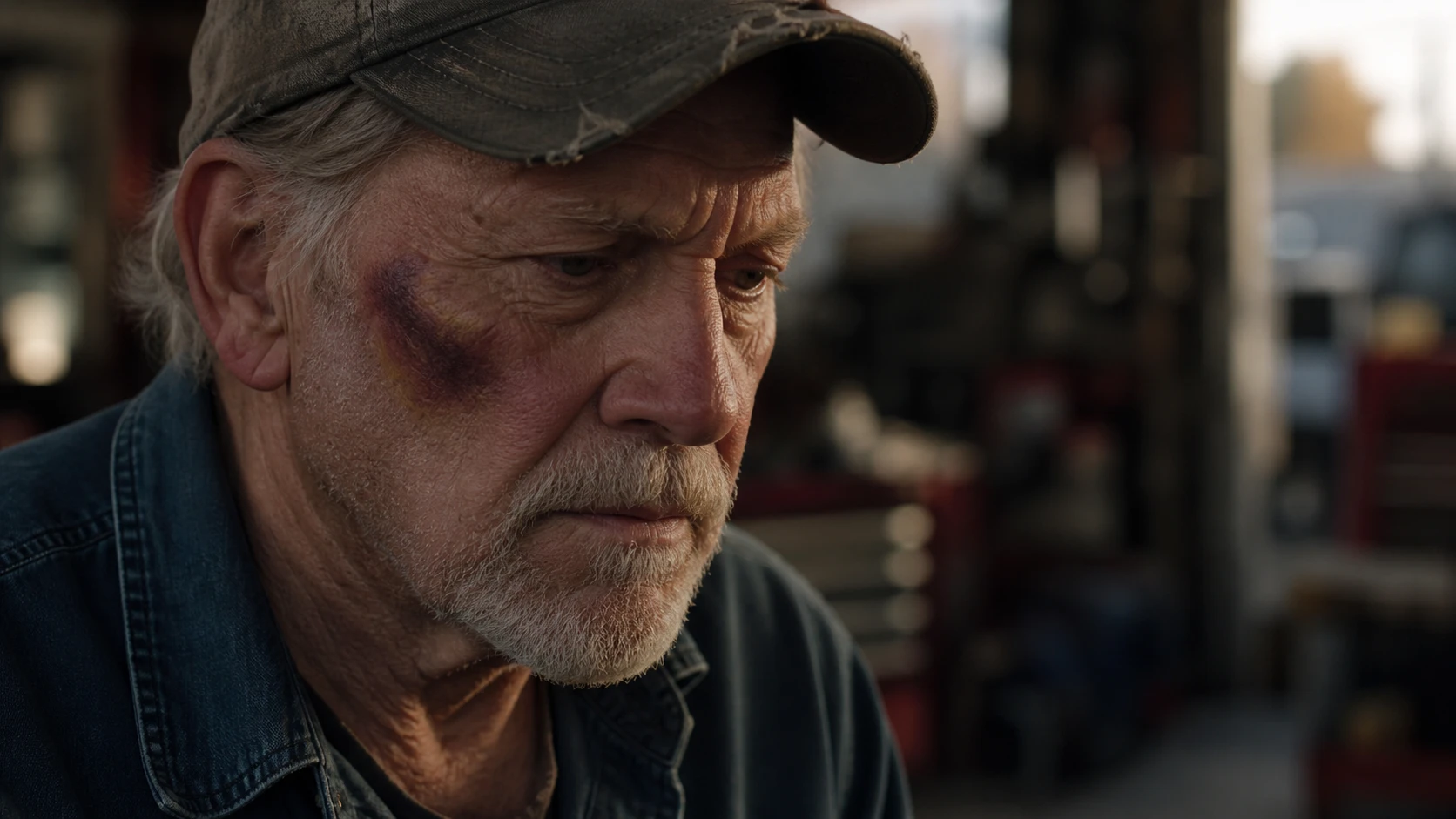
He saw Frank one afternoon, limping past his shop on his way back from the pharmacy. His face was tight with pain he was trying to hide. A fresh bruise darkened his cheekbone.
“You okay, Frank?” he called out.
Frank froze. He’d served two tours in Vietnam. He’d learned not to complain.
“My leg hurts,” he said quietly.
Doc wiped his hands on a rag. “How long?”
“A while.”
“You tell anyone?”
“They said it’s nothing.”
Doc’s jaw tightened. He’d heard that line before. People were real good at deciding what counted as “nothing” when listening was inconvenient.
“It’s not nothing if it hurts,” Doc said. “You mind if I call someone who can check it properly?”
Frank hesitated. At seventy-three, he’d learned that asking for help usually made things worse. But something about Doc’s voice—steady, no pity, no pressure—made him nod.
Doc made the call. Within an hour, a nurse from the county clinic arrived. She examined Frank’s leg carefully, her face growing more serious with every moment.
“This needs imaging,” the nurse said quietly to Doc. “And someone needs to ask him how it happened.”
The answer came in pieces. Quiet confessions in a room that finally felt safe.
His nephew. The one who’d moved in to “help” after Frank’s wife died. The one who was supposed to take care of him. The one who took his VA checks and hurt him when he asked questions.
The kind of truth Maple Ridge didn’t want on its clean streets.
Doc didn’t hesitate. He made more calls. To the right people this time. People who couldn’t ignore paperwork and medical reports.
But Doc also knew something else.
Small towns protect their image. Cases get buried. Witnesses forget. And old veterans learn to disappear.
So Doc called Mack.
Mack led a motorcycle club two counties over. Not the kind of guys you see in movies. No crime, no chaos. Just veterans and tradesmen who’d learned that sometimes the system needs a push.
“We’ve got a situation,” Doc said. “I need backup.”
“How many bikes?” Mack asked.
“Enough to make sure they can’t ignore him.”
Three days later, Heritage Day arrived.
Banners stretched across Main Street. The mayor smiled on his little stage. The marching band warmed up. Families gathered, ready for their perfect small-town moment.
The parade started moving.
That’s when the motorcycles arrived.
One after another, they rolled onto Main Street with deliberate calm. No revving engines. No aggression. Just presence.
They lined the curb and stopped.
The marching band faltered. A baton clattered to the pavement.
Mack removed his helmet and walked toward the stage. Someone handed him a microphone.
He looked at the crowd—neighbors who’d waved at Frank every morning, people who’d thanked him for his service but never asked if he was okay, officials who’d filed away concerns as “family business.”
“We’re not here to celebrate,” Mack said, his voice steady and clear.
The crowd shifted uncomfortably.
“We’re here because a veteran in this town couldn’t walk right, and too many people decided not to ask why.”
Silence spread through Main Street like a held breath.
“He served this country,” Mack continued. “And this town let someone hurt him in his own home. What’s wrong is that we taught him silence instead of safety.”
People started looking around. Some eyes landed on a younger man near the food trucks—rigid shoulders, scanning for an exit. Frank’s nephew.
Mack didn’t point. He didn’t name names. He didn’t need to.
Police officers moved through the crowd. Not with swagger this time. With purpose. Too many witnesses now. Too much truth in the daylight.
Frank sat in the shade with Doc and a social worker named Tessa. He held a cup of water someone had brought him. His eyes stayed on Mack.
“I didn’t want to ruin the parade,” he whispered.
Doc knelt beside him. “You didn’t ruin anything. You just told the truth.”
By nightfall, the whispers had turned into official paperwork. By morning, the bulletin boards that usually held parade flyers carried new notices—resources, hotlines, elder abuse support services. Information Maple Ridge had pretended it didn’t need.
Frank lay in a hospital bed, his leg properly braced. The room smelled like clean sheets and the strange calm that comes when help finally arrives.
Mack sat in a chair that looked too small for him, elbows on his knees.
Frank’s eyes were half-closed. “It hurts less now,” he whispered.
“Good,” Mack said softly.
He shifted slightly. “I should’ve been stronger.”
Mack shook his head firmly. “You were strong enough to survive. That’s what matters.”
Frank’s weathered hand gripped the bedsheet.
Mack leaned forward. “It’s not your job to fight alone anymore.”
Outside, Heritage Day banners sagged in the heat, their bright colors no longer able to cover what had been brought into the open.
The nephew was arrested that night. No bail. No second chances. The evidence was clear, the witnesses too many, the town’s silence finally broken. Frank’s VA benefits were secured, and arrangements were made for proper care.
Maple Ridge had a choice now.
Keep pretending.
Or learn to actually protect its veterans.
Doc stood by the hospital window, watching the sun set over the town.
“You think it’ll stick?” Tessa asked. “The change?”
Doc was quiet for a moment.
“It will if we make them remember,” he said. “Every time they want to look away. Every time they want to call something ‘nothing.’ We make them remember what it cost him.”
Mack stood to leave, pausing at the door to look back at Frank. He was already asleep, breathing easier than he had in weeks.
“He’s going to be okay,” Tessa said.
Mack nodded once. “He is now.”
As the bikers rolled out of Maple Ridge that night, they left behind something the town couldn’t ignore: proof that silence only protects the wrong people, and that sometimes justice needs an audience.
Original fictional stories. AI-assisted creative content.