The diner smelled like burnt coffee and old regret.
Vernon Sloane sat in the far corner with a cold mug and a secret that had been eating him alive for the last decade. His Vietnam cap was soft at the brim from too many nervous hands. His eyes kept drifting to the clock above the pie case.
11:28.
Across the highway, his old platoon was already gathering.
And they were all expecting to finally meet his son.
The lie had started small, the way most lies do.
One reunion, maybe eight years back, someone had asked about Nolan. How’s the boy? What’s he up to? And Vernon, who had not spoken to his son in years, had said the first thing that felt survivable.
“He’s doing well. Designer in Seattle. Real sharp kid.”
They had smiled and nodded and moved on. And Vernon had let himself believe it was just a harmless story.
But stories have a way of growing teeth.
Every year the lie got bigger. The career got more impressive. The relationship got warmer. The invented phone calls got more detailed. By now, Vernon had described a son who called every Sunday, who remembered birthdays, who asked about the old days like they were treasure.
The truth was that he had driven Nolan away with years of drinking and darkness. That he had gotten sober too late. That every letter he had written since went unanswered. That somewhere out there was a grown man carrying wounds Vernon had put there himself.
He stared at the clock.
11:31.
That was when five bikers walked in.
The room stiffened the way rooms do. Conversations thinned. Silverware paused mid-motion. The man at the head of the group was enormous — broad through the chest, gray at his temples, with a rough beard and an old scar dividing one eyebrow. His vest read Deke.
He moved through the diner like a man who had stopped worrying about what other people thought of him a long time ago.
Vernon looked at him.
Then he looked at the clock again.
Then he stood up.
His knees cracked when he rose. A few people noticed. He straightened his jacket, swallowed what was left of his pride, and walked across the black-and-white tile toward the bikers’ table.
A lean man with a snake tattoo curling up his neck turned first.
“You looking for the exit, old man?”
Vernon kept walking. He stopped beside the booth and fixed his eyes on Deke.
“Let him talk,” Deke said.
The lean man settled back. The others watched.
Vernon stood there for one terrible second, holding the full weight of what he was about to ask. Then he said, “My name is Vernon Sloane. In about twenty-five minutes I have to walk into that veterans hall across the road and face the men I served with in Vietnam.”
Deke said nothing.
“I’ve been lying to them for years.” Vernon’s voice dropped to something rougher than he intended. “About my son. I told them he was successful. I told them we were close. I told them he was coming today.”
One of the other bikers snorted. Deke’s expression didn’t shift.
“He hasn’t spoken to me in years,” Vernon said. “And I cannot walk in there alone and let them see what I actually made of my life.”
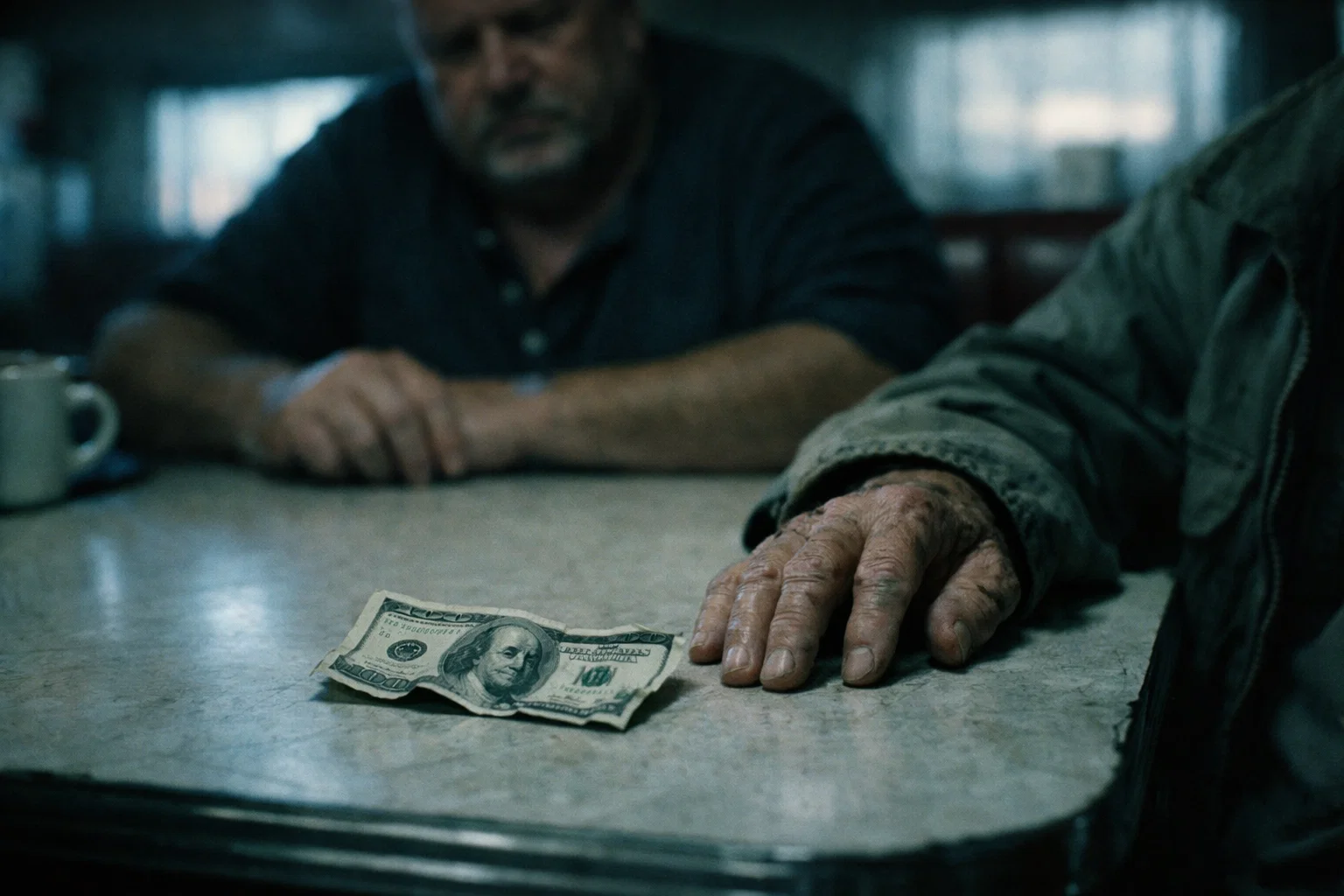
He reached into his pocket and set a wrinkled hundred-dollar bill on the table. His hand was shaking badly enough that the money rattled against the wood.
“Would you pretend to be my son for a couple of hours?”
The reaction at the table was immediate.
The stocky one at the end laughed outright. Another shook his head. The snake-tattoo biker looked offended on Deke’s behalf.
But Deke didn’t move.
He looked at the bill. Then at Vernon’s hand. Then at the faded insignia on Vernon’s cap.
Then he placed one large hand over the money.
Vernon flushed. “I’m sorry. Forget I said it. I shouldn’t have come over here.”
“Put it away,” Deke said.
“Excuse me?”
“Your money. Put it in your pocket.”
The bikers exchanged glances.
Deke rose from the booth slowly and handed his leather vest to the man beside him. Without it he looked less like a symbol and more like a man with a long history and a quiet understanding of pain.
“My father came back from a war too,” he said. “Different one. He drank. He broke everything he touched. By the time I was old enough to understand him, I was already done trying.” He paused. “I never got to hear him say he was sorry.”
Vernon couldn’t speak.
“Maybe today I’m doing this for the version of that story that never happened for me.” Deke straightened. “What’s your son’s name?”
“Nolan.”
Deke nodded once. “Then I’m Nolan for the next few hours. Keep the story simple. I’m not pretending to be some city architect if somebody starts pressing.”
“Of course. Whatever you need.”
“And keep your money.”
The veterans hall smelled like floor polish, casseroles, old photographs, and the particular warmth of people who had survived things together.
A man in a wheelchair spotted them first. Deep lines, an oxygen tube, and sixty years of authority still intact in his voice.
“Vern Sloane!” Wade Mercer called out. “About time.”
He rolled toward them, eyes already moving to Deke.
“This must be Nolan.”
Deke stepped forward and shook the man’s hand with the steadiness of someone who respected what the handshake meant.
“Honor to meet you, sir. My dad’s been talking about you my whole life.”
Wade laughed. “Bet he left out all the worst parts.”
“Every single one.”
Wade laughed harder.
The first hour was easier than Vernon had expected and harder than he could have prepared for.
Deke listened more than he talked. When the stories got big and loud, he let the older men carry them. When someone asked about work, he tilted into the truth just enough.
“I did some design work for a while,” he said. “Ended up building custom motorcycles instead. Turns out I’d rather make something I can put my hands on.”
That answer landed better than any architect story ever would have.
Vernon watched him from across the table and felt an ache so deep it had no bottom.
This was not his son. He knew that with every breath.
But the steadiness. The care. The way Deke refilled Vernon’s coffee without being asked, the way he pulled out Vernon’s chair, the quiet respect he showed these old men — it was the shape of what Vernon had thrown away.
He could barely stand it.
After lunch, the room went quiet for the memorial roll call.
Names of men who had died in the past year were spoken aloud. Heads bowed. Some eyes closed. Vernon stood beside Deke in the silence and thought about all the men who had made it home but had never fully come back.
That was when the front door opened.
A man in his forties crossed the room — expensive coat, sharp suit, the kind of ease that came from years of airports and boardrooms. Wade’s face brightened.
“There’s my nephew Everett.”
Everett greeted his uncle, then turned toward Vernon and Deke with an extended hand.
“Everett,” Wade said, “this is Vernon Sloane and his son Nolan. I’ve been telling you about them for years.”
Everett shook Deke’s hand. Then something changed in his face.
He looked closer.
“Nolan Sloane?” he said slowly.
“That’s right,” Deke answered.
Everett’s polite smile faded in a way that had nothing to do with rudeness. He was doing math.
“That’s interesting,” he said. “I work for a development group in Seattle. Years back we reviewed an acquisition, and there was a Nolan Sloane connected to one of the firms.”
Vernon felt his stomach drop straight through the floor.
“He wasn’t a senior designer,” Everett continued, his voice careful now. “He was a junior draftsman. And from what I remember, his career ended badly.”
The room seemed to tilt.
“What do you remember?” Deke asked.
Everett met his eyes. “Addiction. Missing money. A collapse nobody wanted to attach their name to.”
The words hit Vernon the way the truth always does when it finally arrives — not like a surprise, but like a confirmation of the thing you had been most afraid to know.
Nolan had not built a quiet life somewhere. He had fallen.
He had fallen hard.
And Vernon had been nowhere near him when it happened.
Deke turned toward him, and in that moment something shifted behind his eyes — not the performance of a stranger playing a role, but something older and quieter and real.
He crouched beside Vernon’s chair.
“Listen to me,” Deke said, low enough that only Vernon could fully hear. “Your son did not disappear because he stopped caring.”
Vernon looked at him.
“I know Nolan.” Deke’s jaw tightened. “Not from a story. I knew him.”
“Where?” Vernon’s voice had dropped to nothing.
“Inside a state prison. Four years ago.”
The room seemed to hold its breath.
Wade had gone still. Everett had stepped back. Even the ambient noise of the hall seemed to fall away.
Deke stood and faced them all.
“Vernon lied,” he said plainly, “because he was ashamed. Ashamed of what the years after the war did to him. Ashamed of what his drinking cost his family. Ashamed that he and his son lost each other and never found a way back.” He paused. “If you want someone to blame, blame what happens when men come home from war and are expected to carry their pain in silence and call that strength.”
No one answered.
Wade wheeled himself forward until he was directly in front of Vernon.
“You think you were the only one who came home broken?” he asked. His voice was tired and honest and full of something that had been carried a long time. “You think the rest of us built perfect lives? We didn’t need a polished story from you, Vern. We just needed you.”
Vernon lowered his head.
And for the first time in years, he stopped trying to defend himself from the truth.
Outside, the desert wind moved across the parking lot and the sun was hard and clean overhead.
Deke helped Vernon into the passenger seat of an old pickup truck and closed the door gently. Neither of them spoke for a while. They merged onto the highway and the miles began to move.
Then Vernon asked, “Is he alive?”
“Yes.”
The sound that came out of Vernon was half sob, half prayer.
Deke kept his eyes on the road and told him what he could. Nolan had struggled badly. He had fallen deep. He had paid a price that couldn’t be undone. But he had survived. And when he got out, Deke had taken him in.
He owned a motorcycle shop in San Bernardino. A legitimate one. Nolan had started by sweeping floors and sorting bolts. Slowly, carefully, with sober hands and a clear head, he had started designing custom frames.
“He’s good at it,” Deke said. “Better than good. He sees structure in things most people don’t notice.”
Vernon wiped his eyes. “Does he still hate me?”
Deke was quiet for a moment.
“He was hurt,” he said. “He was angry. But hurt and hate are not always the same thing.”
The shop sat in an industrial strip in San Bernardino. A chain-link fence. A faded sign: IRON VALE CUSTOMS. Inside, the air smelled of hot metal and oil and the particular focus of people who were good at something with their hands.
At the back, a man in protective gear was bent over a frame, working a weld line that burned blue-white in the dim light.
Deke cut the breaker.
The shop went dark.
The man jerked upright and pushed his welding shield back.
He turned.
Vernon forgot how to breathe.
Nolan was older — broader through the shoulders, his face marked by time and hard years — but unmistakable in the way that certain things never really change. The line of his jaw. The pale eyes. The scar along his chin from a bicycle accident when he was eight years old.
The rag dropped from Nolan’s hand.
“No,” he said quietly.
Then louder, to Deke: “What did you do?”
“I brought him here,” Deke said. “Because it was time.”
Nolan stepped back until he hit the workbench. “I told you I wasn’t ready for this.”
Vernon removed his cap with shaking hands.
“Then tell me to leave,” he said. “I will go. But please just let me look at you first.”
Nolan’s face moved through anger and fear and something else that had been underneath both of them for years.
“You don’t get to show up now and act like it’s simple,” he said.
“I know.”
“Do you?” He stepped forward. “Do you know what it cost me to try to become someone you wouldn’t have to be ashamed of? Because I failed at that too. I failed at everything.”
Vernon took one small step forward.
“I was ashamed of myself,” he said, his voice breaking at the edges. “Never of you. Not once. Not ever.”
Nolan laughed — a short, empty sound. “That is not how it felt.”
“Then I am here to tell you what I should have told you years ago.”
The shop went completely still.
Deke moved to the side of the room and stayed there, steady as a wall, close enough to catch either one of them if they fell.
Vernon looked at his son and let the truth out without softening any of it.
He spoke about the drinking. About the rage. About how fear had turned to cruelty when he was younger and weaker than he had ever admitted to anyone. He said that he had lied to his old platoon for years because facing the real story felt like standing in front of a firing squad. He said the lie had fallen apart that afternoon, in front of the men who had known him longest, and that he had deserved every second of it.
He said none of it mattered against the simple fact of seeing Nolan alive.
Then he said the one thing that had never been said.
“I am sorry, son. Completely and without excuse. I was wrong. You did not deserve the home I gave you.”
Nolan looked at the floor. Then away. Then back.
“I had a speech ready,” he said quietly. “I rehearsed it for years. Every way you ruined things, in order, with evidence.” He exhaled slowly. “But now you’re standing here and you look like time already did most of the work.”
“Maybe it did.”
A long silence stretched between them.
Then Nolan’s face crumpled in a way that made him look, for just a second, exactly like the boy Vernon remembered at ten years old.
He stepped forward.
And Vernon stepped into his arms.
The embrace was clumsy at first. Then desperate. Then real. Father and son held onto each other in the middle of the shop while years of grief and shame and anger and love finally found a way out.
Deke turned away and gave them the privacy of distance, though he stayed close enough to catch either one of them if they needed it.
Later, when the tears slowed and the words came easier, the three men sat on worn stools near the open bay door while the late afternoon light slanted golden across the shop floor.
Nothing was repaired in an afternoon. Vernon knew that. Nolan knew that.
But the truth had been spoken out loud, and it had survived.
Deke looked at Vernon and said, quietly, “You ready to stop pretending you don’t have a son?”
Vernon looked at Nolan.
Nolan looked at his father.
“Yeah,” Vernon said. “I think I finally am.”
Original fictional stories. AI-assisted creative content.