The Water He Couldn’t Afford to Replace
The bell above the door of Mae’s Diner on Maple Run Road had the same tired ring it always did. Walter Kincaid heard it behind him and did not look up.
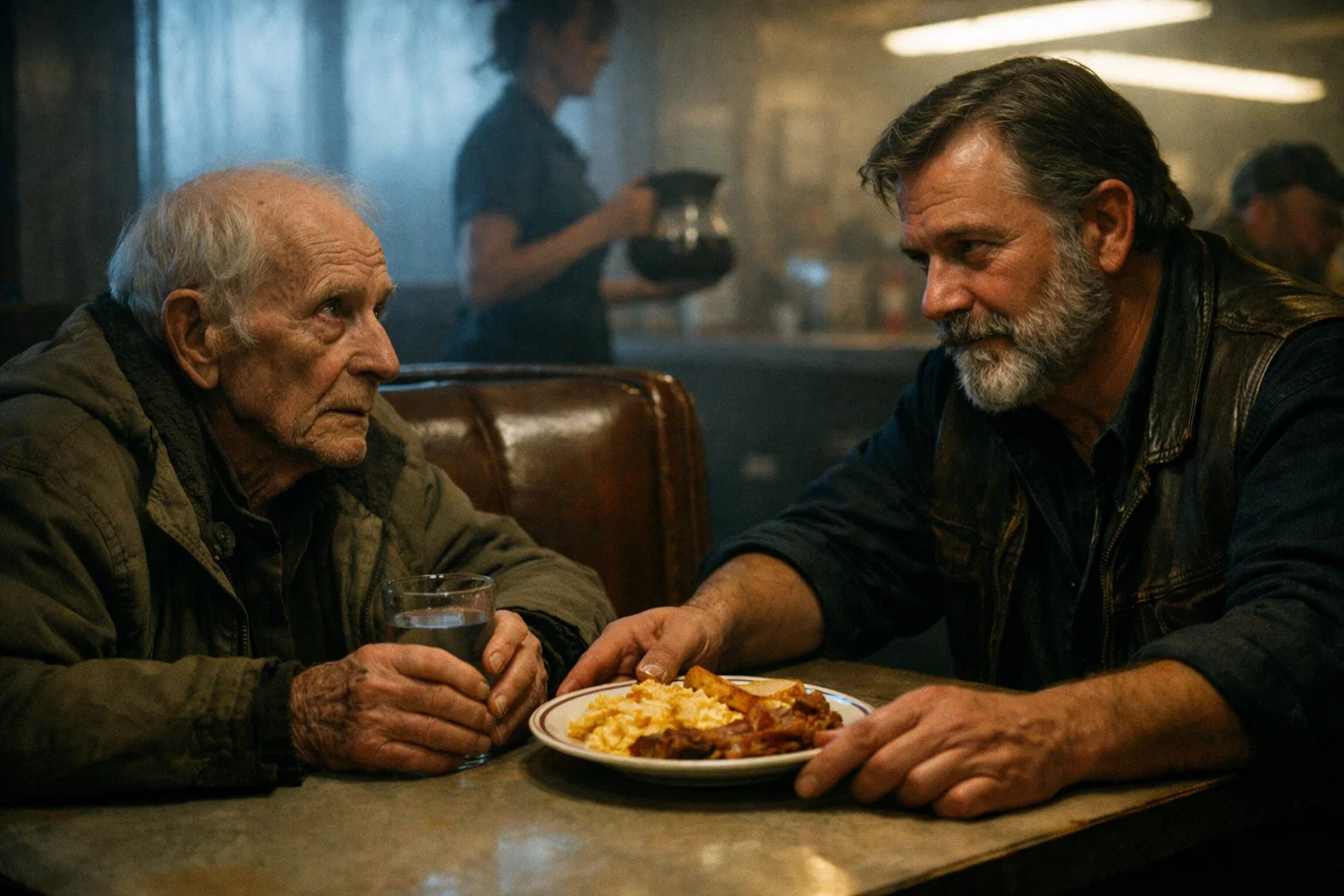
He had been sitting in the corner booth for forty minutes with both hands wrapped around a glass of water. The glass was still full. He hadn’t touched it. He just needed something to hold.
The vinyl on the booth seat was cracked in a long diagonal seam. He’d sat in this same spot every Tuesday and Thursday for nearly two years. He knew the seam by feel now. He knew exactly how the light hit the window at ten in the morning, pale and cold through the winter glass.
He wasn’t supposed to be hungry like this.
He was eighty-five years old. He had paid off his house in 1991. He had a pension, small but real. He had a son.
None of that was helping him today.
His stomach had moved past the stage of growling. It just pulled now — a slow, mean pull that went up into his chest and made his hands shake if he didn’t press them against something. He pressed them against the glass.
At the counter, Tessa Bell refilled a trucker’s coffee without looking at it. She was watching Walter.
She had watched him change over the past several months. First the eggs disappeared from his order. Then the toast. Then coffee. Now he just sat with water. She knew what it meant. She also knew Walter Kincaid would rather sit quietly and starve than let her bring him a plate he hadn’t paid for. He was that kind of man. The kind who carried his pride like it weighed nothing, when really it was the heaviest thing on him.
She wanted to help. She hadn’t figured out how yet.
Walter stared at the water and thought about whether he could manage the walk home if he left now. Four blocks. He’d done it in worse cold. But the shaking worried him. Not the danger of it so much as the indignity. He did not want to be the kind of man who fell down on a sidewalk.
He was still working through the problem when the windows started vibrating.
The Men Nobody Wanted to Sit Near
The motorcycles pulled into the lot two at a time and then a fifth, parking side by side beneath the flat gray sky. Walter looked up without meaning to.
Five of them. Large men in leather vests, worn jeans, heavy boots. One had a gray beard that went to his collar. Another had knuckles so scarred they looked like river stone. They moved without rushing, not because they were slow but because they were absolutely certain no one was going to say anything to them.
The bell rang as they came in. The whole diner went quiet.
The couple by the window stopped mid-sentence. The trucker at the counter set down his fork. Tessa held the coffee pot perfectly still.
The bikers looked around once, the way men look at a room to understand it rather than admire it, then moved toward the back.
They passed Walter’s booth.
Their leader — the broad-shouldered one with the gray beard — slowed for half a step. His eyes went to the full glass of water. To the empty table. To Walter’s hands.
Then he kept moving.
They sat in the booth just behind Walter. Orders went in. Within a few minutes, the smell hit him — steak, eggs, toast, coffee, bacon — and it was so sudden and so overwhelming that Walter had to close his eyes.
He breathed through his nose and told himself not to be dramatic.
He had survived Korea. He had spent three nights in a frozen foxhole with two dead men and no rations. He was not going to lose his composure over the smell of a diner breakfast.
But his hands shook harder now.
And the thoughts came in fast.
Don’t ask.
You have to.
Not them. Anyone but them.
You don’t have anyone else.
You have your dignity.
Your dignity won’t keep you standing up on the walk home.
He sat with it for another five minutes. Then he put his dignity very carefully to the side and turned toward the bearded man.
“Sir,” he said. His voice came out rougher than he planned. “I’m sorry to bother you.”
The man turned. He didn’t look annoyed. Just present.
Walter swallowed. “Could you spare a dollar?”
The Silence
Nothing moved.
Tessa pressed her hand flat against the counter to keep it from shaking.
The trucker stared at his plate.
Walter looked down at the table and thought: This is the moment. You’re going to remember this moment for the rest of your life.
He waited for the refusal. A polite one, maybe. Or a quiet one. Or just the man turning back to his food.
The bearded man didn’t do any of those things.
He sat still for a long second. His eyes moved over Walter — not rudely, just reading him. The worn coat. The faded military tattoo that just barely showed at the edge of his sleeve. The way Walter was holding the glass.
He set down his fork.
“You don’t need a dollar.”
Walter felt his face heat. He started to nod, already pulling back, already sorry for asking.
The man kept talking.
“You need breakfast.”
Walter looked up.
The man slid his plate toward the middle of the table and tilted his head toward the empty seat across from him.
“Come sit with us, old soldier.”
Walter blinked. “I couldn’t do that.”
One of the other bikers — dark-haired, quiet eyes — pushed the coffee pot toward the edge of the table.
“Yes, you can.”
The bearded man said it plainly, without pity, which was the only way Walter could have heard it: “Sit down. Eat while it’s still hot.”
The First Bite
Walter moved as if his body had made the decision before his mind finished arguing.
He slid into the booth across from the five of them, spine straight out of old habit, shoulders still with the effort of not crying in public. He was eighty-five years old. He had not cried in a diner since he was four.
He was not going to start today.
They made room without ceremony. That was the thing he noticed first. No one announced it. No one made it feel like charity. They just moved and left space for him to exist alongside them.
Walter picked up the fork. His fingers weren’t cooperating the way he wanted, but he got the first piece of steak cut. Put it in his mouth.
He kept chewing because stopping would have meant crying.
He kept his eyes on the table.
One tear ran down his cheek anyway. He let it go. Drawing attention to it would have made it worse.
No one said a word.
They let him eat.
That was the thing he would remember for years afterward, above everything else that happened that day. They let him eat without watching him do it. They gave him the dignity of being hungry without being pitied.
He got through half the plate before his hands steadied enough to hold the coffee cup properly.
His Name
The bearded man wrapped both hands around his own mug and asked, in a tone that made the question feel like it mattered: “What’s your name?”
Walter set down his fork. “Walter Kincaid.”
“Boone,” the man said, and gestured to the others in turn. “Eli. Mason. Reece. Darnell.”
Each one nodded. Eli was the broad quiet one. Mason had a face that looked rough until he smiled. Reece’s knuckles were the river-stone ones. Darnell had said almost nothing but hadn’t stopped watching Walter with a kind of careful attention.
“You serve?” Boone asked.
“Korea.”
Boone’s expression shifted — not softer, exactly, but something deeper settled into it. Like a room changing light.
“Army?”
“Marines.”
Eli let out a low breath. Mason sat back slightly, which was the most he did. Boone gave a slow nod.
“That explains the spine,” he said.
Walter produced the smallest laugh. He hadn’t expected to laugh this morning. It startled him.
Boone glanced at the tattoo. “You’ve carried a lot.”
“Same as plenty of others.”
“You got people around here?”
Walter lifted his coffee. “I stay with my son. And his wife.”
He kept his tone even when he said it. But even was the only neutral ground left in a sentence that had no good version.
Boone didn’t press. He waited.
Walter looked at the table. “It’s temporary.”
Neither of them believed that.
“You eating over there?” Boone asked.
Walter did not answer.
He didn’t need to.
The Ride
Boone paid the check before Walter saw it coming. He left money on the table that made Tessa put both hands over her mouth.
Then he stood. “We’re taking you home.”
Walter looked up fast. “That’s not necessary.”
“Maybe not,” Boone said. “But we’re doing it.”
“I don’t want trouble.”
Reece gave him a careful look. “Sounds like trouble found you first.”
There was no threat in it. No performance. Just a simple fact delivered gently by a man who had spent enough time around hard situations to call them by their right name.
A few minutes later, Walter was sitting in the sidecar attached to Eli’s bike, wrapped in a spare jacket one of them had insisted on without asking. The morning wind cut across the highway and over the bridge at Maple Run, but he sat straight-backed in the sidecar the way he had learned to sit in a transport plane sixty years ago. Upright. Facing forward.
Cedar Hollow went past: small houses, rusted fences, mailboxes leaning on tired posts, trees stripped bare for winter.
When they turned onto Briar Street, Walter wanted to tell them to stop. Let him walk the last half block. He didn’t want them to see it.
But they already had.
The lawn had gone to weeds months ago. One shutter hung off its bracket. The paint along the porch rail was peeling in long strips. A torn trash bag lay by the side steps where something had gotten into it and left the mess.
Boone looked at the house.
Then he looked at Walter.
Walter looked straight ahead.
The Door
Boone knocked once. Firm.
Footsteps inside. A pause. Then the door opened on Travis Kincaid, Walter’s son — fifty-one years old, still in a T-shirt from the day before, irritation already rising in his face.
Then he saw the five of them.
The irritation went somewhere else.
“Dad.” He looked at Walter. “What is this?”
“They gave me a ride,” Walter said quietly.
Travis’s eyes moved to Boone, then across the others, then back to Boone.
“Thanks for that,” he said. His voice had gotten careful. “We’ve got it from here.”
Boone did not move.
“We also came,” he said calmly, “to understand why an eighty-five-year-old veteran had to ask a stranger for a dollar to eat breakfast.”
The silence in the doorway was a different kind of silence than the one in the diner. That one had been surprise. This one was something uglier.
Travis’s jaw tightened. “You don’t know anything about our family.”
“No,” Boone agreed. “We don’t.”
He let that sit for a moment.
“Mind if we step in?”
Travis didn’t answer fast enough. Neither did Candace, his wife, who had appeared at the edge of the hallway behind him. She looked at the bikers. She looked at Walter. Her expression was calculating in a way Walter recognized because he had lived with it for months.
The bikers entered.
What Was Inside
The truth wasn’t hidden carefully enough.
The refrigerator had condiments, half a loaf of bread going dry, and a carton of milk two days past its date. Walter’s room at the back of the house was noticeably colder than the rest. The blanket on his bed was thin — not thin for summer, thin for a house in Missouri in December. His medications were untouched beside an empty glass. His walker leaned against the wall, one rubber tip worn nearly to nothing.
Boone stood in the kitchen and looked at Travis the way a man looks at something he has already decided about but is giving one last chance to be wrong.
“He served his country,” Boone said. Quiet. Final. “He should not be hungry in his own home.”
Travis’s voice came up an octave. “You have no right to walk in here and tell me how to take care of my father.”
Boone took one step forward. He did not raise his voice.
“A son who takes care of his father,” Boone said, “doesn’t let him sit in a diner too weak to ask for food.”
Candace made a sound. “He’s forgetful. He exaggerates.”
Walter flinched. He tried not to let it show.
Boone saw it anyway.
“He’s standing right there,” Boone said. “So is the refrigerator.”
Candace crossed her arms. “I don’t know who you people think you are, coming into our house—”
“His house,” Boone said.
She stopped.
Mason spoke for the first time since the diner. His voice was easy, conversational, which somehow made it worse. “You said your name was Candace, right? Candace, whose name is on the deed?”
Travis said, “That is absolutely none of your—”
“Walter,” Boone said, turning. “Whose name is on the deed?”
Walter stood near the doorway with one hand on the wall for balance. He looked smaller here than he had in the diner — not because of age, but because this was where his silence had been living.
“Mine,” he said. “Paid it off in ninety-one.”
Boone looked back at Travis and Candace.
“Then,” he said, “it seems like everyone should remember that.”
The Quiet That Did the Work
What happened next surprised people who heard about it later, because they expected shouting.
There was none.
No one threw anything. No one screamed. The neighbors didn’t come out. Boone and the others simply stood in calm, immovable silence while Travis and Candace came to understand — without being told — that this conversation was over, and that the next step was theirs to choose.
They made it quickly.
Walter kept trying to say it had gone far enough. He kept saying he didn’t want them to have to leave on his account. Boone looked at him steadily.
“Sometimes kindness has to stand up straight,” he said.
By two in the afternoon, Travis and Candace had gathered what they needed and gone. They drove away without looking back, which told Walter everything he needed to know about the years behind him.
He stood in the kitchen alone for a moment, listening to the house.
It was quiet. Different quiet than before, though. Not the quiet of being ignored. Just quiet.
Then there was noise at the front door.
The Bikers Stayed
Mason made a phone call and came back forty minutes later with enough groceries to fill the refrigerator properly. Reece drove Walter to the pharmacy for his medication refills. Eli found the loose porch board, went to his bike, got a toolkit from the saddlebag, and had it fixed before the sun dropped. Darnell drove home and came back that same evening with a space heater from his garage.
Boone sat at the kitchen table with Walter and a legal pad and made a list.
“Tell me what needs doing in the house,” he said.
Walter said, “You’ve already done too much.”
“Tell me what needs doing.”
Walter looked at him for a long second. Then he picked up a pen and started pointing.
Over the next two days, Cedar Hollow saw something it had not seen before and would talk about for years.
Men the town had crossed streets to avoid were now painting the porch rail. Hauling trash. Fixing gutters. Replacing a kitchen faucet that had dripped since September. Installing new locks on the back door. Stocking the cabinets.
Tessa from the diner came by Thursday with a casserole and a card signed by every employee. The trucker from the booth that morning pulled up with two wool blankets and a bag of firewood and said he didn’t need thanks. The young couple from the window seat showed up Saturday with a floor lamp for the living room and stayed for an hour.
Compassion spread faster than gossip.
Walter stood on his porch Sunday afternoon and looked at a house that did not feel forgotten anymore. The windows were clean. The gutters were clear. The pantry had food in it. Fresh curtains in the kitchen. Someone had even straightened the mailbox out front.
He shook his head.
“I asked for one dollar,” he said.
Boone was tightening the last screw on the porch rail. He looked up.
“Good thing we didn’t stop there.”
Colonel
Spring arrived. Then summer. Then a winter that felt shorter than all the ones before it.
Walter no longer sat with only water in front of him at Mae’s Diner. On Tuesdays and Thursdays, someone usually showed up. Sometimes Boone. Sometimes Eli. Sometimes all five of them, loud enough that Tessa had to ask the table behind them if they minded, and usually that table didn’t.
He laughed more. Ate better. Walked a little stronger — not the walking of a younger man, but the walking of a man who had somewhere to be.
The bikers never treated him like a project. They never spoke about him the way people speak about someone they are helping. They spoke to him the way they spoke to each other. They argued with him about baseball. They asked his opinion on things. They complained about the weather and he complained back.
They called him Colonel, even though he kept correcting them.
“I was a staff sergeant.”
“We know,” Boone said. “We just like watching your face when we say Colonel.”
Walter shook his head but did not argue as hard as he used to.
On his eighty-sixth birthday, they filled his yard with folding chairs and barbecue smoke and too much pie and enough motorcycles to make the windows rattle. Children ran through the grass. Neighbors who would have locked their doors at the sound of motorcycles six months earlier came over with lemonade and side dishes. Tessa brought a cake.
Walter sat at the center of it in his lawn chair with his hands on his knees and tears running freely down his face, not because he was sad but because he had not believed a man could lose so much and still be given back this much.
He hadn’t thought that was how the math worked.
The Funeral Line
Years later, when Walter Kincaid passed at ninety-two — peacefully, at home, with Boone and Darnell in the room — the funeral procession down Maple Run Road stretched further than anyone had expected.
Motorcycles. Pickup trucks. Ordinary sedans. A school bus from the elementary school where Walter had started reading to second-graders on Wednesday mornings two years after the kitchen table conversation with Boone.
Tessa was there. The trucker. The young couple, older now, with two kids of their own.
Boone stood before the crowd afterward, hat in both hands, voice rough in a way he didn’t try to fix.
“He thought he was asking for help,” Boone said. “What he actually did was give us a chance to do something worthy. He reminded us that dignity doesn’t expire. That quiet people carry histories that would have broken most of us. That no man who served and loved and worked and endured should ever have to sit alone and be invisible.”
He looked toward the flag near the grave.
The wind moved softly in the trees along the road.
“He asked for one dollar,” Boone said.
He let it sit for a moment.
“Instead, he gave us a brother.”
The Things a Morning Can Do
There is a kind of pride that does not announce itself. It just sits at a corner table and tries not to ask for anything. It wears a coat that is too thin for the weather. It holds a glass of water with both hands and tells itself this is enough.
That pride is not weakness. It is the product of a lifetime of giving when there was nothing to spare and standing when everything said to fall. The men and women who carry it quietly have usually already given more than they will ever be given credit for.
Walter Kincaid asked for one dollar.
He did not get it.
He got something considerably harder to explain and considerably harder to replace.
A table. A hot plate. A name spoken with respect. A ride home. A list made at a kitchen table at two in the afternoon. A porch board fixed before sunset. A refrigerator full of food. A room that was warm. A birthday with too much pie and motorcycles rattling the windows.
A set of people who called him by the wrong rank on purpose because they liked watching him correct them.
A family.
It started because a man with gray beard and steady eyes looked at a glass of water and understood what it meant.
It started because he set down his fork.
It started because five large men in leather vests decided that one Tuesday morning was the right morning to not look away.
It did not start with anything extraordinary.
It started with a dollar that was never given.
And what grew from that refusal was something neither Walter nor Boone could have named that morning in Mae’s Diner — something larger than charity, quieter than justice, and longer-lasting than either of them planned.
Which is how the best things usually begin.
Original fictional stories. AI-assisted creative content.