The bell above the diner door rang, and I knew before I looked up that something was wrong.
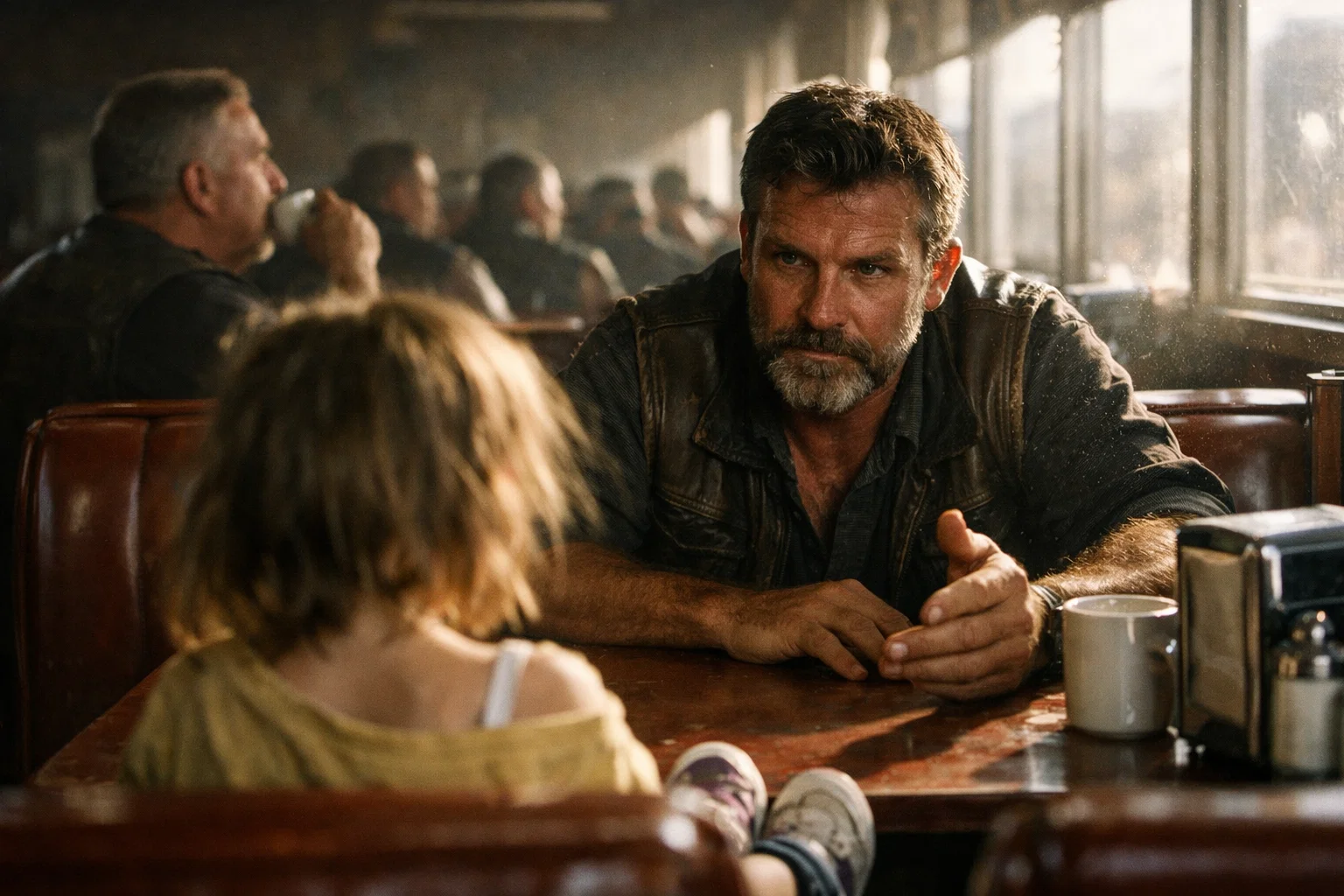
My name is Travis Hale. Forty-nine years old. Road Captain for the Silver Ridge Brotherhood for fifteen of those years. I sit with my back to the wall. I face the door. It’s a habit that’s kept me alive.
“You feel that?” Boone asked across the booth.
“Yeah.”
“Door?”
“Door.”
Boone Carter is my Sergeant-at-Arms. He’s been riding at my six since before his beard went gray. He didn’t turn around. He didn’t need to.
A thin man walked in first, sweating through his shirt in a way the Arizona heat didn’t explain. He had the wrist of a little girl clamped in his right hand. She wore one purple sneaker and one white. Her yellow shirt slipped off her shoulder. Her hair looked like someone had cut it with kitchen scissors in the dark.
She wasn’t crying. That was the part that bothered me.
“You seeing what I’m seeing?” Boone murmured.
“I’m seeing it.”
“Could be nothing.”
“Could be.”
Neither of us believed that.
They slid into a booth by the window. He ordered fries and water and kept tapping his thumb against the table like he was counting something. The girl folded her hands in her lap and stared at the salt shaker. Didn’t touch a fry. Didn’t ask for ketchup. Didn’t do any of the things a six-year-old does in a diner.
“Travis.”
“I know.”
“You want me to—”
“Not yet.”
“He’s got his hand on her wrist under the table.”
“I see it.”
“That bruise on her collarbone.”
“I see that too.”
Boone took a slow sip of coffee.
“How long we giving this?”
“Until she tells us something, or until he moves her toward that door. Whichever comes first.”
“And if he moves her toward the door?”
“Then it’s not a conversation anymore.”
“Copy that.”
The waitress, a woman in her sixties named Patty according to her name tag, refilled our cups without being asked. She glanced at the window booth, then at me, then back at her coffee pot. She didn’t say a word, but she lingered an extra second. She’d seen it too.
Ten minutes passed. The man stood, pulled a crumpled bill from his pocket, and walked to the counter to pay. His back turned. Just for a moment.
That was all she needed.
She slid out of the booth and walked down the aisle between tables, past leather vests and heavy boots, like she’d been planning the route the whole time. She stopped at my booth. Her head barely cleared the edge of the table.
She tugged the bottom of my vest.
I set my fork down. I leaned in so she wouldn’t have to speak up.
“Hey, sweetheart. You lost?”
She shook her head. Her eyes cut to the counter and back.
“That’s not my dad,” she whispered.
The diner didn’t go silent. Not exactly. But every rider in the room heard it. You can feel a shift like that in your back teeth.
“Okay,” I said. Soft. Calm. “Then who is he?”
“He hurt my daddy. In the garage. Daddy didn’t get up.”
“What’s your name, honey?”
“Lily.”
“Lily, I need you to listen to me. You’re gonna stand right here by my leg. Don’t move. Don’t look at him. Can you do that?”
She nodded once.
Behind me, chairs creaked. Boots shifted. Nobody said a word. Two hundred men adjusted their posture at the same time, and it sounded like weather changing.
“Boone.”
“Got him.”
“Slow.”
“Always.”
The man at the counter turned, pulling a twenty from his wallet, and his eyes found the empty booth first. Then they found her. Standing next to me. My hand resting on her shoulder.
His face went the color of old milk.
And that was the moment every phone in the building screamed at once.
The Amber Alert cut through the room like a blade across a wire. Phones buzzed on tables, in pockets, on counters. Every screen lit up at the same second.
Boone read his out loud. Steady. Like he was reading a weather report.
“Amber Alert. Blue SUV. Suspected homicide of adult male. Missing female, age six. Name — Lily Bennett.”
I felt her fingers close around two of mine.
Outside the window sat a blue SUV. Engine still running. Driver’s door half-open.
“Sir,” the waitress said from behind the counter. Her voice shook. “Sir, please don’t move.”
“Patty,” I said, not taking my eyes off him, “go in the back. Right now.”
“I’m calling—”
“It’s already called. Go.”
She went.
The man’s hand went to his waistband.
“Don’t,” Boone said.
He pulled the gun anyway. Small. Cheap. Shaking so hard in his hand he couldn’t have hit a wall.
“She’s my kid!” he shouted. “You don’t know anything about it! She’s my kid, she’s lying—”
“She’s not your kid,” I said.
“You don’t know—”
“Her name is Lily Bennett. Her grandmother’s name is Margaret. And the Amber Alert that just went off on every phone in this building has your vehicle description on it.”
“Shut up.”
“Put it down.”
“I said shut up!”
“Put it down, son. This doesn’t end the way you’re picturing.”
“Get away from her!”
“Can’t do that.”
“I said get away from her!”
“Son.” My voice didn’t rise. “Look around.”
He did. And I watched him finally see it. Two hundred men. No one panicking. No one running. No one even standing up all the way. Just watching him the way you watch a snake you’ve already decided to kill.
A rider by the door — his name is Ty, he did two tours in Fallujah — stepped sideways one single step and the exit was no longer an exit.
“There’s nowhere to go, brother,” Boone said, almost gently. “Put the gun on the counter and lie down on the floor. We’ll wait for the deputies together.”
“I can’t go back,” the man said. His voice cracked. “I can’t go back inside.”
“That’s not up to us.”
“You don’t understand—”
“I don’t need to.”
He made the wrong choice. They usually do.
He lunged.
Boone was already moving. He swept the man’s front leg out from under him and the tile floor caught the rest. The gun skittered across the linoleum and a boot I didn’t see came down on it. Three riders were on his back before the waitress finished her scream.
“Hands behind you,” Boone said. “Now.”
“Get off me—”
“Hands.”
Lily had her palms pressed flat against her ears. She was crouched against the side of the booth, eyes squeezed shut.
I knelt down in front of her. Slowly.
“Lily. Lily, look at me.”
She opened her eyes.
“He’s never touching you again. You hear me? Never.”
“Promise?”
“I promise.”
Sirens started somewhere out past the heat lines on Route 66.
The sheriff’s station smelled like burnt coffee and floor wax. Fluorescent lights hummed overhead. Lily sat in a plastic chair with both hands wrapped around the bottom front of my vest, and she hadn’t let go since we walked in.
A deputy crouched down to her eye level. She flinched so hard she almost came off the chair.
“Whoa. Hey. It’s okay.”
“Don’t,” I said. “Give her some space.”
“I just need to ask her a couple questions, sir.”
“Ask ’em from over there. She’s six. She just watched a man pull a gun.”
“Maybe let him try,” the deputy said to me, quiet.
“She’s had a day.”
“I know it. We’ve still got a process.”
“I understand the process. Give her ten minutes.”
He held my eyes for a second. Then nodded and backed off.
A woman walked in carrying a clipboard. Mid-forties. Kind face. Tired eyes. The kind of tired that doesn’t come from one long shift.
“Dana Whitmore. I’m with the caseworker’s office.” She knelt a few feet from Lily, not close enough to crowd her. “Hi, Lily. I’m Dana. Can I sit over here?”
Lily pressed her face into my ribs.
“That’s a yes,” Dana said. “Okay. I’m gonna sit.”
She sat on the floor. Clipboard across her knees.
“She’s gonna need a medical evaluation,” Dana said to me, quieter. “Then emergency placement until we confirm next of kin. I know that’s hard to hear.”
“Where does she go tonight?”
“Foster home in Kingman. Just for tonight. Family’s been vetted. Good people.”
“I want him.” Lily’s voice came out muffled against my vest. “Don’t make me go with strangers. Please.”
“Honey—”
“Please.”
Dana’s face did something complicated.
“Honey,” she said, “I wish I could change how this works. I really do.”
“Dana.” I kept my voice low. “Can I ride with her in the van? Just till placement?”
“That’s not standard.”
“I’m asking anyway.”
She looked at Lily. Then at me. Then back at Lily, whose knuckles had gone white on my vest.
“I can allow that. But I sit between you and her in the van. And you leave when I tell you to leave.”
“Deal.”
Lily’s fingers loosened, just barely.
“You said he can’t take me,” she whispered up at me.
“He can’t. He won’t. And I’m not disappearing on you.”
She studied my face for a long time. Kids can tell when you’re lying. This one especially.
“Promise?”
I already knew what that word cost.
I had a daughter once. Her name was Avery. She was ten. I missed her spring recital because I was leading a charity ride up in Nevada — two hundred bikes, fifteen thousand dollars for a children’s hospital. I got the call on the ride home. Distracted driver. Highway 93. She never made it off the stage in my memory.
I learned what it feels like to promise something and arrive too late.
“I promise,” I told Lily.
She reached into her pocket. Pulled out a small silver star charm on a broken chain. Pressed it into my palm.
“So you remember.”
I closed my fingers around it.
“I’ll remember.”
The Amber Alert listed one living relative. Grandmother. Margaret Bennett. Prescott, Arizona.
We rode north before sunset. Thirty bikes in formation. Boone on my wing.
Margaret lived in a beige house with wind chimes on the porch. When she opened the door and saw the line of motorcycles down her street, her hands started shaking and she grabbed the doorframe.
“Is she—” she couldn’t finish.
“She’s alive,” I said. “She’s safe. She’s in Kingman tonight.”
Margaret put both hands over her mouth and sat down right there on her front step.
“Oh God. Oh God, oh God.”
“Ma’am.”
“Say it again. Please.”
“She’s alive. She’s safe. Her name is Lily and she’s got all her fingers and toes and she told me she likes the color purple. She’s okay, Margaret.”
Margaret started crying the way people cry when they’ve been holding it in for weeks.
“Ma’am, my name’s Travis Hale. This is Boone. Can we come inside?”
“Yes. Yes, please, I’m sorry—”
“Don’t apologize. Not today.”
Her living room was wallpapered in Lily. School photos. Birthday cakes. A missing front tooth in a kindergarten picture. A drawing of a stick-figure grandma and a stick-figure girl holding hands under a sun with too many rays.
“I tried to tell my son,” Margaret said. She wouldn’t sit. She paced. “I tried. That man — her mother’s boyfriend — I filed reports. I filed reports twice. The first time they said it was a custody matter. The second time they said there wasn’t enough. My son was a good man, Mr. Hale. He was trying to get her out of there. He was—”
“Ma’am, you don’t have to—”
“He was a good dad.”
“I believe you.”
“He was a good dad.”
“I know.”
“There is now,” Boone said quietly. “Enough, I mean. There’s enough now.”
Margaret looked at him like she’d forgotten he was in the room.
“What happens to me?”
“Ma’am?”
“When the state comes. What happens to me? I’m sixty-eight. My husband’s been gone four years. This house is in my name but the mortgage — I’m on a fixed — they’ll take her from me too. Won’t they? They’ll say I’m too old. That I can’t keep up with a six-year-old. That the house is too small. That I can’t—”
“Margaret.”
“—that I can’t afford a lawyer, that I—”
“Margaret. Listen to me.”
She stopped.
“Our club has an attorney. His name is Russell Maddox. He’s one of ours. He’s going to file emergency custody paperwork tonight. If we need to post bond, pay fees, fix up a room, put a fence in the yard, install a car seat — whatever the court wants — it’s handled.”
“I can’t pay—”
“You’re not paying anything.”
“I can’t accept—”
“You can. And you will. Because that little girl needs you, and you need to be standing on solid ground when she gets here. Yes?”
Margaret pressed her palm flat against her mouth and nodded.
Boone pulled his helmet off the coffee table and set it on the kitchen counter upside-down. He dropped a folded hundred into it. Then he walked out to the porch.
I watched through the window as he went down the line. Bike to bike. Helmet in his hand. Didn’t say a word. Didn’t have to.
When he brought it back inside, Margaret looked at what was in it and put her face in her hands.
“I don’t know you people,” she said.
“You do now.”
Russell Maddox got the emergency petition signed at eleven the next morning. By two that afternoon, a white state van pulled into Margaret’s driveway.
“Russell,” I said, standing on the porch. “Talk to me.”
“Clean order. Emergency kinship placement, pending full hearing in thirty days. Judge Alvarez signed it before his first coffee. He’s got grandkids. He read the file and the whole thing took six minutes.”
“What about the hearing?”
“Margaret’s going to win the hearing, Travis. The boyfriend is going away for a long time. The mother’s nowhere in the picture. The house passed the home-study walk-through this morning. I’ve got letters of support lined up from the sheriff, from Dana Whitmore, and from every single one of us if it comes to it.”
“It’s not going to come to it.”
“It’s not.”
“Thank you, brother.”
“Don’t thank me. Thank the kid who decided to walk across that diner.”
Lily climbed out of the van holding a clear plastic bag with a toothbrush, a pair of socks, and a stuffed rabbit missing one ear. She stopped on the gravel and looked up at the porch.
Margaret stood there. Hands clenched at her sides. Not breathing.
“Lily-bug?”
Lily froze for half a second. Then she dropped the bag and ran.
Margaret caught her and sat down hard on the porch step with the girl wrapped around her neck, and neither of them said anything for a long minute. Just held on.
“I missed you,” Margaret said finally, her voice wet. “I missed you so bad, baby.”
“I missed you too, Grandma.”
“You’re home now. You’re home.”
“Is this forever?”
“It’s forever, baby. It’s forever.”
Dana stepped out of the van with her clipboard. Started to speak.
Russell walked past her and handed her the signed custody order.
Dana read it. Read it again. Looked up.
“This is same-day. You filed this at eleven?”
“Eleven oh-four.”
“Russell, that’s—”
“Fast. Yeah.”
“That’s not fast. That’s a miracle.”
“It’s paperwork. Filed correctly. By a lawyer who hasn’t slept.”
She almost smiled. Didn’t quite. Then she did.
“Well,” she said. “I guess we’re done here.”
Lily pulled back from her grandmother’s shoulder and looked around until she found me standing by my bike.
She walked over. Held up the silver star charm.
“You keep it,” she said.
I shook my head. Closed her small fingers around it.
“No, sweetheart. You hold onto that. That way you know I’m coming back.”
“When?”
“Soon.”
“How soon?”
“How about the first Wednesday of next month? You and your grandma meet me at the Sun Valley Diner. We’ll get pancakes.”
“I’ve never been there.”
“Sure you have.”
“Not for pancakes.”
“Then it’ll be a first.”
“Promise?”
“Already promised you once today. Don’t make me do it twice.”
She smiled. First real smile I’d seen on her face.
“Okay.”
Three months later, the bell above the Sun Valley Diner rang, and this time the engines outside sounded different. Lighter. I don’t know how else to say it.
“Uncle Travis!”
She came across the diner in a dead sprint. Braided hair. Clean clothes. A denim vest with a patch on the chest that read HONORARY RIDER. Margaret had sewn it herself.
Lily threw her arms around my neck with the full-body strength only a six-year-old has.
“I got first place in reading,” she said into my ear.
“Yeah?”
“Yeah.”
“Give me a big word.”
She leaned back and grinned. “Responsibility.”
“Spell it.”
She did. Didn’t miss a letter.
Boone, across the booth, applauded with two fingers against his palm like he was at the opera.
“Show-off,” he said.
“You couldn’t spell it,” she shot back.
“Brutal,” I told him.
“Absolutely brutal,” he agreed.
Margaret slid into the booth beside Boone, and she looked ten years younger than she had on that porch step in Prescott. Color in her face. A cardigan that actually fit. A cup of coffee she actually drank.
“How’s she sleeping?” I asked Margaret quietly.
“Through the night, most nights. Some nights she comes into my room. That’s okay. That’s what I’m there for.”
“And the counselor?”
“Tuesdays and Thursdays. We like her. Lily calls her Miss Bird because her last name is Byrd.”
“Of course she does.”
“The hearing’s next week. Russell says it’s a formality.”
“It is.”
“I don’t know how to pay—”
“Margaret. Stop.”
“I just—”
“Stop.”
She nodded. Wiped her eye with the back of her thumb. Sipped her coffee.
Lily climbed into the booth beside me and pulled a crayon out of her vest pocket. She started drawing a desert sunset on the paper placemat. Orange. Purple. A tiny silver star in the corner.
I watched her color.
I wasn’t mapping exits. I wasn’t counting people at the door. I wasn’t scanning for the thin pale man who, three months ago, had been sentenced to twenty-two years in the Arizona state prison system for first-degree murder and attempted kidnapping of a minor. The judge had looked him in the eye and said “You are the exact reason this statute exists.” I was in the gallery that day. So was Boone. So was Margaret.
I wasn’t carrying any of that right now.
I was just watching a kid draw a sunset.
“Uncle Travis?”
“Yeah, bug.”
She reached up to her collar and pulled out a thin chain. The silver star charm hung from it.
“Grandma fixed the chain,” she said.
“I see that.”
“It still works.”
“Works how?”
She looked up at me, dead serious, and tapped the star twice with one small finger.
“You came back,” she said. “Both times.”
I didn’t trust my voice for a second.
“That’s how it works,” I said finally.
“Uncle Travis?”
“Yeah.”
“Is there gonna be a third time?”
“Every first Wednesday. As long as you want me here.”
“Forever?”
“Forever.”
“Spell it,” she said.
I laughed. I hadn’t laughed in a booth in a long time.
“F-O-R-E-V-E-R.”
“Good,” she said. “That’s a real word.”
She nodded, satisfied, and went back to her sunset.
Outside, two hundred bikes sat quiet under the Arizona sun. Inside, a little girl colored a star into the corner of a paper placemat. And for the first time since I’d lost Avery, I felt the weight come off my shoulders and stay off.
Boone watched me across the booth.
“You okay?” he asked.
“Yeah.” I cleared my throat. “Yeah, I’m good, brother.”
“Yeah,” he said. “You are.”
Margaret reached across the table and put her weathered hand on top of mine.
“Thank you,” she said. Quiet. Simple.
I nodded. I couldn’t say anything.
I didn’t need to.
Lily held up her placemat.
“Done,” she announced.
The sunset was orange and purple and had a silver star in the corner, and underneath it, in the careful block letters of a kid who’d just won first place in reading, she had written three words.
MY FAMILY. HOME.
I put the placemat in my vest pocket.
It’s still there.
Original fictional stories. AI-assisted creative content.