Walter Hensley had twenty dollars left.
He sat on the bench outside Mason’s Grill in Millhaven, Ohio, pressing his gloved hand against the inside pocket of his coat where the folded bill waited. November air cut through every gap in the street—through cracked windows, under warped doors, straight into the bones of anyone foolish enough to sit still.
Walter was eighty. He knew exactly what twenty dollars meant.
It meant canned soup stretched thin. It meant black coffee for dinner. It meant five days of pretending hunger was something he chose instead of something that chose him.
He’d done harder things. Buried his wife. Watched his daughter become a stranger. Learned that some people only called on Sundays when they needed a signature.
The twenty stayed warm against his chest.
He noticed the biker while deciding whether to buy groceries now or wait until morning.
The man stood near the diner window—tall, broad, leather vest over a black hoodie, boots that had walked through more trouble than most people would see in a lifetime. His beard carried gray. His face carried everything else.
But Walter wasn’t looking at the leather or the size of him.
He was looking at the way the man stared at the plate of food through the glass, then looked away.
He knew that movement. He’d made it himself. He’d seen it in Clara’s eyes late at night when the bills outnumbered the paychecks and she thought he was sleeping.
Walter pushed himself up. His knees protested. His cane tapped the concrete once, twice, three times.
The biker turned immediately—alert, tense, the way men get when kindness usually comes with conditions.
“Can I help you, sir?”
Walter pulled out the twenty.
“Maybe. You look like you need this more than I do.”
The biker stared at the bill like it was written in a language he’d forgotten.
“No,” he said. “I can’t take that.”
“Yes, you can.”
“Sir. Keep it.”
Walter gave him a tired smile. “I’m old, not blind. I know the difference between a man killing time and a man standing still because his stomach’s empty.”
Something shifted in the biker’s face. Fast. Raw. Gone before he could hide it.
Walter didn’t wait for permission. He took the man’s hand, pressed the twenty into his palm, and folded his fingers over it.
“Go get yourself a meal.”
The biker opened his mouth. Nothing came out.
Walter nodded once and turned back toward the bench. By the time he sat down, the weight of it settled. The money was gone. The week just got harder.
But beneath the worry, something else stirred.
He’d lost almost everything. He hadn’t lost the part of himself that still recognized another person’s pain.
The biker’s name was Reed Calloway.
Most people in his club called him Stone. He’d been called worse. He was used to locked doors, crossed streets, whispered judgments. What he was not used to was an old man in a threadbare coat handing him his last dollar like it was nothing.
Except it wasn’t nothing. Reed could tell by the way the bill had been folded—careful, deliberate, the way people fold money when there’s no more coming.
He went inside Mason’s Grill.
The waitress gave him that cautious smile people use when they’re hoping nothing bad happens.
“What can I get you?”
“Turkey plate. Coffee.”
When it arrived, steam rising off mashed potatoes and green beans, his stomach clenched so hard he almost couldn’t breathe. He’d been living on vending machine crackers since his bike repair emptied his wallet that morning.
He should have eaten.
Instead, he looked through the window.
Walter was still on the bench. Sitting. Patient. Alone.
Reed thought about his own father. A proud man who wore silence like a shield until the day it killed him. Reed had always believed there’d be another chance to make things right.
There hadn’t been.
He pushed the plate away.
“Everything all right?” the waitress asked.
Reed slid the twenty across the counter. “Box this up. And another coffee to go.”
“You’re not eating?”
He looked out the window again.
“Not by myself.”
The bench was empty when he got outside.
Reed stood there holding a boxed meal and two coffees, and for the first time in years felt an urgency he didn’t know how to name.
He asked the paper vendor on the corner. The man pointed vaguely toward the old buildings off Willow Street.
That was enough.
It took him three hours. He knocked on doors. He asked questions. He followed bad directions and backtracked. Somewhere along the way, one boxed meal stopped being enough.
He called his club brother Boone.
“Lend me a hundred till the weekend.”
“For what?”
“Groceries.”
“You don’t eat groceries. You eat gas station burritos.”
“They’re not for me.”
Boone wired the money without another question.
Reed bought bread, eggs, soup, apples, potatoes, a roasted chicken. Then he passed a hardware store and walked out with weather stripping, lightbulbs, and a small electric heater.
None of it felt like enough.
But it was a start.
Walter opened the door of Apartment 4C with caution, then surprise.
“You found me.”
Reed lifted the bags. “You gave a stranger your last twenty bucks. Felt wrong to let that story end on a sidewalk.”
Walter looked from Reed’s face to the bags to the boxed dinner.
“You tracked me down over one meal?”
“Not over the meal. Over what it cost you.”
Walter studied him for a long moment, then stepped aside.
“Come in.”
The apartment told its own story. One chair by the window. A table barely big enough for two. A heater older than both of them. Cupboards that held almost nothing. No clutter. No comfort. Just careful survival dressed up in clean surfaces and quiet pride.
Reed set the groceries on the table and started unloading.
Walter watched in silence, his expression guarded.
“You didn’t have to do all this.”
Reed looked up.
“Yeah. I did.”
Walter’s eyes landed on the boxed container. “And that?”
“That’s the dinner your twenty bought.”
Something soft crossed Walter’s face—half sad, half amused.
“Well, you’d better eat it before it gets cold. My Clara would never forgive me if I let food sit in a kitchen without serving it.”
They split the meal with two mismatched forks.
The silence between them wasn’t uncomfortable. It was the kind that happens when two people have already understood something important without needing words.
Reed noticed the curtain moving near the window. “That heater doing its job?”
Walter snorted. “It makes noise. I’m not sure that counts.”
Reed pulled out his phone.
Walter narrowed his eyes. “I don’t like that expression. It usually means trouble or generosity, and I’m not prepared for either.”
Reed dialed anyway.
“Bring tools,” he said. “And groceries if you can fit them. Willow Street, building by the old pharmacy, Apartment 4C.”
Walter pointed his fork at him.
“Absolutely not.”
Reed gave him a calm look.
“Too late.”
Within an hour, Willow Street changed.
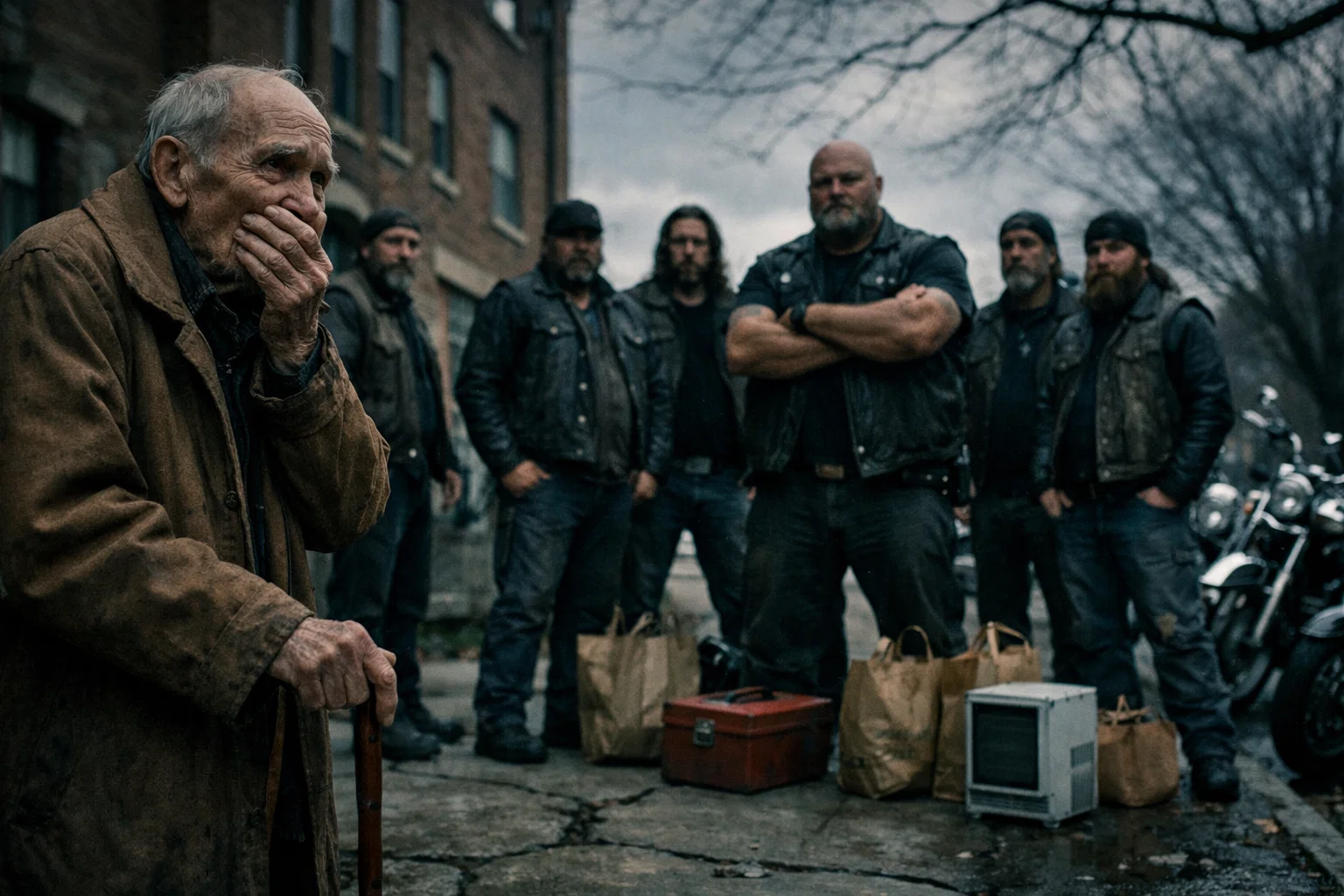
The first motorcycle rolled in low and steady. Then another. Then four more behind it. Neighbors peeked through curtains. A woman across the hall cracked her door and froze. Kids on the sidewalk stopped and stared.
Walter stood by the window, one hand on his cane.
“Good heavens.”
Reed shrugged. “They look louder than they are.”
The first one through the door was Marla Voss—dark-haired, leather jacket, carrying two grocery bags and a toolbox, with eyes that missed nothing.
“You rob a supermarket?” she asked Reed.
Then she saw Walter and her face changed immediately.
“Evening, sir. I’m Marla.”
Behind her came Boone—huge, bald, carrying a new heater and an extension cord like they weighed nothing. Then two more with lightbulbs, caulk, and pantry items. Within minutes, Walter’s tiny apartment was full of boots and quiet voices and people who didn’t waste time turning kindness into a performance.
One person sealed the drafty window. Another checked the sink. Marla filled the shelves. Boone replaced the heater and fixed the bedside lamp. Nobody used a pitying tone. Nobody spoke to Walter like he was helpless.
They just worked.
That mattered more than Walter expected.
After a while, he asked the question that had been pressing against his chest since Reed appeared at his door.
“Why are you doing this?”
The room went quiet.
Reed looked over from the window frame where he was pressing insulation into place.
“Because you gave me your last twenty dollars.”
“You don’t know that was my last.”
Reed glanced at the nearly empty cupboards, the unpaid pharmacy slip on the table, and the old man sitting in a room that had been quietly falling apart.
“I know enough.”
Walter lowered his head.
“It wasn’t much.”
Reed’s voice was steady. “To you, maybe it felt small. To me, it was everything.”
Nobody in the room spoke after that.
Reed came back two days later with chili.
Then again with laundry quarters. Then with a replacement rubber tip for Walter’s cane because he’d noticed the old one slipping on the stairs. The visits became routine before either man named them that.
In time, Walter talked.
He’d worked farm supply for nearly thirty years. Married Clara for fifty-one. Had one daughter, Joanna, who used to be gentle before life and money changed her into someone he couldn’t recognize anymore.
After Clara died, Joanna and her husband started “helping” with Walter’s paperwork. The help had slowly become control.
The truth came out in pieces.
One afternoon, Marla was sorting mail at Walter’s table when she found bank statements showing monthly transfers Walter couldn’t explain. Small amounts. Scattered enough not to raise alarm if you trusted the hands managing them.
But added together, they told a different story.
Reed read the pages in silence, his jaw tight.
“That’s why your pension never stretches.”
Walter stared at the numbers like he was seeing his own life translated into betrayal.
“She used to sleep in our room during thunderstorms,” he said quietly. “Clara would make hot cocoa and Joanna would put her feet on my legs because she said that kept the lightning away.”
Reed had no answer to that. Some wounds ran too deep for quick words.
But he knew this much: no one was going to keep draining this man dry and call it love.
They made calls. A lawyer named Fenton who worked elder abuse cases. A housing advocate. A retired county investigator Marla trusted. What they uncovered went beyond stolen pension money.
The building owner had been pressuring older tenants to vacate under the excuse of “renovations.” Joanna had already made inquiries about moving Walter into state-managed senior housing—conveniently clearing the path for whatever he had left.
“How long?” Reed asked Fenton.
“At least two years. Maybe longer. The transfers were structured to stay small.”
Reed looked at Walter.
Walter’s hands were flat on the table, trembling slightly.
“I signed things,” he said. “She told me they were for insurance.”
“That’s not your fault,” Marla said firmly.
“It feels like my fault.”
“It’s not.”
Reed leaned forward. “Walter. We’re going to fix this. But you have to let us.”
Walter looked at the bank statements, then at the people sitting in his kitchen—people who had no reason to be there except that they chose to be.
“All right,” he said.
Joanna arrived on a Thursday afternoon in a white SUV that looked too clean for Willow Street.
She entered the apartment with anger already arranged on her face.
“Dad, what is going on?”
Walter was seated at the table. Reed stood by the window. Marla leaned against the counter with her arms folded.
Joanna’s eyes swept across the repaired heater, the stocked pantry, and the biker standing in her father’s apartment.
“You’ve brought strangers into this?”
Reed spoke before Walter had to.
“Funny thing to say when you’re the one taking money that isn’t yours.”
She turned sharply. “Stay out of family business.”
Walter’s voice was calm. That calm frightened everyone in the room more than shouting would have.
“No,” Walter said. “I think family business is exactly why we’re here.”
He placed copies of the bank transfers in front of her.
Joanna looked at them for less than a second before looking away.
That was answer enough.
“You were supposed to be helping me,” Walter said. “Not emptying what little I had left.”
She lifted her chin. “You were confused. We were managing things for you.”
“No. You were managing me.”
Her voice rose. “These people have turned you against your own daughter.”
Walter met her gaze without flinching.
“No. They showed up when my own daughter stopped acting like one.”
The words landed like a dropped glass in a silent room.
Joanna looked stunned. Then furious. Then strangely small.
She grabbed her bag and headed for the door. “You’ll regret humiliating me, Dad.”
Walter didn’t move. “The only thing I regret is how long I pretended not to see it.”
The door slammed.
The apartment fell quiet.
Marla asked softly, “You all right?”
Walter sat very still for a long moment.
“I think I just remembered I still have the right to choose who gets close to my life.”
The legal process took time, but truth had a way of compounding once people stopped looking away.
The transfers were frozen. The relocation notice was challenged. Other elderly tenants came forward with their own stories. The landlord’s pressure campaign started unraveling. Joanna’s husband was exposed for funneling Walter’s money through a fake consulting account—$14,000 over twenty-six months.
Fenton filed charges.
Millhaven noticed.
What began as one old man’s quiet suffering became a town-wide reckoning about how easily people looked away when hardship wore ordinary clothes.
The diner owner at Mason’s Grill started a fundraiser called The Last Twenty Supper. Every meal sold after five o’clock helped cover food and heating costs for seniors in town. He expected a modest turnout.
More than two hundred people showed up the first night.
Farmers sat beside bikers. Church volunteers carried trays. Teenagers wiped down tables. Walter, embarrassed by the attention but too moved to hide it, sat near the center.
Reed sat a few seats away, pretending none of it affected him while his eyes stayed suspiciously bright.
That winter, Boone suggested turning an empty storage building behind the diner into a community kitchen. Marla found donors. Fenton handled the paperwork. Reed organized volunteer routes.
Walter, to his own disbelief, became the center of it all.
They named it Hensley’s Table.
Walter argued against the name for three straight days before giving up.
“You’re outnumbered,” Marla told him.
“I’ve been outnumbered since a biker showed up at my door with a boxed turkey plate,” Walter said. “That doesn’t mean I have to enjoy it.”
By spring, the kitchen served hot meals twice a week. Seniors came. Laborers between jobs came. Single mothers came. Proud men who claimed they were “just passing through” came and stayed long enough for seconds.
Nobody left empty-handed.
Walter volunteered at the front, greeting people and insisting they take fruit for later. Reed handled deliveries and anything heavy. Children who once crossed the street when the motorcycles rolled by now waved at Boone from school buses.
Months later, after Fenton’s cases were settled and some of Walter’s money had been recovered, he sat on the bench outside Mason’s Grill one more time.
The evening air was cool. Not cruel. Just cool.
Reed came out carrying two coffees and handed one over without a word.
They sat.
Good silence. The kind that means everything is exactly where it should be.
“I used to think family was just blood,” Reed said. “Club colors and old loyalty. I don’t think that anymore.”
Walter smiled faintly into his cup. “That’s because life finally taught you the difference between who belongs to you and who shows up for you.”
“You always talk like that?”
“Only when I’m trying to make younger men uncomfortable.”
Reed shook his head, still smiling.
Walter reached into his coat and pulled out a folded twenty-dollar bill.
Reed groaned. “No. Absolutely not.”
Walter tucked the bill beneath the sugar caddy on the windowsill.
“For the next person who needs breakfast.”
“You are financially supervised now.”
“And still wiser than you.”
Across the street, volunteers from Hensley’s Table were loading food carriers into cars. Marla was laughing at something Boone said. The last light of the day turned Willow Street golden for a few minutes, the way it sometimes does when a place has finally earned it.
Reed looked at them, then at Walter, and felt something settle in his chest.
Not guilt.
Not regret.
Something warmer.
Peace.
And tucked beneath a sugar caddy on a windowsill in Millhaven, Ohio, a twenty-dollar bill waited patiently—ready to start the whole thing over again.
Original fictional stories. AI-assisted creative content.