Arthur Pendelton had one night.
One chance to stand in front of the most powerful military gathering in Washington D.C. and tell the truth about what happened in the desert twenty-five years ago. He had the notebook. He had the names. He had the coordinates written in a dead man’s handwriting.
He just didn’t expect General Thomas Vance to rip it out of his hands.
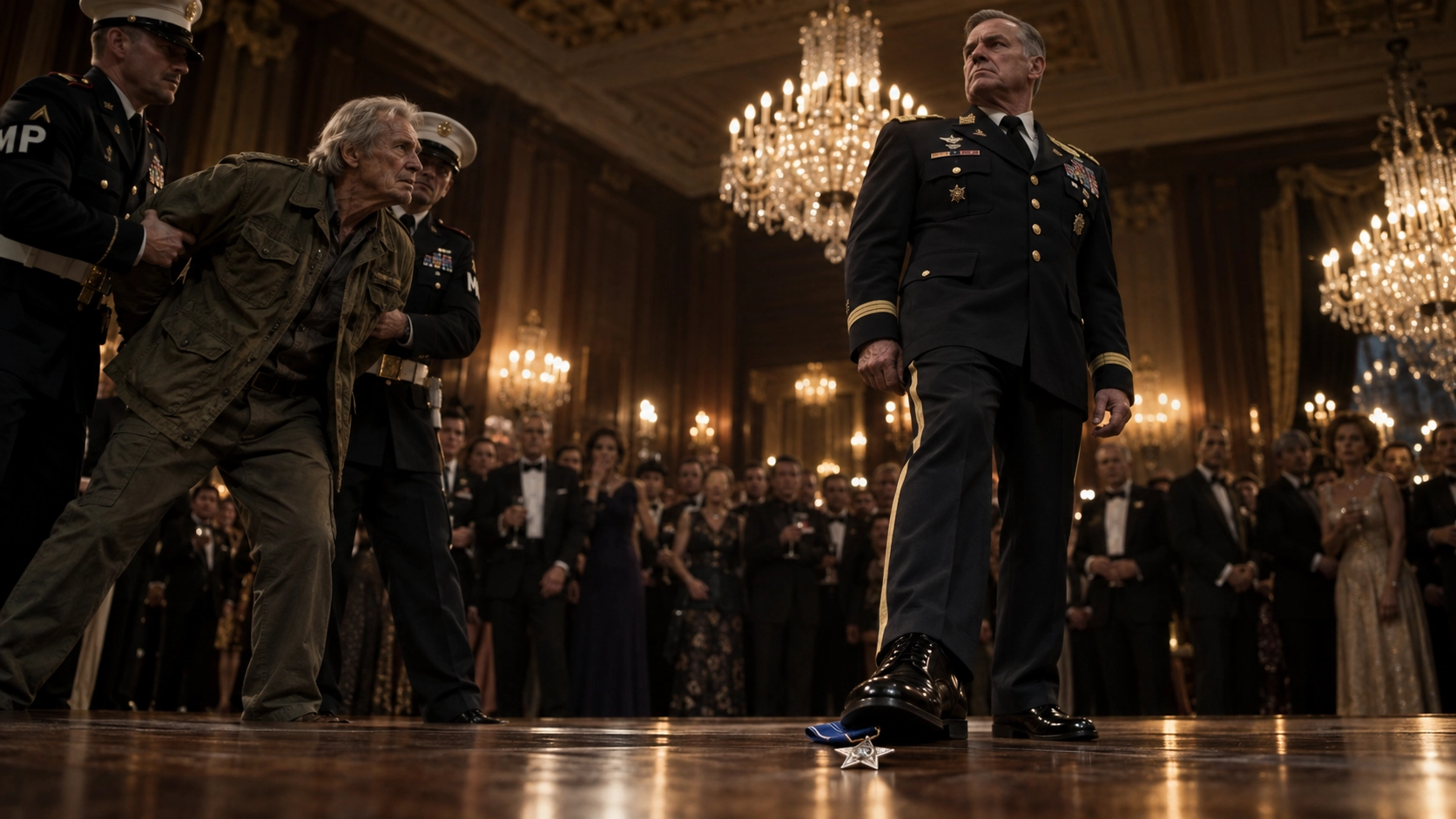
The D.C. Heritage Ballroom was packed with brass, senators, and cameras when Arthur walked onto that stage. He was seventy-two years old, his left knee clicking with every step, his dress uniform pressed so tight across his chest he could barely breathe.
He threw his Silver Stars at Vance’s feet.
The medals bounced off the polished stage and clattered into the silence.
“Those belonged to men you murdered,” Arthur said into the microphone.
Vance didn’t flinch. The four-star general looked at Arthur the way a man looks at roadkill—vaguely inconvenient, already forgotten.
“Security,” Vance said quietly.
Two MPs grabbed Arthur from behind.
But Arthur had already opened the notebook.
He shoved the cracked green cover directly toward Vance’s face. Inside, six handwritten names stared back at the General, each one stamped with a faded red CLASSIFIED seal.
“Read the sixth name, Tom,” Arthur commanded, his voice cutting across the microphones and into every phone camera in the room. “Read it out loud.”
Vance’s jaw tightened.
“Confiscate that,” he hissed at the MPs. “That is stolen government property.”
One of the guards lunged for the notebook. Arthur twisted, tucking it against his chest. He took a knee strike to the ribs for it. The pain was blinding.
“Hey!” a voice rang out from the front row. A young captain in his mid-thirties stood up from his seat. “He’s a seventy-two-year-old man! Ease up!”
“Stand down, Captain!” Vance roared. The veins in his neck bulged against his starched white collar. “Lock the ballroom doors. Nobody leaves with a recording of this.”
Two men in black suits moved toward the exits. The heavy double doors slammed shut.
The room erupted. Senators shouted. Diplomats stood on their chairs. Every phone in the ballroom was already up, recording.
Arthur ground his teeth, forced himself to his feet.
“It’s not forged, Tom,” Arthur said, his voice dropping dangerously low. “This is Corporal Elias Hayes’s handwriting. You remember Hayes. The kid from Chicago who carried the radio. The one you ordered silenced.”
Every last drop of color drained from General Thomas Vance’s face.
He recovered fast. He always did.
“Arthur.” Vance stepped forward, his voice going smooth as oil. “You’ve been carrying the grief of Black Ridge for twenty-five years. We all have. The chopper went down in a sandstorm. There was nothing anyone could do.”
“A sandstorm,” Arthur repeated.
A short, bitter laugh escaped him.
“That’s what you told their wives. That’s what you put on the after-action report.” Arthur pointed to coordinates scrawled in the notebook’s margin. “But Hayes wrote down the weather conditions at nineteen-hundred hours. Clear skies. Visibility ten miles. They didn’t crash, General. They were waiting at Grid Delta-Niner. They found your private weapons cache. And instead of sending a rescue bird, you called an artillery strike down on your own men’s coordinates.”
“Shut your mouth,” Vance whispered.
He closed the distance between them in four steps, stepping so close Arthur could smell the stale scotch on his breath.
“You have no proof,” Vance murmured directly into Arthur’s ear, his fingers finding Arthur’s throat. “A dead man’s diary means nothing in a tribunal. I will put you in Leavenworth until you rot. I will strip your pension, take your house, and erase your name from every record that exists.”
Arthur gagged. But he smiled.
“I didn’t bring the notebook to be the proof, Tom,” Arthur rasped.
Vance’s grip loosened. “What?”
“I brought it so he could read his own handwriting.”
The sound started at the back of the ballroom.
Heavy. Rhythmic. Metal striking hardwood.
Thud. Thud. Thud.
The crowd parted.
A tall man walked out of the shadows at the far end of the aisle. He wore a dark suit that hung loosely on his frame. A severe burn scar stretched across the entire left side of his face, pulling his eye into a permanent squint. He dragged his right leg with every step, relying on a metal forearm crutch.
He stopped at the edge of the stage.
His one good eye fixed directly on General Thomas Vance.
“He didn’t write those names, General,” the man said. His voice was a deep, gravelly rasp that needed no microphone to fill the room. “I did.”
Vance let go of Arthur’s throat.
“That’s impossible,” Vance stammered, his voice catching on the open microphone. “Elias Hayes is dead. His remains were identified.”
“You identified fragments of my gear,” Elias said. “You buried a closed casket and called it a day. It was very convenient for you.”
“Arrest him!” Vance suddenly screamed, his polished mask shattering all at once. He pointed a trembling finger at Elias. “He’s an imposter! This is a coordinated attack! Lock this room down!”
The MPs hesitated. They looked from Vance to the scarred veteran standing below the stage, dog tags catching the chandelier light.
That second of hesitation was all Arthur needed.
He wrenched his left arm free and curled his body around the notebook.
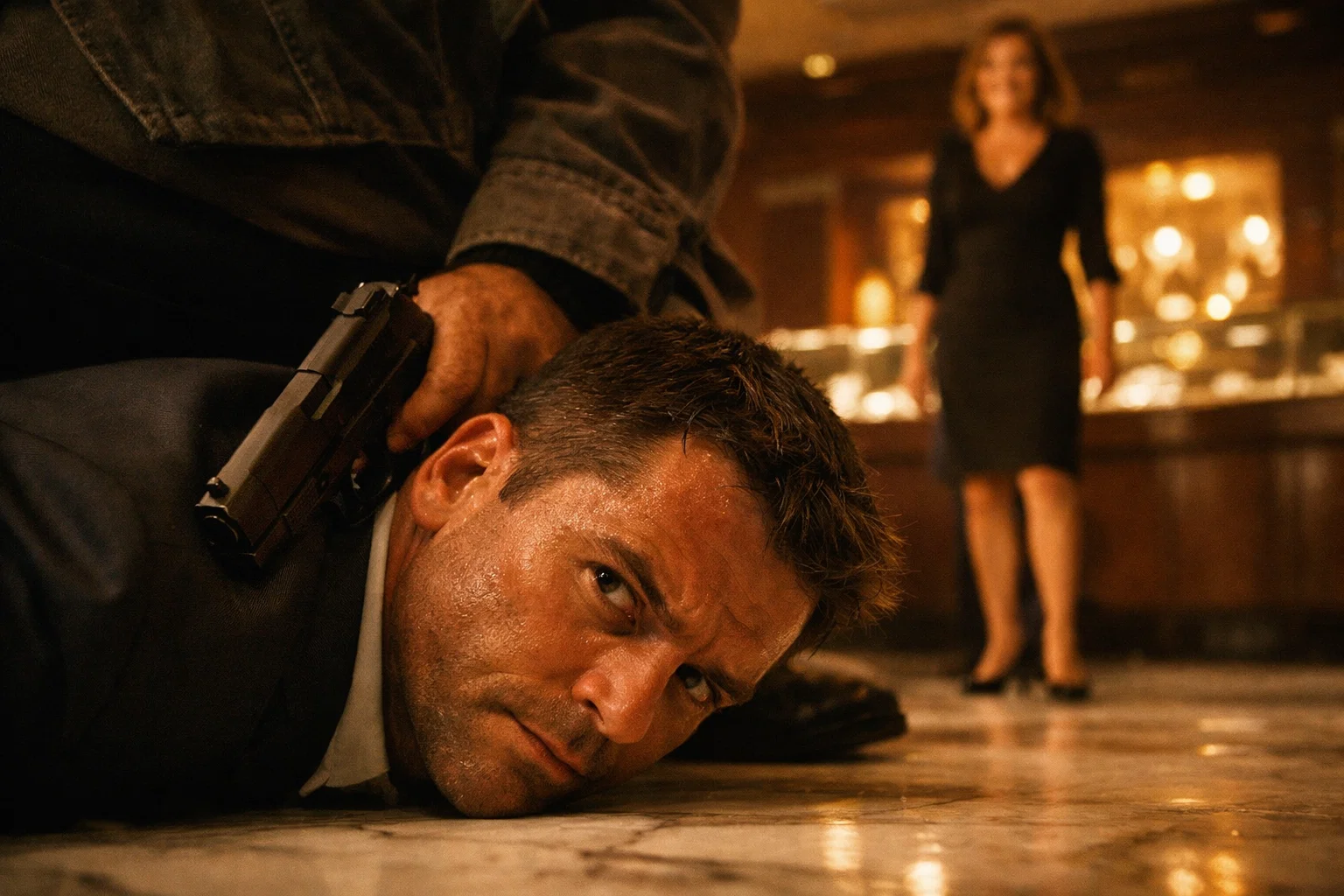
Vance didn’t wait for security. He lunged off the edge of the podium and crashed directly into Arthur, driving the older man hard into the floor.
“Give it to me!” Vance clawed at Arthur’s chest.
Arthur clamped down with both arms. “You’re not burying this. Not again.”
Vance’s fingers found the edge of the notebook. He yanked. The sound of tearing paper ripped through the room.
A thick section of center pages came free in Vance’s fist. He shoved them into the inner pocket of his dress uniform, his chest heaving.
Before he could lunge again, a heavy hand grabbed the back of Vance’s collar and wrenched him backward.
The young captain from the front row put himself squarely between Vance and Arthur.
“Step away from him, General,” Captain Reynolds said. His hands were balled into fists. He wasn’t recording anymore.
“You just ended your career, Captain,” Vance spit, straightening his jacket.
“My career is fine, sir,” Reynolds replied. “But I think yours just did.”
They made it out through the catering entrance.
Reynolds had the layout memorized. He shoved a charging guard into the podium, bought them thirty seconds, and got them through the kitchen while Elias cleared a path with his forearm crutch across a guard’s wrist.
They hit the loading dock at the back of the building. Humid D.C. night air. The stink of the alley. Two massive dumpsters. Arthur leaned against the brick wall, gasping.
He looked at Elias.
Really looked at him. The man he had been told was dead for twenty-five years. The man whose name he had carried like a stone around his neck through two decades of nightmares.
“How,” Arthur breathed. “I heard the strike, Elias. There was nothing left.”
“Edge of the blast radius,” Elias said. He wiped sweat from his scarred forehead. “Miller and Costas took the direct hit. I got thrown into the ravine. Woke up three days later in a militia hospital. They realized I was American. Figured I was worth money.”
Arthur felt the guilt arrive like a wave. “Twenty-five years. You were alive and we stopped looking.”
“You didn’t know. Vance sealed everything. KIA, closed casket, don’t ask questions.” Elias met Arthur’s eyes. “I spent fifteen years in a concrete cell. Took another ten to get back stateside, piece together a new identity, and find you.”
“I thought I failed you,” Arthur whispered.
“You kept the notebook,” Elias said. “You didn’t fail anyone.”
Arthur looked down at the notebook. His stomach dropped.
The center pages were gone.
“The ledger,” Arthur said, his voice breaking. “When he tackled me on the stage—he got the pages. The offshore routing numbers. The money trail. The only thing that proves why he ordered the strike.”
Elias leaned back against the dumpster, jaw set. “Without those numbers, the notebook just proves there was a friendly-fire incident. Vance calls it a tragedy. Claims bad coordinates. He walks.”
“He won,” Arthur said. The words tasted like ash. “We finally had him in the light and he still won.”
Tires screamed at the mouth of the alley.
A black SUV jumped the curb, headlights pinning them against the wall. Arthur raised his arm. Then the driver’s door flew open and Captain Reynolds stepped out, dress jacket gone, white shirt open at the collar.
“Get in,” Reynolds said. “D.C. Metro is two minutes out.”
They were moving before the doors were fully shut. Reynolds hit the radio. A newscaster’s voice filled the cabin.
“…reports of an active situation at the D.C. Heritage gala. General Thomas Vance has issued a statement claiming a mentally unstable veteran attacked the stage accompanied by an unidentified armed man posing as a deceased soldier. Arrest warrants have been issued. The men are considered armed and highly dangerous…”
Reynolds turned it off.
“He called DoD,” Reynolds said grimly. “He’s framing you for domestic terrorism. Shoot-on-sight authorization.”
Arthur stared out the window at the passing streetlights.
“We have to disappear,” Arthur said.
“No,” Elias said.
Quiet. Final. The word landed like a stone.
“Elias—they will kill us.”
“Let them try.” Elias turned from the window. “I didn’t survive fifteen years in a desert prison to run from Thomas Vance. He thinks he’s safe. He thinks he has the only copy.”
Arthur frowned. “He ripped the pages out of the notebook himself. There is no other copy.”
“There’s the master ledger,” Elias said. “Who do you think set up the offshore accounts, Artie? Vance gave the orders. But somebody had to cook the books. Somebody had to sign the requisition forms for the weapons he was moving. That somebody kept records. Because that’s what cowards do. They keep insurance.”
Reynolds glanced in the mirror. “Griggs.”
“Colonel David Griggs,” Elias confirmed. “Vance’s quartermaster in Afghanistan. I watched Griggs load those weapons crates the night before we found the cache. He built the money trail. And a rat like Griggs never burns his only bridge.”
“Griggs is at the Four Seasons in Georgetown,” Reynolds said, his voice already tightening with focus. “Penthouse suite. He’s got private security. A former mercenary named Miller.”
“I don’t care if he has the Secret Service,” Elias said. “Vance expects us to run. He won’t expect us to go forward.”
Reynolds pulled the SUV into a dark parking lot behind a strip mall and cut the headlights.
“I know the security layout,” Reynolds said quietly. “I ran an advance on that hotel last month. There’s a service elevator that bypasses the lobby.”
“I can get us a keycard,” Elias said.
Arthur looked down at the torn notebook in his lap.
For twenty-five years he had lived under Vance’s shadow. He had followed orders he knew were wrong. He had let a powerful man control the story of what happened to good men in the desert.
He was done letting Vance write the ending.
“We go in at three a.m.,” Arthur said. “We find Griggs. And we don’t leave that hotel room until we have the rope to hang Thomas Vance.”
The dashboard clock read 2:42 AM.
Rain slicked the Georgetown streets in a cold, greasy sheen. Reynolds parked across from the loading dock and killed the engine. The three men sat in total silence for thirty seconds.
In the back seat, Elias checked the magazine of a matte-black pistol and chambered a round without ceremony.
Reynolds watched him in the mirror. “Where did you get that?”
“You don’t survive a decade bouncing through the Middle East without making friends in logistics,” Elias said, tucking the weapon away. “I won’t use it unless I have to. But I am not going back to a cell. Not Vance’s. Not a federal one.”
They crossed the parking lot at a jog, hugging the blind spots Reynolds had memorized. The loading dock door was locked. Elias pressed a small electronic fob against the card reader. A green light blinked. The door clicked open.
Arthur stared at him.
“I told you,” Elias said.
They moved through service corridors that smelled of bleached linens, Reynolds clearing every corner before waving them forward. The service elevator was silent. They rode it to the top floor.
The rear hallway of the penthouse level was dimly lit and empty.
Through the cracked mahogany door ahead of them, the suite was a disaster. Drawers yanked out of desks. Crystal glasses knocked over. At the far end of the room, near a roaring gas fireplace, a heavy commercial paper shredder whirred loudly.
Colonel David Griggs stood in front of it, shoving handfuls of financial documents into its teeth. He was older than Arthur remembered. Heavier. Gray hair thinning. He wore a silk bathrobe over a dress shirt, sweating through it, hands shaking.
Between them and Griggs stood the security guard. Miller. Built like a tank. Hand resting on a holstered weapon, watching Griggs with bored disdain.
Elias moved.
Despite his heavy limp, he crossed the distance in three strides. He came up directly behind Miller, swung the heavy metal base of his crutch in one precise arc, and connected perfectly with the nerve cluster behind the guard’s ear.
Miller’s eyes rolled back. He went down without a sound.
Elias slid the guard’s weapon across the floor.
The shredder was still running. Griggs had heard nothing.
Arthur walked past the fireplace.
“You missed a spot, David,” he said.
Griggs spun so fast he dropped a stack of bank statements. He looked at Arthur. Then at the shape on the floor.
“Artie,” he stammered, backing into the edge of the dining table. “The news said—you were armed and dangerous—”
“They got the dangerous part right,” a voice came from the shadows.
Elias stepped into the firelight. The flames played across the burns on the left side of his face. His one eye was fixed on Griggs like a rifle scope.
Griggs’s knees buckled. He grabbed the table to keep standing.
“No,” he whispered. “I saw the casualty report. I signed the death certificates.”
“You signed a lie,” Elias said, stepping forward. “Just like you signed the wire transfers. Just like you signed the requisition forms.”
“I didn’t want to!” Griggs’s hands flew up. “Vance made me! He was commanding officer! If I didn’t cook the books, he would have had me court-martialed! Or worse!”
“So you let three innocent men get blown to pieces,” Arthur said, his voice cold with disgust. “You let them die so you could keep your pension. And now you’re standing in a five-thousand-dollar suite shredding the evidence.”
“He’s going to kill us all,” Griggs cried, tears cutting down his sweating face. “You don’t understand the power Tom has. He has the President’s ear. He has men everywhere—”
“He’s definitely going to kill you,” Elias said flatly. “Unless you give us the master ledger.”
Griggs looked at the shredder. At the papers on the floor.
“I destroyed the hard copies. It’s gone.”
“Don’t play games,” Elias growled, moving so close Griggs flinched. “A rat never burns his only bridge. You have a digital copy. You’ve been holding it as blackmail against Vance for twenty-five years. Where is it?”
Griggs’s eyes flicked to the bookshelf. Just once. Involuntary.
Reynolds was already moving. He shoved a heavy bronze bust aside and pulled a black steel lockbox from behind the books. He dropped it on the glass table.
“Open it,” Reynolds said.
“If I give that to you, Vance will have me killed in a federal prison,” Griggs whimpered.
Elias pulled the pistol from his waistband and pressed the barrel flat against the center of Griggs’s forehead.
“Open the box, David,” Elias said softly, “or I save Vance the trouble.”
Griggs sobbed. A broken, pathetic sound. His trembling fingers found the keypad. He punched in six digits. The lock beeped.
Inside was a single silver flash drive.
Arthur reached for it.
The mahogany door exploded inward.
Wood splintered across the carpet. Reynolds spun and had a blinding tactical flashlight in his eyes before his hand reached his sidearm. Two men in black tactical gear poured through the wreckage, suppressed submachine guns leveled.
“Drop your weapons! Now!”
Elias froze, reading the angles. Outgunned. Exposed.
A third man walked in behind them.
General Thomas Vance, in a dark tailored suit, the torn notebook pages still crumpled in his left fist, stepped into the living room light. His face was a mask of absolute, contemptuous confidence.
“You know, Artie,” Vance said, stepping over Miller’s unconscious body. “I always thought you were too soft for the real world. You play by the rules. That is exactly why you always lose.”
Arthur’s grip tightened on the table edge. “You tracked him.”
“Of course I tracked him. Griggs is a coward. The moment the gala went sideways, I knew he’d try to run.” Vance’s cold eyes shifted to Griggs. “You didn’t tell them anything?”
“They broke in!” Griggs pressed himself against the window glass. “I didn’t say a word, Tom!”
“Shut up, David,” Vance said, not looking at him. He turned to Elias.
For a fraction of a second, standing face to face with the man he’d ordered killed twenty-five years ago, something flickered in Vance’s eyes. Not remorse. Fear. The specific fear of a man confronted with evidence that the world he built is not as airtight as he believed.
He recovered in under a second.
“Elias Hayes,” Vance murmured, shaking his head. “Harder to kill than a cockroach. But look at yourself. A broken, crippled fugitive. Standing in a hotel room, about to die all over again. For what?”
“I didn’t come here to die, Tom,” Elias said.
“No?” Vance sneered, safely behind his tactical men. “Because in thirty seconds, my men are going to shoot the three of you. You resisted arrest. You broke into a federal contractor’s room. The report writes itself.” He held out his palm toward Arthur. “Give me the flash drive. And I promise I’ll make it quick.”
Arthur looked at the silver drive in the open lockbox.
He looked at Reynolds, standing perfectly still, hands near his shoulders, eyes completely calm.
He looked at Elias.
Elias gave him the smallest nod. Barely a movement.
Arthur picked up the drive. Held it up between his thumb and finger.
“You think this saves you?” Arthur asked.
“It buries you,” Vance smiled. “Toss it.”
Arthur threw the drive onto the floor at Vance’s feet.
Vance laughed. He placed his polished shoe on top of the drive and ground his heel down until the casing cracked and the chip snapped with a sharp, clean pop.
He looked up with the smile of a man who had just won the last game that would ever matter.
“There. Twenty-five years of evidence. Gone.” Vance spread his hands. “Now. Lower your weapon, Corporal. Before my men put you down.”
Elias didn’t lower the gun.
A slow, terrible smile spread across the unburned side of his face.
“You’re right about one thing, General,” Elias said. “Griggs is a coward. He’s terrified of you.”
Vance’s smile stiffened.
“But he’s a greedy coward,” Elias continued. “And greedy men don’t trust physical objects. They trust the cloud.”
Vance’s head whipped toward Griggs.
Griggs was staring at Reynolds.
Reynolds slowly lowered his hands. He reached into his jacket pocket and pulled out his phone. The screen was lit. A green progress bar filled the display from edge to edge.
FILE TRANSFER COMPLETE.
“What did you do,” Vance said. It wasn’t a question. His voice had gone flat.
“When your men breached that door,” Reynolds said, stepping forward as if the submachine guns weren’t there, “I wasn’t reaching for my weapon. I was reaching for my phone.”
He tapped the screen once, locked it, slipped it back into his pocket.
“I used the hotel’s secure Wi-Fi to pull the master ledger off Griggs’s hidden IP address—the one he gave me before you walked in. Then I forwarded it to the DoD Inspector General, the FBI’s anti-corruption task force, and the news desks of every major network in this country. Including the raw video from the gala.”
The color left Vance’s face in one long, slow drain. He looked like a man who had just watched the floor open beneath him.
“You’re bluffing,” Vance whispered.
“Check your phone, Tom,” Arthur said quietly.
A second later, Vance’s jacket pocket began to buzz.
Then the tactical guard on the left. Then the guard on the right.
The quiet penthouse filled with the sound of ringing phones. The world outside was waking up to everything Vance had buried for twenty-five years.
“Shoot them!” Vance screamed. Spittle flew from his lips. He pointed wildly at Arthur, Elias, Reynolds. “Shoot them now! All of them! Kill them!”
The guards didn’t move.
They were off-the-books, loyal to Vance’s money. But they weren’t stupid. Their phones were exploding with alerts. The cover was blown. Murdering an active-duty captain and a legally resurrected veteran in a hotel room in Georgetown was a one-way ticket to lethal injection.
The guard on the right slowly lowered his weapon and stepped back toward the door.
“I said shoot them!” Vance lunged for the guard’s gun.
He never reached it.
Elias crossed the room in two massive strides. He didn’t use the pistol. He swung his heavy aluminum crutch in one vicious sweeping arc. The shaft connected squarely with the back of Vance’s knees.
The General’s legs buckled. He hit the floor hard, his chin bouncing off the expensive hardwood. Before he could scramble up, Elias drove the rubber tip of the crutch into the center of Vance’s back, pinning him flat.
Vance thrashed like a netted animal, clawing at the floorboards, his suit wrinkling, his perfectly combed hair falling over his bloodshot, panicking eyes.
“Get off me! I am a four-star General! I command—”
Arthur walked across the room.
He stood over the man who had murdered his friends, stolen his honor, and spent twenty-five years watching him carry the guilt like a weight designed to kill him slowly.
He reached down and peeled the crumpled torn notebook pages from Vance’s sweating fist.
He smoothed them against his own chest.
“You don’t command anything anymore, Tom,” Arthur said.
Down on the street below, the night split open with sirens.
Red and blue light strobed through the penthouse windows, painting frantic shadows across the ceiling. Not one cruiser. Not a patrol unit. A full federal convoy, converging on the hotel from three directions.
Vance stopped struggling. He lay flat on the floor under Elias’s crutch, chest heaving, staring at the ceiling, the reality of his total destruction settling over him.
Arthur looked at Elias.
Elias looked back.
The ghost had caught the general.
The heavy penthouse doors came off their hinges with a single breaching charge.
Smoke hadn’t even cleared before a dozen FBI tactical agents poured into the room, red laser sights sweeping every corner. The two private guards dropped their weapons before they were asked. They knelt, fingers laced behind their heads, and did not speak.
The Special Agent in Charge walked in through the wreckage of the door. Navy windbreaker. Yellow FBI letters. The kind of calm that only comes from knowing exactly how this ends.
He looked down at Thomas Vance on the floor.
“We know exactly who you are, Tom,” the SAC said. “As of ten minutes ago, the Secretary of Defense stripped your command authority. You don’t command a parking attendant right now.”
Vance stared at the ceiling. “You can’t do this without a tribunal.”
“When the Inspector General receives a decrypted master ledger with forty million dollars in offshore accounts tied to missing military armaments,” the SAC said, “they tend to move fast.” He nodded to the agents flanking him. “Cuff him.”
“Griggs!” Vance screamed, his voice pitching into something unrecognizable. “Griggs forged those documents! He’s the quartermaster! He cooked the books! I had nothing to do with any of it!”
Across the room, Griggs was already being hauled up from the floor, wrists cuffed over his silk bathrobe.
“He’s lying!” Griggs wept, his face shining with tears and sweat. “Vance gave every order! He called in the artillery strike himself! I’ll tell you everything, just please don’t put me in a cell with him!”
“You’re going to separate federal facilities,” the SAC said flatly.
The handcuffs ratcheted around Vance’s wrists with a sharp metallic click that sounded, in the sudden quiet of the room, like a gunshot.
They hauled him to his feet. His legs were useless. He stumbled, expensive dress shoes slipping on the same floor he had pinned Arthur to twenty minutes ago.
As they dragged him toward the door, Vance looked back.
Not at the agents. Not at Griggs.
At Arthur.
The arrogance was gone. Twenty-five years of it, gone in a single look. What replaced it was the hollow-eyed terror of a man who finally understood that there was no shadow left to hide in.
Arthur stared back.
He didn’t gloat. He didn’t smile. He held the gaze of the man who had destroyed his life with the quiet, exhausted dignity of someone who had just put down something very heavy.
Vance disappeared into the hallway.
The elevator doors closed.
The sound of his frantic shouting faded.
And then there was nothing.
The sun was barely up over the Potomac when Arthur sat down in a sterile examination room at the FBI’s Washington Field Office.
A medic wrapped his bruised ribs. His left shoulder was in a sling. He held a cup of black coffee with his good hand and let the warmth reach his fingers.
Special Agent Harris, DoD Inspector General’s Office, set a thick manila folder on the metal table and sat across from him.
“I’ve reviewed the data from the encrypted drive Captain Reynolds forwarded,” she said, opening the folder. “It’s exactly what you claimed. Griggs kept meticulous records. Every weapon diverted from the armory. Every offshore wire transfer from the buyers. The exact coordinates of the cache your men found. And the original fire mission logs—Vance ordered the strike directly from his forward command post. He bypassed two layers of standard authorization. He knew exactly what he was targeting.”
Arthur closed his eyes.
He had known for twenty-five years. He had known and carried it and watched it hollow him out one year at a time.
Hearing it confirmed in a federal building, on the record, by a woman with a badge—it didn’t feel like victory. It felt like grief. Clean, final, long-overdue grief.
“Where is Elias?” he asked.
“Down the hall with identity verification,” Harris said gently. “It’s a complicated process when a man’s been legally dead for a quarter century. But nobody in this building doubts who he is.” She paused. “The Secretary of Veterans Affairs has already been briefed. The moment his biometrics clear, Corporal Hayes will be fully reinstated. Full back pay with compound interest. Full medical coverage. Walter Reed trauma specialists.”
Arthur nodded slowly, staring into his coffee.
“What happens to Vance?” he asked.
Harris’s expression hardened.
“He’s in a windowless room on the sub-level right now. Security clearance permanently revoked. Every asset—houses, bank accounts, offshore shell companies—frozen by the Treasury Department.” She tapped the folder. “Griggs broke in the first interrogation. He’s taking a fifteen-year plea deal to testify against Vance in a full military tribunal. He’s given us everything.”
“Vance will try to twist the narrative,” Arthur warned. “He always finds an angle.”
“Not this time,” Harris said, standing. She left the folder on the table. “Get some rest, Master Sergeant. You did your job. You brought them home.”
The door clicked shut.
Arthur sat alone in the quiet room.
He cried. Silently. The tears moved through the dirt and sweat and bruising on his face without ceremony. He didn’t cry for Vance. He didn’t cry for himself. He cried for Elias, who had spent fifteen years in a concrete cell while the country that sent him to war stamped his file with a red seal and moved on. He cried for Miller and Costas, whose names had been buried under a false story for twenty-five years. He cried for the young version of himself who had believed the lie because he had no other choice.
The truth was out now. The ghosts could rest.
Two weeks later, the story broke the world wide open.
The media called it the Black Ridge Betrayal. Every major network ran around-the-clock coverage. A four-star general selling weapons to the enemy and ordering an artillery strike on his own men to cover it—it shook the Pentagon down to its concrete foundations.
A federal grand jury indicted Thomas Vance on thirty-four counts. High treason. Conspiracy to commit murder. Wire fraud. Trafficking of stolen military assets.
Arthur watched the footage of Vance being led out of a federal courthouse in Alexandria on the television in his living room. The General was wearing a shapeless orange federal jumpsuit. His wrists and ankles were shackled with heavy chains. He looked small, frail, and completely broken. The polished veneer was gone, leaving only an old man facing the rest of his life in a maximum-security military prison at Fort Leavenworth.
Elias sat on the couch across from him. He looked drastically different than he had in the hotel room. A sharply tailored dark gray suit, hair neatly trimmed, courtesy of a military liaison. He still leaned on his crutch. The burns on his face would never fade. But there was a light in his surviving eye that hadn’t been there before.
He reached over and turned off the television.
“You don’t want to watch the rest?” Arthur asked.
“I’ve seen enough,” Elias said. “Vance is in a cage. Griggs is in a cage. That’s all I needed to know.”
A knock at the door.
Arthur pushed himself up from the armchair and walked to the entryway. Captain Reynolds stood on the porch in his crisp blue dress uniform, service cap under his arm.
“Master Sergeant,” Reynolds said, stepping inside. He gave Elias a sharp, respectful nod. “Corporal Hayes.”
“You kept your rank,” Elias noted, glancing at the silver bars on Reynolds’s shoulders.
“Thanks to the two of you and the Inspector General,” Reynolds said. “My command pushed for discharge on insubordination grounds. The Senate Armed Services Committee threatened to publicly destroy anyone who touched my career. I’ve been reassigned to the Pentagon’s internal oversight division.”
“A watchdog,” Arthur said. “Fitting.”
Reynolds reached into the inner pocket of his dress jacket and produced a heavy dark blue velvet box. He held it out to Arthur.
Arthur took it with his good hand. He unlatched it slowly.
Three medals lay on pristine white satin. Two Silver Stars. One Purple Heart. The ribbons were flawless. The metal polished to a mirror shine.
“The Department of the Army had them reissued this morning,” Reynolds said quietly. “Since General Vance destroyed the originals on the stage. The Secretary of the Army wanted me to deliver them to you personally, with his deepest apologies.”
Arthur ran his thumb across the gold profile of George Washington on the Purple Heart.
For twenty-five years he had felt like an imposter. A man carrying the medals of people he couldn’t save.
He looked at them now. The guilt was gone.
“Thank you, Captain,” Arthur whispered. “For everything.”
Reynolds smiled. “No, Arthur. Thank you. For my brother. And for the truth.”
Three days later, Arthur sat at the witness table in a heavy wood-paneled hearing room in Washington, his freshly pressed Class-A uniform bearing the newly issued medals on his chest. Elias sat beside him, silent, in his dark suit, crutch resting against the table.
Across the aisle, Thomas Vance sat at the defense table in a cheap, ill-fitting gray suit, staring at the legal pads in front of him. He would not look at Arthur. He would not look at Elias. He looked at nothing. He was already somewhere else in his mind, already inhabiting the future he could not escape.
The lead judge, a stern-faced Admiral, looked down at the docket.
“The official record of Operation Black Ridge is hereby permanently corrected,” the Admiral’s voice filled the room. “The classification of ‘Killed in Action due to environmental hazards’ is struck from the record. The deaths of Private Miller and Specialist Costas are officially recognized as casualties of a hostile, illegal action. Corporal Hayes is officially recognized as a survivor of said action. All previous reprimands, cover-ups, and falsified documents orchestrated by the defendant are nullified.”
He looked directly at Vance.
“Thomas Vance, you have disgraced the uniform of the United States military. Your trial for treason and murder will begin next month. May God have mercy on you, because this tribunal will not.”
Vance’s hands trembled on the table. The MP guards stepped forward and hauled him to his feet. As they walked him toward the heavy oak doors, he finally looked back.
He looked at Arthur.
It was a look of total defeat.
Arthur didn’t blink. He watched the man who had stolen twenty-five years of his life get walked through those doors, heading for a concrete cell he would never leave. He watched without satisfaction and without hatred.
He watched with the calm of a man who has finally finished something he should have finished long ago.
When the doors clicked shut, the weight Arthur had carried since the desert lifted off his chest in one long, clean exhale.
He took a full breath. The air tasted clean for the first time in twenty-five years.
A month later, autumn swept gold and crimson across the hills of Arlington National Cemetery.
Arthur walked the paved path slowly, his cane planting firmly on the ground with each step. His knee felt better than it had in years. His ribs were healed. The sling was gone.
Beside him, the rhythmic thud of Elias’s metal crutch was the only sound between them.
They turned off the path and crossed the manicured grass to a quiet section on the eastern slope.
Two new white marble headstones stood side by side in the morning sun.
Private First Class Marcus Miller. Killed in Action. Operation Black Ridge. A True Patriot.
Specialist David Costas. Killed in Action. Operation Black Ridge. He Held the Line.
Elias stepped forward and rested his scarred hand on top of Miller’s stone. Then Costas’s. He didn’t speak. He didn’t have to.
Arthur reached inside his coat and pulled out the weathered green field notebook.
The spine was still held by cracked black duct tape. The pages were still stained with desert blood. But he had carefully taped the torn center pages—the ones Vance had ripped out on the stage—back into the binding. The ledger was whole. The truth was intact.
He knelt slowly on the soft earth between the two headstones. He placed the notebook on the grass. He smoothed his hand over the cracked cover one last time.
It wasn’t his burden anymore.
He stood. Adjusted his coat in the cool autumn breeze.
Elias gave him a slow, deep nod.
Arthur turned away from the graves. He planted his cane on the ground and walked back up the green hill toward the rising sun.
For the first time in twenty-five years, he didn’t look over his shoulder.
Original fictional stories. AI-assisted creative content.