The Cry Behind the Door
I heard my newborn son before I got the key in the door.
His cries were sharp. Desperate. Not the normal fuss of a baby wanting to be held.
I was three hours early. A meeting got canceled, and I’d been relieved, thinking I’d surprise Laurel with takeout.
My mother, Doreen, had offered to “help out” while Laurel recovered.
I should have known better.
The kitchen smelled like scorched rice. Laundry sat dumped in the hallway. Grocery bags leaked onto the floor by the back door.
Then I saw her.
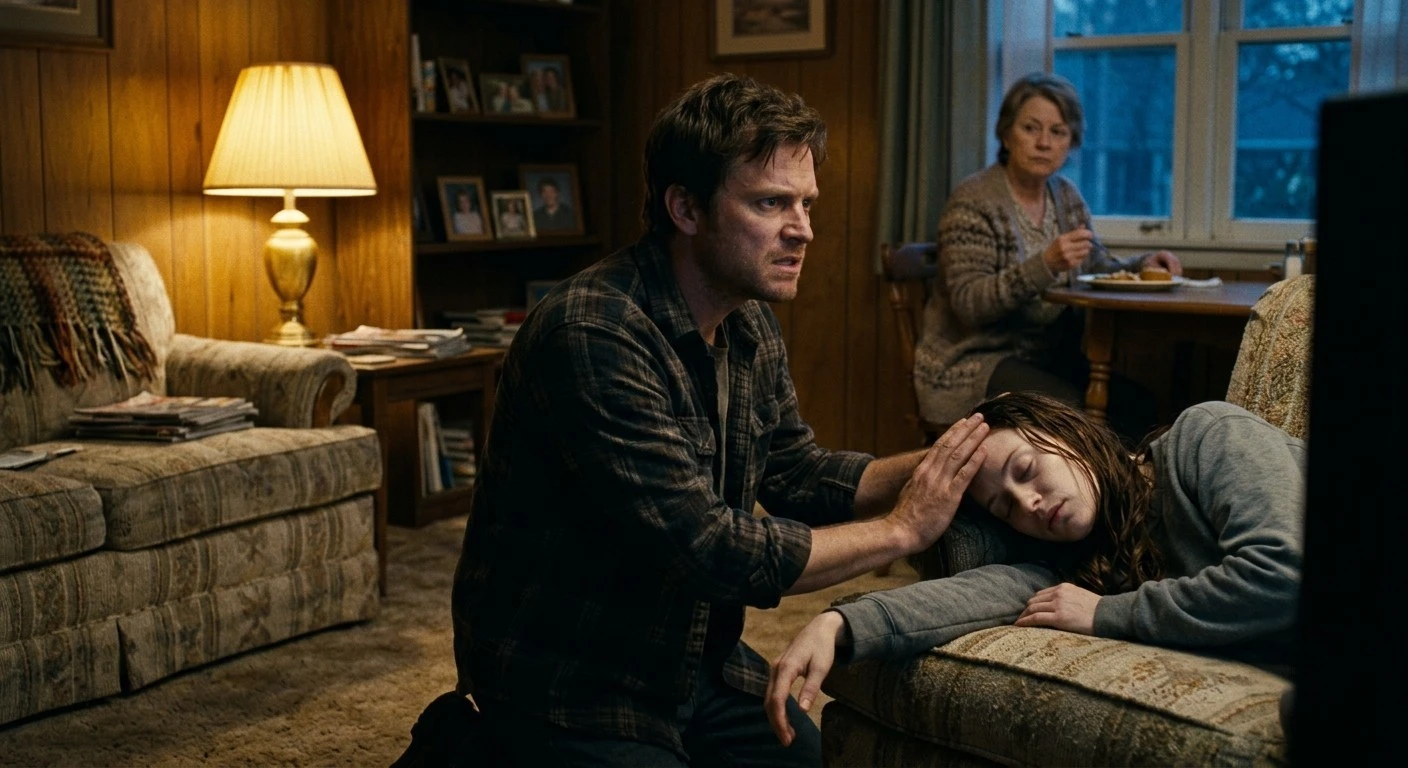
Laurel was sprawled across the sofa, arm hanging off the cushion, face gray.
Our son, Silas, screamed in his bassinet, blanket kicked off, onesie soaked through.
My mother sat at the table. Eating.
“She’s always been dramatic,” Mom said, not even looking up.
Something in me went completely quiet.
The Woman on the Sofa
I scooped Silas up first. His cries dropped to a whimper against my chest.
Then I knelt by Laurel.
“Laurel. Can you hear me?”
Nothing. Then her eyes fluttered.
“Graham…” Her voice was barely a breath.
“You’re making this worse,” Mom said behind me. “She needs to stop expecting everyone to panic.”
“She’s barely conscious.”
“She had a baby. Women have done that forever.”
I looked at the sink full of pots. The cutting board. The half-made bottle sitting in cooling water.
“Did you make her cook this?” I asked.
“I did not make her do anything,” Mom said. “I told her a home doesn’t stop running just because she’s uncomfortable.”
Laurel’s fingers found mine.
“She said you told her she had to prove she could manage the house,” she whispered.
Mom’s jaw tightened. “Don’t twist my words.”
The Ambulance
I didn’t argue. I called 911.
“Sir, is she breathing normally?” the dispatcher asked.
“Yes, but she’s barely responsive. She had a baby two days ago.”
“Any bleeding? Fever?”
I pressed my hand to Laurel’s forehead. “She’s cold. Really cold.”
“Stay with her. Help is on the way.”
Mom stood up from the table, wiping her mouth with a napkin. “You’re overreacting, Graham.”
“Sit down, Mom.”
“Excuse me?”
“I said sit down.” My voice didn’t sound like mine. “You don’t get to talk right now.”
For the first time in thirty-five years, she actually did what I said.
The paramedics arrived nine minutes later. One of them, a woman with steady hands, crouched beside Laurel and checked her pulse.
“Ma’am, can you tell me your name?”
Laurel’s lips moved. Barely a sound came out.
“Blood pressure’s low. We need to move her now,” the paramedic said to her partner.
They lifted her onto the gurney. I held Silas tighter and followed them to the door.
“Sir, are you riding with us?”
“Yes.” I turned back once. “Mom, watch the house. Don’t touch anything else.”
She stood frozen by the table, plate still half full.
The Doctor’s Words
The ER at St. Luke’s was bright and too loud. I sat in the waiting area holding Silas, rocking without meaning to.
A doctor came out forty minutes later. Dr. Patricia Nunez, according to her badge.
“Mr. Whitfield?”
“That’s me.”
“Your wife is stable. She was severely dehydrated and her blood pressure had dropped dangerously low. We’re also seeing signs consistent with postpartum preeclampsia, which can escalate quickly if untreated.”
My stomach dropped. “Escalate how?”
“Seizures. Organ strain. In rare cases, worse.” She paused. “Two days postpartum, she should not have been on her feet cooking a full meal, doing laundry, and caring for a newborn without rest or fluids.”
“She wasn’t supposed to be doing any of that.”
“Well, someone let her.”
I didn’t correct her. I didn’t need to.
“Can I see her?”
“She’s asking for you. And for the baby.”
The Room
Laurel looked small in the hospital bed, an IV taped to the back of her hand.
“Hey,” she said, voice raw. “Is he okay?”
“He’s perfect. He’s right here.” I set Silas gently in her arms.
She kissed his forehead, then looked up at me, eyes wet.
“I kept telling her I needed to rest,” Laurel said. “She kept saying I was being lazy. That I needed to earn my place in this family.”
“Earn your place.” I repeated it like the words tasted wrong.
“She said if I couldn’t run a household two days after birth, how was I supposed to raise a child.”
“She said that.”
“She’s been saying versions of that since the wedding, Graham. I just never told you how bad it got when you weren’t home.”
I sat on the edge of the bed. “Why didn’t you tell me?”
“Because every time I tried, you defended her. You said she just has ‘high standards.'”
That landed like a slap, because it was true.
“I’m done defending her,” I said. “I mean it this time.”
Laurel searched my face, like she was checking whether the words would hold.
“Prove it,” she said quietly.
The Phone I Wasn’t Supposed to See
While Laurel slept that night, a text lit up her phone on the nightstand.
It was from my mother.
Doreen: Don’t make this into something it isn’t. You fainted. That’s all. Don’t let Graham turn this into a reason to keep my grandson from me.
My hands went cold.
I scrolled up. There was a whole thread I’d never seen, going back weeks.
Doreen (3 weeks ago): A real mother doesn’t need help. My mother raised five kids with no dishwasher and no complaints.
Doreen (2 weeks ago): If you can’t handle a house and a baby, maybe Graham married the wrong woman.
Doreen (5 days ago): I’ll come stay while you recover. You’ll thank me later. Someone needs to keep this house from falling apart while you’re weak.
Laurel: I don’t need you to run my house, Doreen. I need rest.
Doreen: Rest is a luxury. Responsibility isn’t optional.
My throat tightened with every message.
Then I found the one from that afternoon, sent while I was still at work.
Doreen: Dinner needs to be made by 6. Groceries need to be put away. Laundry needs to be done before Graham gets home. I won’t have him coming back to a house that looks like this. Get up and do your job.
Timestamp: 3:47 PM.
I got home at 5:10.
She had known exactly what state Laurel was in. And she’d pushed anyway.
The Group Chat
I didn’t sleep. Instead, I opened the family group chat — me, Mom, my sister Renee, my aunt Carol.
I typed for ten minutes before I sent anything.
Graham: Laurel is in the hospital. Postpartum preeclampsia, severe dehydration. She collapsed after Mom made her cook, clean, do laundry, and care for Silas alone, two days after giving birth, while Mom sat and ate dinner in front of her.
Renee: WHAT? Is she okay??
Doreen: This is not the full story. Graham is exaggerating because he’s scared.
Graham: I have the texts, Mom. I have timestamps. You told her to get up and “do her job” while she could barely stand.
The chat went quiet for a full minute.
Carol: Doreen, is this true?
Doreen: I was trying to teach her responsibility. Nobody appreciates what I do for this family.
Renee: She almost died, Mom.
Doreen: Don’t be so dramatic. Doctors say that about every new mother.
Graham: A doctor told me two hours ago it could have caused seizures or worse. You knew she was struggling and you told her to “get up and do her job.” I have it in writing.
No response for eleven minutes.
Then:
Doreen: I want to see my grandson tomorrow.
That was it. No apology. No concern for Laurel at all.
The Confrontation
Mom showed up at the hospital the next morning anyway, holding a gift bag like nothing had happened.
I met her in the hallway before she reached the room.
“You’re not going in there,” I said.
“Graham, don’t be ridiculous. I’m his grandmother.”
“You’re the reason his mother is in that bed.”
“I was helping.”
“You sent her a text telling her to get up and do her job while she was collapsing. I read it, Mom. I have the timestamps.”
For once, she didn’t have a quick answer.
“I raised you alone,” she finally said. “Nobody helped me. I don’t understand why she gets to fall apart.”
“She wasn’t falling apart. Her body was shutting down. There’s a difference.”
“You’re choosing her over me.”
“I’m choosing my wife and my son over someone who almost let them both get hurt because she wanted control.”
Mom’s eyes filled, but I didn’t feel the old pull to comfort her. Not this time.
“You’ll regret this,” she said.
“Maybe. But I’ll regret it a lot less than I’d regret letting you back into that room today.”
I walked away from her, back toward the door where Laurel and Silas were waiting.
The Ultimatum
That evening, Mom called eleven times. I let it go to voicemail every time.
She texted instead.
Doreen: I’m your mother. You don’t get to cut me off because of one bad day.
Graham: It wasn’t one bad day. It was weeks of messages telling my recovering wife she was lazy, followed by you letting her collapse while you ate dinner. That’s not a bad day. That’s a pattern.
Doreen: So what, I never see my grandson again?
Graham: You see him when you can talk to Laurel with respect, when you apologize to her directly, and when you accept that her recovery is not up for debate. Until then, no.
Doreen: This is emotional blackmail.
Graham: No. This is a boundary. You taught me the difference is whether the other person gets to control the outcome. You don’t, this time.
She didn’t respond again that night.
The Silence That Followed
Laurel came home four days later. Her color had returned. Her blood pressure had stabilized.
The first night back, she sat on the same sofa, Silas asleep against her chest, and looked at me.
“You really told her no more visits?”
“I did.”
“She’s going to make you the villain to everyone in the family.”
“She already tried. Renee and Carol saw the texts. They know exactly who the villain is.”
Laurel was quiet for a moment. “I kept thinking, if I just tried harder, she’d finally accept me.”
“You don’t have to earn safety in your own home, Laurel. Not from her. Not from anyone.”
She leaned her head on my shoulder. “I want you to mean that in six months too. Not just this week.”
“I will.”
Six Weeks Later
Doreen tried one more approach. She called Laurel directly, using a different number.
Laurel put it on speaker so I could hear.
“Laurel, sweetheart, I think we got off on the wrong foot,” Doreen said, voice syrupy. “I only ever wanted what’s best for this family.”
“What’s best for this family,” Laurel said evenly, “was calling an ambulance and getting me help instead of telling me to get up and finish dinner.”
“I’ve apologized for that.”
“You haven’t. Not once, not to me.”
Silence.
“I’m sorry,” Doreen finally said, clipped and reluctant, like the words cost her something.
“I appreciate that,” Laurel said. “But sorry doesn’t undo the pattern. Graham and I have decided visits stay paused until we can trust you around Silas without a script of control underneath it. That’s not punishment. That’s just where we are.”
“You’re keeping my grandson from me.”
“No,” Laurel said. “You did that yourself, three weeks before I even collapsed, one text at a time.”
She ended the call.
The Dinner That Changed Everything
Three months later, Renee hosted a small family dinner. Doreen was invited. So were we.
Doreen arrived quiet, subdued in a way I’d never seen. She sat across the table, watching Laurel feed Silas without offering a single instruction.
Near the end of the meal, she cleared her throat.
“I looked back at those messages,” she said. “All of them. I didn’t want to see it at first, but I read every one.”
The table went still.
“I told a woman two days out of childbirth that rest was a luxury,” Doreen continued, voice unsteady. “I watched her collapse, and I ate dinner in front of her instead of helping. There’s no version of that where I was in the right.”
Laurel didn’t say anything, just watched her, careful.
“I’m not asking to be forgiven tonight,” Doreen said. “I just needed you to hear me say it plainly. I was wrong. Not misunderstood. Wrong.”
Laurel finally nodded, slow. “Thank you for saying that.”
“Does that mean—”
“It means we can talk about small visits again,” Laurel said. “Supervised, for now. It doesn’t mean the old rules come back. If you ever tell me to ‘get up and do my job’ again, this ends permanently. No second chance after that.”
“Understood,” Doreen said.
For the first time in years, I watched my mother accept a boundary instead of fighting it.
Justice Served
Doreen never got the version of the family she wanted, the one where she ran the house from the head of the table and everyone thanked her for it.
She got something smaller instead: supervised visits, careful conversations, and a daughter-in-law who watched her closely and would not hesitate to close the door again.
Laurel healed fully. Her blood pressure returned to normal within two months, and the fear that used to flicker across her face whenever Doreen’s name came up slowly faded.
Silas grew, safe, in a house where no one told his mother that rest was a luxury.
And every time Doreen visited after that, she brought nothing but a small gift and her hands, ready to help exactly as much as she was asked, and not one inch more.
The dinner she once forced Laurel to cook while she was collapsing became something Doreen mentioned only once a year, always the same way.
“I finished a meal that day,” she told Renee once, quietly, “while a woman I was supposed to protect was dying on the couch behind me. I don’t get to forget that. I don’t want to.”
She never tried to control the house again.
Original fictional stories. AI-assisted creative content.