The silence inside Red Crane Dojo turned wrong the moment Grant Holloway pointed at the cleaning woman’s daughter.
June Hale was thirteen years old. She was carrying a school backpack. She had appeared in the doorway ten minutes earlier, taken one look at her mother’s tear-streaked face, and said four words: “Leave my mother alone.”
The room had gone still. Grant had cracked his knuckles, let his smile spread wide, and invited her onto the mat.
Nobody stopped it.
Naomi Hale had worked the closing shift at the dojo for six months. She mopped the floors, wiped every mirror streak-free, and made the place smell of lemon and clean wood. She arrived after the last classes emptied and left before sunrise, invisible by design.
That night, the advanced class ran late. Grant was demonstrating a kick combination when one of his black belts stumbled.
“What was that, Derek?” Grant snapped. “This is a fighting art. It demands perfection.”
Naomi kept her head down and mopped the perimeter. Then her handle clipped a metal water bottle. It rolled three feet and came to rest at the edge of the mat.
Every head turned.
“I’m sorry,” Naomi said quickly. “It was an accident.”
Grant walked toward her slowly. He stopped close enough to force her to tilt her chin up. His gaze moved over her faded uniform, her cloudy bucket water, and he smiled the way people smile at things they consider beneath contempt.
“This is a place of concentration,” he announced, loud enough for the room. “We practice a deadly art here. Distractions are dangerous.”
He circled her.
“Tell me, everyone—what does it mean when someone keeps interrupting a serious class? What does it say about their respect for this space?”
A few students laughed. Most just watched with the dead expressions of people relieved to be watching instead of being watched.
Naomi stared at her mop handle. “I’ll finish up quickly and go.”
“No,” Grant said. “I think you should tell the class something. Tell them what you do here every night, in your own words.”
She looked up. “I clean.”
“You clean.” He repeated it softly, then widened it for the room. “She cleans. And how would a woman like this know anything about discipline? About sacrifice? She pushes a mop. She watches real warriors train and never asks herself—” He paused for effect. “—what separates her from them.”
“Sensei.” Owen’s voice came from the back row. “That’s enough.”
Grant turned with cold surprise. “Excuse me?”
Owen didn’t look away. “She knocked over a water bottle. That’s all.”
The room shifted. One student had stepped into the line.
Grant let the silence work. Then he turned back to Naomi with a smile that said Owen’s moment had been noted and catalogued.
“Tell me your daughter’s name,” he said pleasantly.
That was when June appeared in the doorway.
She had taken the late bus from school, texted her mother twice with no reply, and walked the last four blocks half-running. She already knew something was wrong from the silence in the building, the kind of silence that gathers above a scene it doesn’t want to witness.
She stepped into the dojo.
Her mother stood in the center of the floor, pale and small, surrounded by men in black belts. Grant Holloway faced her with the satisfied stillness of something that had been hunting and had stopped moving because its prey had nowhere left to run.
June took it in for two seconds.
“Leave my mother alone,” she said.
Grant turned with the slow enjoyment of a man who has just been given a better opportunity than he expected.
“What did you say, little girl?”
“You heard me,” June said. “Apologize to her.”
The laughter that followed wasn’t comfortable laughter. It was the kind that gets louder because the alternative is silence, and silence would mean acknowledging what everyone was watching.
Grant crouched to her eye level. “Apologize,” he repeated, as if tasting the word. “To her. For what — teaching her something real about the world?”
He straightened up. “Class, change of plans.”
He pointed at June. “The daughter wants to defend her mother’s honor. Fine. She can take her place on the mat. One touch. If she can land one touch on me, I get down on my knees and apologize to both of them.”
He let the rest hang in the air.
“Don’t do it,” Naomi said quietly, wrapping her arm around June’s shoulders. “We’re leaving.”
June looked at her mother’s face. The tear tracks. The shame. The way Naomi’s eyes kept moving toward the door like escape was the only option she had ever been offered.
Her grandfather’s voice arrived without warning.
You use these things for only two reasons. To protect someone who cannot protect themselves. And only when there is no other choice.
June lifted her mother’s arm gently from her shoulder.
“It’s okay, Mom,” she said. “I have to do this.”
She set her backpack on the bench. She untied her sneakers and placed them side by side at the edge of the mat, neat and deliberate. Every movement was measured, unhurried, stripped of performance.
Then she stepped forward.
Grant rolled his neck and bounced on his heels, making the whole thing theater. He had already narrated it in his head: the story he would tell for years about the cleaning lady’s kid who thought she was brave.
“Okay, little hero,” he said. “Let’s see what you’ve got.”
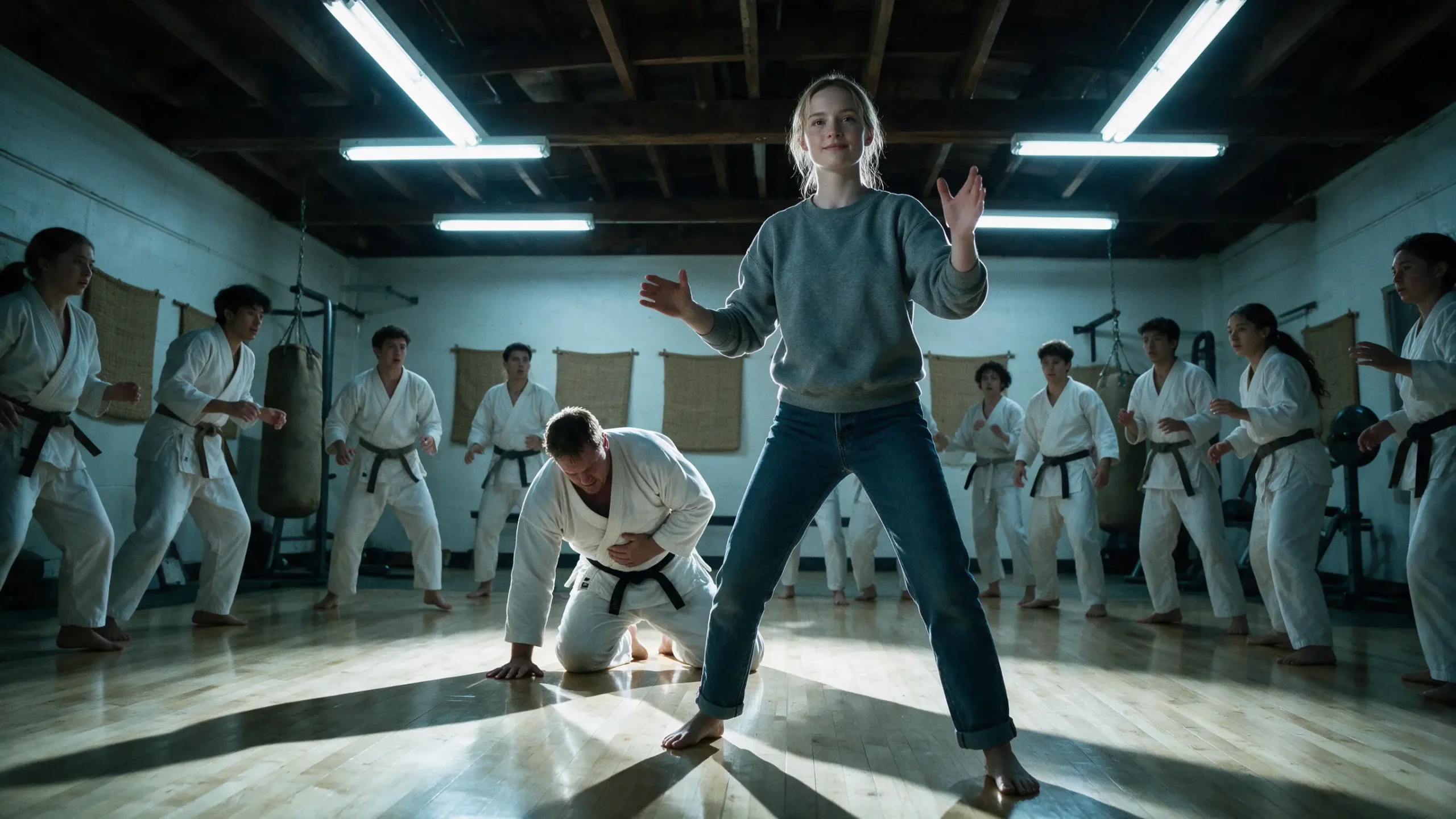
June stopped three feet from him. She released a slow breath, lowered her center of gravity, and raised her hands open-palmed, one slightly ahead of the other.
Nobody recognized the stance.
Owen, who had spent years reading old combat manuals in the back of the school library, felt something go cold in his chest. He had seen a photograph of that stance exactly once. In a yellowed military close-quarters manual from 1971.
It was not designed for sport.
Grant looked at her hands. For one fraction of a second, the smirk faltered. He recovered quickly.
“Are you surrendering? Or offering me a high five?”
June said nothing. She watched his shoulders. His weight distribution. The way his left hip dropped a centimeter each time he shifted forward.
Grant, irritated by her stillness, decided to end it fast.
He threw a sharp front kick at her midsection.
It passed through empty air.
June had pivoted on the ball of her back foot—barely, just enough—and the kick extended too far. Grant stumbled slightly before catching himself. He turned, confusion and fury fighting for his face.
“Beginner’s luck.”
He came again. A jab. A cross.
June tilted her head and the jab whispered past her ear. She leaned back from the waist and the cross cut through the space her face had just occupied.
Her feet never moved.
“Your movements are too wide,” she said quietly.
The words fell into the room with surgical clarity.
“You telegraph with your shoulders.”
Grant stared at her. Around him, his students’ expressions had changed. Doubt had appeared on faces that had worn nothing but reverence for years.
Something in him snapped.
Whatever professional distance remained vanished. He charged with a sound that came from somewhere below technique, a sound of rage and wounded pride. His form broke entirely. His arms swung wide and huge and wild, the haymaker of a man trying to end something with sheer weight.
June saw the opening appear.
She stepped in.
Her left hand caught his forearm at the wrist and redirected his momentum. His balance gave. At the same instant her right hand moved—not a fist, not a kick. A spear-hand strike, fingers rigid, driving cleanly into the solar plexus just below the ribcage.
The sound was small.
Grant froze.
His arm dropped. His roar collapsed into a strangled gasp. His body locked where it stood as if something internal had switched off, and then, slowly, he folded at the knees and went down to the mat with a heavy thud.
He knelt there, convulsing, fighting for one full breath.
In the room, no one moved.
June withdrew her hand, stepped back into her stance, and looked at the circle of students around her.
“Does anyone else want a lesson?”
No one spoke.
No one moved.
Grant was on his knees in the center of his own dojo, and every person watching understood at once that everything they had believed about this room had been wrong.
Owen was the first to say anything. He moved forward slowly and bowed his head—a genuine bow, the kind he had given Grant a hundred times without meaning it.
“That was Krav Maga,” he said quietly. “Or something close to it. Military discipline.”
June looked at him. His face held no mockery. Only serious recognition.
“My grandfather taught me,” she said.
Grant, hauling himself upright on trembling legs, spat the words out through shame and pain. “That was a cheap shot. A dirty trick. That wasn’t a martial art.”
“You’re wrong,” Owen said, turning to face him.
This time the word Sensei was nowhere in his voice.
“That was the purest definition of martial arts,” Owen said. “The art of war. You challenged a civilian. She ended it.”
He held Grant’s gaze.
“That’s the point, isn’t it?”
“She’s a child,” Grant rasped. “She attacked me.”
“You challenged her,” Owen replied. “You humiliated her mother. You created every single thing that happened in this room tonight.”
He looked around. No one contradicted him. Eyes dropped. Derek, who had laughed hardest at Naomi, had gone pale and was already stepping toward his bag.
Grant reached for the last tool he had left.
“Get out,” he said, voice cracking. “Both of you. Now.”
He pointed at Naomi. “You’re fired. And if you,” he said, turning to June, “ever come back here, I’m calling the police. Assault. That’s what this was.”
June looked at him steadily.
“You won’t call the police,” she said. “Because then you’d have to explain why you were fighting a thirteen-year-old girl. You’d have to explain everything you said to my mother. You’d have to explain the witnesses.”
She tilted her head.
“Do you really think you’d be the victim in that story?”
Color left his face.
She was right. There were too many witnesses. His reputation, the image he had built across two decades, was collapsing in real time, and he had no move left that didn’t make it worse.
“I said get out,” he said again, voice breaking completely now.
Naomi took June’s arm and led her off the mat. June picked up her sneakers and backpack. As they passed the trophy case, the polished metal behind the glass looked empty to her — prizes stripped of meaning, belonging to a version of this room that no longer existed.
Owen stepped into their path as they reached the door.
“Your grandfather must have been extraordinary,” he said.
June smiled for the first time all night.
“He really was,” she said.
Then she and her mother stepped into the cool night air.
Behind them, the dojo emptied.
Derek walked out first, without a word. Others followed. Within fifteen minutes the building was hollow, students gone in ones and twos, no one willing to meet Grant’s eyes on the way out.
Owen was the last. He stood at the door for a moment.
“You talked about strength,” he said. “That girl had more of it in one finger than you have in your whole body. You taught us how to fight. Her grandfather taught her why.”
He opened the door.
“Now you know the difference.”
The door closed softly.
Grant stood alone in the smell of sweat, polish, and total, irreversible collapse.
The walk home was silent.
Naomi held June’s hand with the grip of someone who had watched something impossible and was still not sure the ground was solid. The streetlights threw long shadows. Neither of them spoke until they were inside the apartment.
Naomi went to the kitchen and put on the kettle. Her hands moved on their own, doing the small familiar things while her mind tried to process the scene she had just witnessed. She had always known her father served. She had thought the backyard training sessions were confidence exercises. Father-daughter bonding.
She had never once imagined that.
A few minutes later she carried two mugs down the hall and knocked.
“June? Can I come in?”
“Yeah.”
June sat on the edge of her bed in the same clothes, looking at a framed photograph on her nightstand. Her and Grandpa Walt in the backyard, summer, ordinary and warm and irreplaceable.
Naomi sat beside her and handed her the tea.
“I broke my promise, Mom,” June said quietly.
“What promise?”
“Grandpa made me promise I’d only open the box for protection. Only last resort.” She looked up, eyes wet. “He’d be disappointed.”
“No,” Naomi said. “He wouldn’t.”
She pulled her daughter close.
“You protected me. You were a shield. That is exactly what he asked.”
“I was angry,” June said. “I wanted to hurt him for what he said to you. Grandpa always said anger makes you sloppy.” Her voice dropped. “And I was angry.”
Naomi stroked her hair and understood then that her father had given June something far more than technique. He had given her a code. And this frightened, serious child was trying with everything she had to live inside it.
“You stopped when it was done,” Naomi said gently. “You didn’t keep going. You controlled it.”
They drank their tea in the quiet. The warmth pulled some of the night back from the edges of the room.
“He was a soldier,” Naomi said eventually. “A real one.”
June nodded. “A special unit. Most of it was classified. He said he left because he kept watching strong people use their strength for pride. For power. When you were born, he wanted to be something different.”
Naomi let out a slow breath.
Now it made sense. The patience. The stillness. The gentleness that had never broken no matter what life threw at their family. She had always thought it was softness. She understood now that it was discipline earned through fire, held by choice every single day.
“Grant won’t let this go,” June said. “Men like him don’t. When you take their pride, they get dangerous in other ways.”
Naomi looked at her daughter’s face, this thirteen-year-old who already understood something about the world that most adults spent their whole lives not seeing.
“Let him try,” she said quietly. “We’ll face it together.”
June had been right.
Grant’s humiliation didn’t fade. It curdled.
Within days the story had spread through the local martial arts community the way fire moves through dry grass — first as rumor, then as eyewitness account, then as established fact. Owen didn’t gossip. But when instructors asked him directly, he answered. He told it the same way every time. A black belt had humiliated a cleaning woman, challenged her thirteen-year-old daughter, and been put on his knees in one strike.
Grant told a different story. He said she had used a concealed device. He said she had sucker-punched him. He said it was a setup. But his version kept changing, and every revision made him look smaller than the one before it.
Students stopped coming.
Nobody wanted to train under a man who had been beaten that quickly, under those circumstances, by a child. Within six weeks the dojo had emptied. Revenue disappeared. Grant had poured his money, his identity, and twenty years of pride into that building, and the bank took it before summer ended. When the “For Lease” sign appeared in his former window, it felt like a headstone.
But June had warned her mother correctly.
A man with nothing left to lose can still be dangerous.
Grant’s hatred compressed and sharpened. He aimed it at Naomi with the patience of someone who had decided to make a single thing his entire project. He called her employers and accused her of theft. He said her daughter was violent and unstable. He showed up outside businesses without speaking, parking in plain sight, standing at the corner until the weight of his presence did the work for him.
One by one, Naomi lost the jobs.
Owners didn’t want trouble. Letting her go was easier.
Bills stacked up on the kitchen table. Naomi tried to hide the fear, but fear leaves marks. Dark circles. A flinch at sudden sounds. The particular stillness of someone cataloguing exits.
June saw all of it.
And guilt settled into her bones.
She had opened the box, she told herself. She had used her grandfather’s gift in public, in front of witnesses, and now the damage was radiating outward in ways a strike couldn’t stop. She had pulled a bully into the light, and the light had blinded him into something more dangerous than he had been before.
But what Walt had taught her was never only about strikes.
Never fight on your enemy’s terms, his voice told her. If they want fists, give them a board they don’t understand. If they want darkness, drag them somewhere light and let everyone watch.
She needed evidence. She needed witnesses. She needed ground where intimidation and denial would collapse under their own weight.
She found Owen’s name in a tournament photograph on the dojo’s social media archive. From there she tracked him through the high school directory and waited outside the main entrance the following afternoon, watching students pour out in noisy groups.
She nearly lost her nerve when she saw him.
Then she pictured her mother staring at the unpaid bills.
“Owen.”
He stopped. Recognition came quickly.
“I’m June Hale. From the dojo.”
His expression changed at once. “Is everything okay?”
“No,” she said. “It’s bad. Grant got my mother fired from all her jobs. He’s stalking her. We have nothing left. I need your help.”
She told him everything. The calls. The employers. The way he stood outside buildings and waited in the dark. Owen listened without interrupting, and by the time she finished his face had hardened into something quiet and cold.
“I knew he was a bully,” he said. “I didn’t know he was this.”
“The police can’t move without proof,” June said. “We need documentation. Time-stamped. Undeniable.”
“I’m in,” Owen said immediately. “Tell me what you need.”
Naomi found temporary work cleaning a downtown office building on the night shift. June knew Grant would follow.
Owen took position in a coffee shop across the street with his phone charged and camera ready. On the first night, right on schedule, Grant’s truck rolled into view and parked half a block down.
He never got out.
He sat in the dark with his phone’s blue glow lighting his face, watching the building entrance for two hours.
Owen filmed every minute of it.
They ran the same operation the next three nights. Each time Grant returned. Silent. Patient. Waiting. By the end of the week Owen had hours of time-stamped footage showing the same pattern: the truck, the face, the building, the timestamp in the corner.
They had their intelligence.
Now June needed a battlefield.
Oak Grove Neighbors was the town’s community Facebook group—a digital town square moderated by a retired teacher named Mrs. Talbot. People trusted her. They sold furniture there, recommended contractors, argued about city council decisions. It was the place where a statement made in public would be witnessed, evaluated, and impossible to quietly bury.
This was the ground.
With Owen beside her, June drafted the post. Not angry. Not hysterical. Just clear. She introduced herself. She named her mother. She described the harassment in plain terms: the lost jobs, the stalking, the nightly surveillance. She presented Naomi as what she was—a hardworking woman under sustained, deliberate attack—and Grant as what he had become.
Then she set the trap.
She did not upload the video.
The post ended by stating they had proof. Hours of it. And that they were asking publicly for Grant Holloway to leave their family alone.
Then she tagged him.
Owen frowned at the screen. “Why not post the video now? That ends it.”
“Not yet,” June said. “We need him to destroy himself. His ego will do the work if we give it a stage.”
They posted Friday evening, when the page was busiest.
It took eight minutes.
Grant exploded in all-caps, full of rage, denial, and self-pity. He accused June of assault. He called Naomi incompetent and dishonest. He said the whole thing was a scheme because his business had failed. He denied everything and dared them to produce evidence that didn’t exist.
The page erupted. Some people defended him at first, remembering the version of him they thought they knew. Others recoiled immediately. A grown man screaming in capitals at a child and her mother didn’t look innocent.
Mrs. Talbot stepped in.
“Mr. Holloway. This is a serious allegation. The girl says she has video evidence. Are you stating that no such evidence exists?”
Blinded by rage and certainty in his own version of events, Grant walked directly into it.
He denied the evidence outright. He called it fabricated. He said he had never been near Naomi’s workplace and dared them to post it.
June looked at Owen.
“Now.”
Owen uploaded the first clip. Five minutes. Clear shot of the street, the building entrance, the truck, and Grant’s face lit by his phone screen. The timestamp burned in the corner.
The caption read:
Monday night. He lied. We have more.
The page changed instantly.
People who had defended him went quiet. Others responded with horror. Mrs. Talbot’s next comment came cold and formal, telling Grant he had been caught in a public lie and that his conduct was unacceptable.
Grant spiraled. He called the footage edited. He said the truck wasn’t his. He said Owen had helped stage it.
Then Owen uploaded Tuesday.
Then Wednesday.
Then Thursday.
Each clip drove the truth deeper. Grant Holloway—who had built everything on the image of a man in control—had been exposed in a public square as a liar, a coward, and a stalker.
June had won the second fight without throwing a single strike.
The next morning, the apartment doorbell rang.
Naomi and June exchanged a look. When Naomi opened the door, a police officer stood outside beside Mrs. Talbot.
“We’ve received multiple calls,” the officer said quietly. “Mrs. Talbot shared the thread and the footage. We have enough to issue a restraining order and strong grounds for stalking charges.”
Mrs. Talbot stepped forward with a notepad and warmth in her eyes.
“I made calls this morning,” she said. “When your former employers understood what had actually happened, they were horrified. Two of them want you back immediately. Other business owners in town are asking if you need work.”
Her voice softened.
“This town takes care of its own. We won’t let him do this to you.”
Tears ran down Naomi’s face—but for the first time in months they came from relief and nothing else.
Things moved quickly after that.
Faced with a restraining order, criminal charges, and public humiliation he couldn’t outrun, Grant left town. Someone saw his truck on the interstate heading north. After that, no one in Oak Grove heard from him again.
He became a ghost.
Naomi got her best job back within the week. The dread that had settled over the apartment—the flinching, the dark circles, the bills on the table—began to lift. Safety came back in pieces.
Several weeks later, on a bright Saturday afternoon, June was tending tomatoes in the small community garden behind their building when she heard footsteps behind her.
She turned.
Owen stood there holding something wrapped in paper, a look of self-conscious embarrassment on his face.
“I got you something,” he said. “A thank-you. For teaching me something.”
June unwrapped it carefully.
A leather-bound journal and a good pen.
Owen shifted. “What you did in that dojo—that wasn’t just fighting. It was strategy. Discipline. Using your mind instead of your fists. I quit training after everything. Started studying chess instead.” He glanced down. “I figured I should have somewhere to write down what I learn.”
June smiled—not the careful controlled smile she had worn in difficult rooms, but a real one.
“Grandpa Walt would have liked that,” she said. “He always told me the strongest muscle in your body was the one between your ears.”
She looked down at the journal and felt something settle inside her. Something that had been sitting wrong for weeks, maybe longer, finally found its place.
Her grandfather had taught her how to strike. But more than that, he had taught her how to stand upright in a world full of different kinds of monsters. He had given her leverage and timing and judgment and restraint. He had given her tools for protection.
She had used every one of them.
She had protected her mother.
And Walter Hale—quiet gardener, retired mailman, former soldier, extraordinary man—had been right about everything that mattered.
Original fictional stories. AI-assisted creative content.