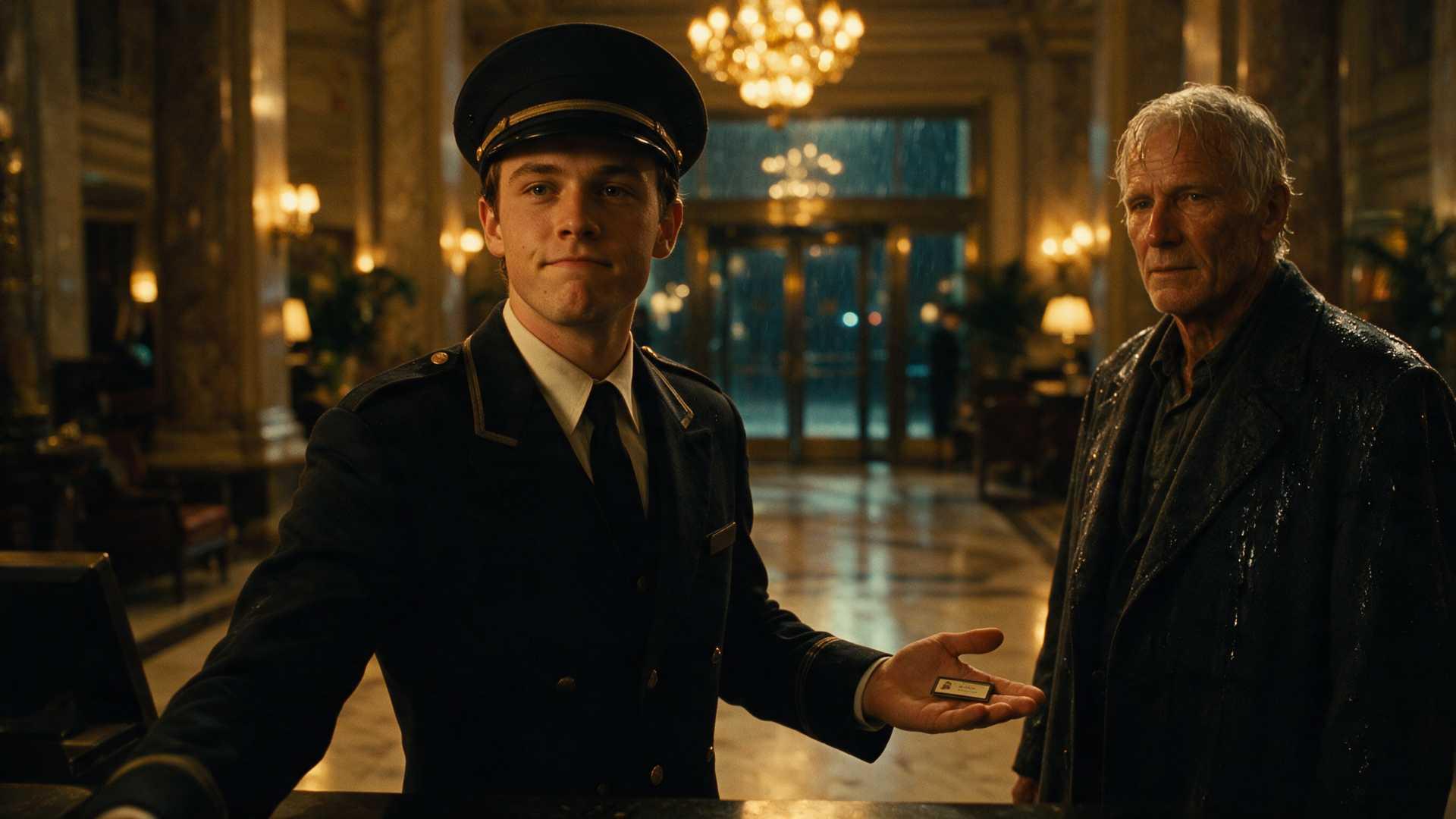
Rain hammered the entrance of the Grand Meridian Hotel like it had a grudge against the city.
Inside, everything was warm marble and low lighting. Guests in designer coats drifted toward the bar. A pianist played something forgettable near the fountain.
Caleb Morrison stood near the entrance doors, hands folded, watching.
At twenty-two, he’d worked the Meridian’s front floor for eleven months. His badge said “Bellhop.” His coworkers said he was too helpful.
“Morrison.” The voice cut across the lobby. “Stop daydreaming.”
That was Director Harlan Rowe. Black blazer. Silver cufflinks. Expression like a man perpetually disappointed in the human race.
“The Kessler party lands in eight minutes,” Rowe said. “I want those carts staged before the town car pulls up.”
“Already done.”
Rowe adjusted his cufflinks. “Do it again.”
Caleb turned — and the entrance doors opened.
A gust of cold air pushed through the lobby.
An old man stepped inside.
He was maybe seventy. Maybe older. White stubble, silver hair matted flat from rain. His charcoal overcoat was soaked through, water running off the hem onto the marble floor. He carried a duffel bag that looked like it had survived three decades and several arguments.
He didn’t move toward the desk. He just stood there, breathing hard, like making it through the door had cost him everything.
Several guests glanced over. One woman pulled her daughter sideways without looking at him again.
Caleb watched the man’s hands.
They were shaking.
He crossed the lobby.
“Sir.”
The old man looked up. His eyes were clear and steady but exhausted.
“You all right?”
“I’m fine.” A faint smile. “The weather had other opinions.”
Caleb reached back to a service station and grabbed a folded towel. He draped it over the man’s shoulders before anyone could say a word.
“Thank you.” The old man’s voice was quiet. “That’s — thank you.”
“Caleb.”
Rowe was behind him. Close. Quiet. The kind of quiet that meant serious.
“Step away.”
Caleb didn’t step away. “He’s soaked, sir. I’m just —”
“I see what you’re doing.” Rowe’s jaw was tight. “This is a private property. We have a guest profile to protect.”
The old man looked at the floor.
Caleb turned to face his director. “He walked in out of the rain.”
“Which means he entered without a reservation.”
“He’s elderly. He’s drenched. He’s shaking —”
“Security can assist him from here.”
The old man’s voice came again, calm now. “I simply need to speak with someone at your front desk.”
Rowe gave him the thin smile reserved for people he’d already decided were problems. “I’m afraid our front desk is reserved for registered guests.”
Caleb looked at the man’s shoes. Old leather, worn at the toe. He looked at the duffel bag. A small airline tag still hung from the zipper — faded, from a flight years ago.
He looked back at Rowe.
“I’ll take him to the desk myself.”
“Morrison.”
Caleb gently placed a hand under the man’s arm. “Come on, sir. I’ve got you.”
The old man hesitated. “You’ll catch trouble for this.”
“Probably.” Caleb kept walking. “I’m going anyway.”
They crossed the lobby together. Slowly. The man leaned slightly against Caleb’s arm. Guests parted without being asked.
The pianist stopped playing.
They reached the reception counter.
The receptionist looked past them toward Rowe, unsure what she was allowed to do.
The old man rested both hands on the marble counter. “Thank you,” he said to Caleb. “What’s your name?”
“Caleb Morrison.”
The old man nodded. Like he was locking it away somewhere important. “I’m Arthur Webb.”
“Nice to meet you, Mr. Webb.”
Arthur studied him. “You didn’t have to do that.”
“I know.”
“Most people wouldn’t.”
Caleb smiled. “I’m not most people.”
Rowe reached the desk in four hard steps.
“That’s enough.” His voice was cold glass. “Morrison. Badge. Now.”
The lobby went very quiet.
The receptionist pressed her lips together.
Caleb turned around.
“You’re removing me?”
“I’m terminating you.” Rowe held out his hand. “Insubordination. Abandonment of post. Violation of guest floor protocol. Do you want me to continue?”
Caleb looked at Arthur.
The old man’s face had changed. Something behind his eyes shifted — a kind of quiet that wasn’t peace. It was patience.
“This happened because of me,” Arthur said softly.
“No, sir.” Caleb unclipped his badge. “It happened because I made a choice.”
He set the badge in Rowe’s palm.
Rowe closed his fingers around it. “Security will walk you out.”
The silence in the lobby was total.
Then Arthur reached into the inside pocket of his soaked overcoat.
He pulled out a phone. Plain. Black. Nothing expensive about it.
He dialed without looking at the screen.
Rowe exhaled through his nose. “Mr. Webb, you’re welcome to call whoever you’d like from outside —”
Arthur raised one finger.
The call connected.
“This is Arthur Webb.” His voice was different now. Not loud. But the kind of quiet that fills a room. “Please send the oversight team to the lobby. All of them.”
He ended the call.
Rowe blinked. “I’m sorry — the oversight —”
“I heard your apology,” Arthur said. “Sit tight.”
Forty seconds.
The elevator across the lobby chimed.
Doors opened.
Four people in business attire stepped out. Behind them, two more. Behind them, a woman in a navy blazer carrying a leather portfolio, and a tall man in his fifties who walked like he owned the building.
Because he did.
His name was Marcus Deane. Chief Operating Officer of Webb Hospitality Group — the parent company that quietly owned the Grand Meridian, seven other luxury hotels in the U.S., and a portfolio that had been privately held for nearly four decades.
Deane walked straight to Arthur.
“Mr. Webb.” A small nod. “We came immediately.”
“I know you did, Marcus.”
Deane looked at the water still dripping from Arthur’s coat. His expression tightened briefly — not toward Arthur, but toward the lobby. Toward everything he was taking inventory of.
He turned to Rowe.
“You’re the floor director?”
Rowe had gone pale. “I — yes. Harlan Rowe.”
“Mr. Rowe.” Deane’s voice was even. “Do you know who you fired?”
Rowe’s mouth opened. Nothing came out.
The woman in the navy blazer — she introduced herself as Corporate Counsel — opened her portfolio and placed a single document on the reception counter.
Property ownership.
Managing Principal: Arthur J. Webb. Webb Hospitality Group.
Established: 1987.
The receptionist read it upside down and covered her mouth with both hands.
Rowe looked at the paper. Then at Arthur. Then at the soaked overcoat. Then at the worn duffel bag.
“I don’t…” His voice broke. “I don’t understand.”
Arthur Webb tilted his head. “What don’t you understand, Mr. Rowe?”
“You came in like — you looked like you were —”
“Like I didn’t belong here?”
The silence was its own answer.
Arthur walked slowly to the center of the lobby. He stood under the chandelier, water still dripping from his sleeve, and looked at the room.
“Thirty-eight years ago,” he said, “I was twenty-six years old and sleeping in my car during a January freeze in Cleveland.” His voice carried without effort. “I walked into a hotel — smaller than this one, nothing fancy — and asked if I could sit in the lobby until the temperature came up.”
No one moved.
“The manager had me thrown out.” Arthur turned slowly. “I sat on the curb for four hours. I almost lost two fingers to frostbite.” He paused. “I made a decision that night. If I ever built anything — hotels, properties, anything — the people who worked the door would treat every human being like they had a right to be warm.”
The woman with the portfolio looked at Rowe without expression.
Rowe’s cufflinks suddenly looked like props.
“I visit every property,” Arthur continued. “Unannounced. Every year. I come in looking the way I looked tonight.” He glanced at his duffel bag. “Most managers fail this test. Some pass.” His eyes moved to Caleb. “Tonight, one bellhop passed and one director failed.”
Caleb stood near the service station with his badge gone and his jacket still on, because no one had asked him to take it off.
Arthur walked to him.
“You knew nothing about me,” Arthur said.
“No, sir.”
“You helped anyway.”
“He was cold.”
“That’s all?”
Caleb looked at him. “That was enough.”
Arthur studied him for a long moment.
Then he turned to Marcus Deane. “Reinstate him. With back pay for the shift.”
“Done,” Deane said.
He looked at Rowe. “Mr. Rowe — submit your resignation to HR before the end of business tomorrow. We’ll process a standard exit package.”
Rowe opened his mouth.
“That’s not negotiable,” Deane added.
Rowe closed his mouth.
“One more thing.” Arthur turned to the entire lobby — staff, guests, everyone. “This hotel’s mission is not to impress wealthy guests. It is to make every person feel like a human being. I wrote that in 1989. I expect it to be practiced in 2024.” He looked at the chandelier. “Beauty is easy. Kindness takes character.”
He picked up his duffel bag.
Caleb stepped forward. “Let me take that.”
“I’ve got it.” But Arthur smiled. “Walk with me to the desk.”
They walked together across the marble floor.
At the desk, a receptionist with shaking hands checked Arthur Webb into the owner’s suite without being asked twice.
She handed him a keycard.
“Mr. Webb — I’m so sorry. We should have —”
“You’re not the one who needs to apologize,” Arthur said. “But next time you see someone standing at that door in the rain — you’ll remember tonight.”
She nodded. Hard.
Arthur looked at Caleb one more time.
“How long have you worked here?”
“Almost a year.”
“Not anymore.” Arthur reached into the portfolio the counsel had left open on the counter. He signed a single form without explanation and handed it to Deane. “Effective immediately, Caleb Morrison moves to Floor Operations Supervisor. Training starts Monday.”
The receptionist’s jaw dropped.
A housekeeper near the service corridor clasped her hands together.
Caleb stared at the paperwork. “Sir — I’m a bellhop.”
“You were a bellhop.” Arthur picked up his keycard. “Now you’re the person who makes sure this lobby never has another night like tonight.”
Caleb looked at him. “Why me?”
Arthur paused. “Because when everyone else was deciding whether to care, you already had a towel in your hand.”
He walked toward the elevator.
The doors opened.
He stepped inside.
He turned — and for just a moment, the old man in the soaked overcoat looked like exactly what he was. Someone who had been cold once, a very long time ago, and never forgot it.
The doors closed.
The lobby exhaled.
The pianist started playing again.
Caleb looked down at the new paperwork in his hand.
His name was on it.
Above the employee entrance, three days later, they hung a new sign. Not a corporate motto. Not a mission statement.
Just one line, in plain black letters on white:
Everyone who walks through that door deserves to be warm.
Three months in, Caleb sat in his new office reviewing the overnight incident logs when a knock came at his door.
A young woman in a new burgundy uniform leaned in. First week. Nervous eyes.
“There’s an older gentleman at the entrance,” she said. “He’s not a guest. He just — he looks like he needs somewhere to sit. I didn’t know if I should —”
“Get him a towel,” Caleb said, before she finished. “And a chair by the window. Somewhere warm.”
She blinked. “Just like that?”
“Just like that.”
She smiled — the kind of smile that comes from being trusted to do the right thing — and disappeared back into the lobby.
Caleb listened to her footsteps fade across the marble.
He looked at the sign above his door. He’d put it there himself, on the first day.
It cost nothing. Do it anyway.
He turned back to his logs.
Outside, it was raining again.
Inside the Grand Meridian, a stranger was getting warm.
Original fictional stories. AI-assisted creative content.