I landed at Andrews Air Force Base at 4:47 in the morning, still wearing the same field gear I’d had on when we pulled twelve civilian hostages out of a basement in a country I can’t name.
Three of my soldiers were in surgery. I’d held a compress on Sergeant Diaz’s shoulder for the entire flight home.
My phone showed forty-one unread messages. Thirty-eight of them were from Celia.
You HAVE to be at the gala tonight. Mom’s foundation depends on it. Dad says it’s urgent. Don’t embarrass us.
I didn’t shower. I didn’t change. I grabbed a cab from the tarmac and told the driver the address of the Fairmont.
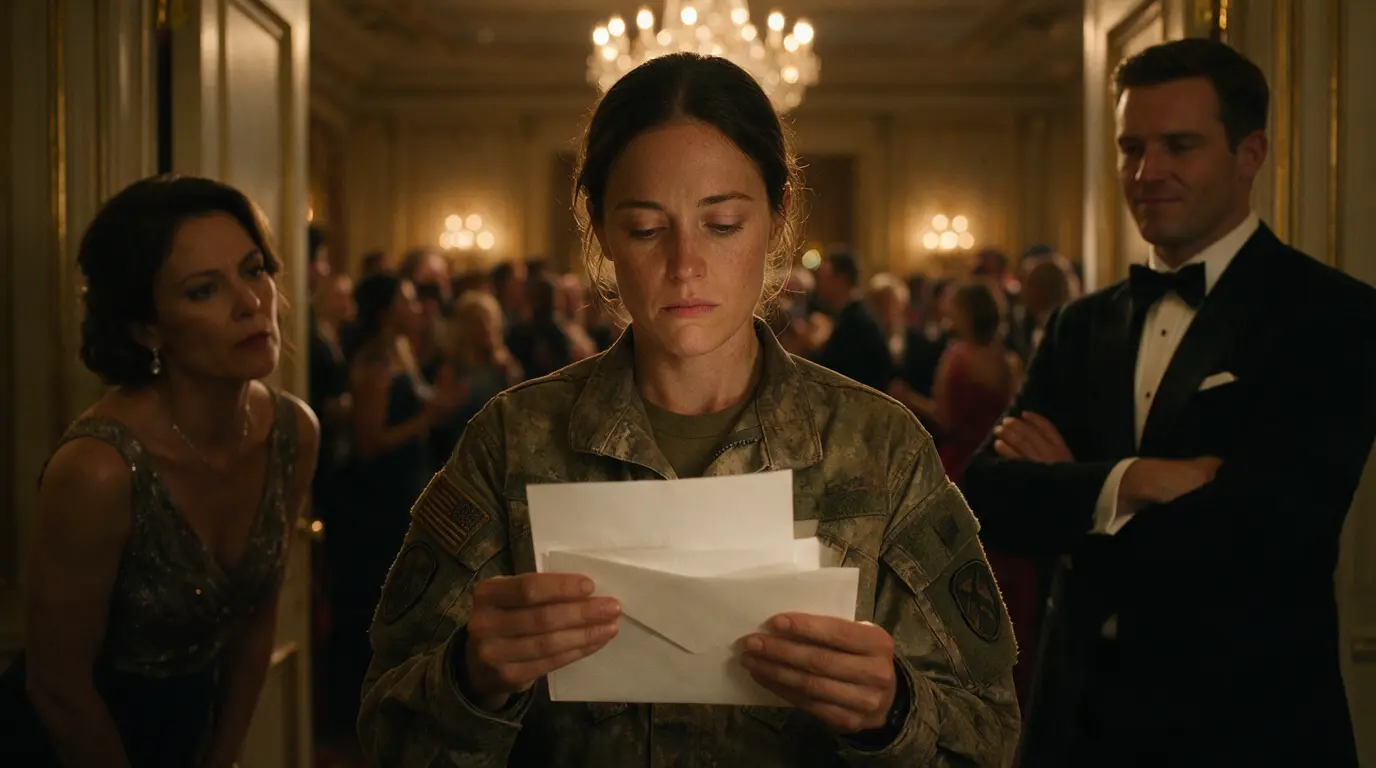
The ballroom was exactly as I remembered it from the year my mother died—white roses everywhere, gold banners, a string quartet playing something that cost more per hour than most veterans made in a week.
Every head turned when I walked in.
I was still in my field jacket. Muddy boots. The kind of gear that doesn’t blend into chandeliers and champagne.
My sister materialized out of the crowd like she’d been waiting by the door.
“Finally,” Celia hissed, gripping my arm. “You look like you crawled here from a ditch. Do you have any idea what tonight means?”
“Where’s Dad?”
“Inside. Come on. There’s something we need you to sign before the keynote.”
I let her pull me through the crowd. I didn’t fight it. I wanted to see what they were going to ask.
The private meeting room off the main ballroom was mahogany and low light. Nolan Pierce—Celia’s fiancé, the family attorney—was already seated at the table. My father stood by the window in his tuxedo, hands clasped behind his back.
He looked every inch the grieving widower who’d dedicated his life to his wife’s legacy.
He looked like a lie.
Nolan slid a white folder across the table toward me. Heavy. Thick with legal paper.
“Sign page seventeen,” he said. “Initials on pages four, nine, and twenty-two. We’ll take care of the rest.”
I didn’t touch it.
“What is it, Nolan?”
“Administrative.” He smiled the way bankers do when they want you to stop asking questions. “Your mother’s restricted veterans’ fund. The board voted to consolidate it into the general endowment. Streamline operations. We just need your signature as the remaining trustee.”
I felt my jaw tighten.
My mother had built that fund in 2018, the year I came home from my first tour with a Purple Heart and a list of names I still couldn’t say out loud without flinching. She’d set it up with one rule, ironclad and legally explicit: No administrative fees. No overhead. No gala costs. Every dollar goes to a veteran.
She’d died before she could see how far her husband had drifted from that promise.
“Consolidate,” I repeated. “Into the general fund that pays for this gala. For Celia’s wardrobe. For your consulting salary, Nolan.”
Celia’s smile thinned to a blade. “Don’t be dramatic. You’ve been off playing soldier in the desert for five years. The least you can do is sign the papers and let us run it properly.”
“Run it properly.” I leaned forward, and both of them flinched. They weren’t used to this version of me—the one who’d spent a decade in rooms with men who were trying to kill her. “Last year, the restricted fund paid out $2.1 million to three hundred and twelve families. The general foundation paid out $480,000 in actual charity and spent $1.7 million on parties, travel, and consulting. You want to merge them because the restricted fund is the only money you haven’t been able to touch yet.”
My father finally spoke.
“Watch your tone, Elise.” His voice was the one he’d used on me since I was twelve—low, measured, designed to make me feel like I was the problem. “You don’t understand how things work here anymore. Without this consolidation, the foundation shuts down in a year. Your mother’s legacy dies with it.”
He softened then, leaning in. “Sign the papers and we’ll take care of you. A stipend. A house. You’ll never have to deploy again.”
I looked at all three of them. My father. My sister. The man she loved.
I’d been in enough interrogation rooms to recognize a rehearsed performance.
I flipped the folder open to page seventeen.
The signature line was blank. Above it, in bold black: I hereby irrevocably surrender all rights, title, and interest in the Warren Restricted Veterans Assistance Fund, including all $14.2 million in principal and future earnings, to the Warren Valor Foundation general endowment, to be disbursed at the sole discretion of the board of trustees.
$14.2 million.
Every dollar my mother had scraped together. Every donation from people who’d trusted her name. Every penny meant for men and women who’d given pieces of themselves for a country that mostly forgot about them the second they came home.
I set the pen down.
Slowly.
Celia was the first to crack.
She slammed her hand on the table so hard the folder jumped. “You don’t have a choice! We’ve already voted! If you won’t sign, we petition the court to have you declared mentally incompetent—”
“Mentally incompetent.” I raised an eyebrow. “Because I came straight from a combat zone in my field gear? Go ahead. Try it. The Pentagon will have something to say about a judge declaring a decorated Special Forces major unfit to manage her own affairs because she didn’t change clothes fast enough for your gala.”
Nolan cut in, smooth as oil on water. “Elise, be reasonable. The IRS has been asking questions. Merging is the only way to protect everyone.”
“Protect everyone,” I said. “Or protect the three of you from the fact that you’ve been embezzling from the general fund for five years and now you need my mother’s money to cover the hole before the auditors arrive?”
My father went white. Then red.
“You dare—”
“I dare.” I stood up and the chair scraped loud. “I’ve read the 990s every year from whatever desert I was stuck in. Nolan’s consulting fees went up four hundred percent in three years. Celia’s event coordination salary is more than the entire grant budget for a small city. You didn’t invite me here because donors were asking questions. You invited me here because you’re out of time. The IRS is coming. Or the FBI. Or both. And you need that $14 million to plug the gap before someone finds out this foundation is nothing but a family piggy bank built on my mother’s name and dead veterans’ donations.”
The room went completely still.
My father’s mask came off.
“Your mother was a sentimental fool,” he said, and his voice was cold and ugly and finally honest. “That fund was built with my name. My connections. My social capital. It belongs to this family. Not to a bunch of broken soldiers who can’t hold down jobs.”
I stared at him. The man who’d taught me to tie my shoes.
“Those broken soldiers,” I said quietly, “are the reason you have a reputation worth trading on. They’re the reason Mom’s name means anything at all. And you’ve been stealing from them for years.”
Celia stepped forward. Her face had gone hard as flint.
“Sign. Or we ruin you. We’ll leak your service records—redacted just enough to make it look like a misconduct discharge. We’ll tell everyone you came back violent. Unstable. The crazy veteran sister who tried to destroy her mother’s legacy.” She smiled, sharp and perfect. “Courts always side with the stable family members over the traumatized soldier.”
Nolan placed the uncapped pen next to my hand.
“It’s not personal, Elise,” he said. “Just business.”
I looked at all three of them.
And I thought about the two men in plainclothes I’d spotted near the lobby bar when I walked in. The earpieces. The way they’d been watching my family, not the donors.
The FBI field office in Quantico had called me six months ago, after I’d found a set of doctored financials in the foundation’s cloud drive while on leave. I hadn’t wanted to believe it. I’d hoped I was wrong.
I hadn’t been.
“I’m not signing,” I said.
I turned for the door.
Celia caught me by the shoulder, spun me around, and slapped me so hard my head snapped sideways.
The crack of it was sharp as a gunshot in the small room.
My cheek burned. I tasted blood.
“After everything we’ve done for you!” she hissed. “We let you have the medals and the glory and the hero story while we stayed here and kept everything running! And this is how you repay us?”
The door flew open.
A hundred faces turned toward us. Donors. Congressmen. Generals. Reporters.
Celia’s mask snapped back into place with the speed of long practice. She stepped back, pressed a hand to her mouth, let tears fall.
“Oh, Elise,” she sobbed, loud enough for the nearest tables. “I’m so sorry. I was scared. You’ve been so agitated since you got back. The doctors said you might have episodes—I was just trying to calm you down—”
She trailed off and let the implication hang in the air like smoke.
PTSD. Unstable. The soldier came home broken.
My father was already at her side, wrapping an arm around her. “That’s enough, Elise. We tried to do this quietly, for your mother’s sake. Security—please escort my daughter out. She’s not well.”
Two hotel security guards started toward me.
I didn’t move.
I didn’t wipe the blood from my lip.
I just stood there—dusty field gear, muddy boots, the tear on my sleeve from when I’d cut through wire to get Diaz out—and looked out over the silent, staring ballroom.
I saw generals I’d served under in three countries. Congressmen who’d pinned things on my chest. The Post reporter who’d put me on the front page after Kandahar.
And I saw the two federal agents, now standing just inside the crowd.
Watching.
Waiting.
“Let me get this straight,” I said, and my voice carried clean and flat through the silence. “I fly seventy-two hours from a classified mission where three of my people were wounded pulling twelve civilian hostages out of a basement. I land at Andrews. I get thirty-eight texts from my sister saying this gala can’t happen without me. I come here straight from the tarmac, still in my gear, because my mother asked me once to always show up for the veterans who needed this foundation. And when I refuse to sign over her $14 million restricted fund so my family can cover their embezzlement trail—my sister slaps me in front of half of Washington. And now I’m the crazy one?”
A murmur went through the crowd. Low at first. Then louder.
Nolan stepped forward, hands raised. “Everyone, please—this is a private family matter. Elise is suffering from severe combat stress. The fund is perfectly—”
“Is it?”
The voice came from the back.
Special Agent in Charge Marcus Hale, FBI, stepped into the light and flashed his badge. The security guards froze.
“My team has been investigating the Warren Valor Foundation for eight months,” he said. His voice was steady and absolutely carried to every corner of the room. “We have three years of bank records, emails, and witness testimony proving that Grant Warren, Celia Warren, and Nolan Pierce have embezzled in excess of $7.8 million from this charity. Money meant for disabled veterans. For widows. For children whose parents didn’t come home.”
He nodded at the folder still open on the table.
“And tonight, we watched them attempt to coerce a decorated active-duty Army officer into signing over another $14 million in restricted funds to cover their tracks—with threats, lies, and physical violence.”
The murmur became a roar.
Celia stopped crying. She went white.
My father dropped his arm from her shoulders like she’d caught fire.
Nolan took one slow step toward the French doors leading to the terrace.
He didn’t make it.
The next ten minutes were a blur.
Agents swarmed all three of them. Mirandized them. Cuffed them.
Celia screamed that it was a setup, that I’d paid them off, that I was a liar and a traitor. The agents just kept reading her rights, quiet as robots.
Nolan didn’t say a word. He just looked at me as they led him past—cold, furious, calculating even now. He knew I’d been the anonymous tip six months ago. We both did.
My father was the only one who didn’t fight. He stood with his shoulders slumped while they clicked the cuffs on his wrists. He looked at me once.
In his eyes I didn’t see anger.
I saw something worse: How dare you make me face the consequences of my own actions?
They took them out through the kitchen, away from the cameras. But it was too late. Half the room had their phones up. The Post reporter was already dictating the story of the year.
Agent Hale walked over to me. His voice dropped to something almost gentle.
“Major Warren. You okay?”
I touched my cheek. Nodded. “I’ve had worse in training. Thank you for waiting. For letting me walk into their trap first.”
“Your call,” he said. “You said if you refused to sign, they’d show their hand in front of the witnesses we needed. You were right. That slap in front of a roomful of generals and a federal agent? Made our case unbreakable.”
He paused. “I’m sorry about your family.”
I looked at the empty space where they’d stood. At the gold banner still hanging over the stage: WARREN VALOR FOUNDATION.
Now just a lie in gold letters.
“They stopped being my family the second they decided stealing from dead veterans was worth more than my mother’s memory,” I said. “Or more than me.”
I stepped up to the podium.
The room fell quiet again slowly, the way rooms do after something seismic—people holding onto each other’s eyes, making sure what they just saw was real.
“I know most of you,” I said into the microphone. “Some of you were there when these ribbons got pinned on. Some of you have been donating to this foundation since my mother started it, because you trusted her name.”
I paused.
“Tonight you saw my sister slap me because I wouldn’t sign over her $14 million. The FBI just arrested my father, my sister, and her fiancé for stealing nearly $8 million from the veterans you thought you were helping.”
An angry murmur swept through the crowd.
I reached into my inner pocket and pulled out the papers I’d been carrying through three countries and seventy-two hours of travel. The real financials. The ones I’d pulled from the foundation’s secure server before my last deployment.
“These are the real books. Over the last five years, you gave $12 million to the Warren Valor Foundation. $4.2 million went to actual veterans. $1.8 million went to legitimate operating costs. The other $6 million went to a Georgetown penthouse, a private jet membership, three country club memberships, a $400,000 engagement ring, a dozen luxury vacations, and nearly $2 million in consulting fees to a man whose only job was helping my father hide all of it.”
I laid the papers on the podium.
“I’m posting every page of this on the foundation’s website tonight. Every transaction. Every receipt. Every email where they laughed about how easy it was to take your money while wrapping themselves in my mother’s flag.”
I gripped the podium edges and looked out at them.
“Tomorrow morning, the restricted fund—all $14.2 million—transfers to an independent fiduciary. A board of actual veterans will run it. Sergeants major. People who’ve spent their lives taking care of the people beside them. Every dollar audited every quarter. Every audit public. You will always know exactly where your money goes.”
I stopped.
“I know you have no reason to trust anything with the name Warren on it ever again. You shouldn’t. But I’m asking you to trust the people who will run it from now on. They won’t let you down. I won’t let you down. Not like my family did.”
I stepped back from the mic.
A three-star general I’d served under in Afghanistan stood up.
He started to clap.
Slowly. Deliberately.
Then another. Then another. Then the whole room was on their feet, and the sound was big enough to shake the chandeliers.
I didn’t feel like a hero. I felt empty. Hollow. Like someone had taken a load-bearing wall out of a building and I was waiting to see what collapsed.
But I stayed standing.
For my mother.
My legs gave out in the lobby.
I came back to myself at Walter Reed. IV in my arm. Heart monitor beeping. A vase of white roses on the nightstand that I immediately asked the nurse to remove.
Agent Hale was sitting in the chair beside my bed, flipping through a file folder.
“Concussion,” he said, closing it. “Mild. Severe exhaustion. Dehydration. The doctors say you’ll be fine if you sleep for approximately one week.”
“Did they talk?”
“Nolan rolled over in the car on the way to booking. Gave us everything. Bank accounts in the Caymans. Shell companies. Three intermediaries. The whole architecture.”
He hesitated. “There’s more, Elise. Something you need to know.”
He slid a single sheet of paper across the blanket.
A life insurance policy.
$5 million.
On my life.
Taken out two years ago.
Owner: Warren Valor Foundation. Beneficiary: Warren Valor Foundation general endowment.
My blood went cold.
“I didn’t authorize this.”
“Your father forged your signature,” Hale said quietly. “The plan wasn’t just to get you to sign over the fund tonight. If you refused—and they always figured you would—they were going to wait a few months. Arrange a tragic accident during your next deployment. A training mishap. An ambush that looked wrong but not suspicious. They’d collect the five million. The restricted fund passes to the foundation on your death as next of kin. Another $14 million. Total take, $19 million. Enough to cover the embezzlement, pay everyone off, and keep the foundation running as a clean vehicle.”
I stared at my forged name at the bottom of the page.
They hadn’t just been planning to steal from veterans.
They’d been planning to kill me.
My own father. My own sister.
They’d decided my life was worth $19 million and had been waiting two years for the right moment to collect.
Hale gently took the paper from my shaking hands.
“You’re safe now,” he said. “24/7 protection until the trial. They won’t get within a mile of you.”
I closed my eyes.
I’d faced down IEDs, snipers, men in a dozen countries who wanted me dead.
None of it had ever felt like this.
Because this time the people who wanted me gone had taught me to ride a bike. Blown out my birthday candles. Held my hand when my mother was dying.
Three days later, the jail called.
Collect.
Celia.
I almost didn’t answer. But something made me pick up.
“Elise?” Her voice was small and broken, nothing like the woman who’d slapped me. “Oh God, thank you for picking up—I need you to listen—they’re saying twenty years. Twenty. I can’t survive that, Elise. Tell them it was Dad and Nolan. Tell them I was scared. That they made me do it. Please. You’re my sister. You have to help me.”
“Celia,” I said. “You slapped me because I wouldn’t let you steal $14 million from disabled veterans. You helped Dad forge my name on a policy so you could collect five million when I died in a fake combat accident. You called the veterans ‘broken losers.’ I read every email, Celia. Every single one.”
She went quiet for a second. Then started again, louder.
“I was young! I was stupid! Nolan manipulated me! You don’t know what it was like living in your shadow—you were the perfect one, the soldier, Mom’s favorite—I had to earn their love—”
The blame shifted so fast it would have been impressive if it hadn’t been so familiar.
“You want to know what I think?” I said. “I think you loved the money. The parties. The dresses. The diamonds. You loved being the rich Warren daughter. And you hated that I got our mother’s respect without lying or cheating or stealing for it. You didn’t do it because Dad made you. You did it because you wanted to. Because you thought you deserved it more than the veterans you were taking it from.”
I paused.
“I’m not testifying against you at trial.”
She gasped. “Really? Oh, Elise, thank you—”
“I’m not testifying because the FBI doesn’t need me. They have your emails. Your texts. Nolan’s testimony. The forged documents. The insurance policy. They have everything. You’re going down hard, Celia. And whatever sentence you get, it’s less than you deserve. The people you stole from couldn’t feed their kids because you needed a Birkin bag. Widows couldn’t pay their mortgages because you needed a vacation in Saint-Tropez. Kids couldn’t go to college because you needed a $400,000 ring.”
My voice dropped to barely a whisper.
“You’re not my sister anymore. You haven’t been for a long time. I hope you get every single day of those twenty years. And when you get out—don’t contact me again. As far as I’m concerned, you died the night you slapped me and called me unstable to cover your own crimes.”
I hung up.
I blocked the number.
I handed the phone back to the nurse.
Agent Hale drove me to my apartment in Alexandria a week later. I’d barely been there in three years. Dusty. Quiet. Smaller than I remembered.
I walked up the front steps.
And stopped.
There were at least fifty people on my lawn.
Men and women in baseball caps with unit patches. Some in wheelchairs. Some on prosthetic legs, standing straight anyway in that way veterans do—like they’ve learned the hard way that posture costs nothing and earns everything. Some holding the hands of small children. Some holding signs: THANK YOU MAJOR WARREN. WE BELIEVED YOU. NOT ALL WARRENS ARE BAD.
One of them rolled forward in his wheelchair. Sergeant First Class Jimmy Carter. I’d pulled him out of a burning Humvee in Iraq in 2021. He’d lost both legs below the knee. He was grinning like he’d just won something, and he was holding a manila envelope.
“Major,” he said. “Heard you had a rough week. Figured we’d bring the cavalry.”
A woman stepped forward behind him. Maybe thirty years old, two little kids holding her hands.
“My husband was Sergeant Torres,” she said, her voice barely holding. “He died in Afghanistan in 2020. Your mom’s fund paid for both my kids’ day care for three years. Let me go to nursing school. If your family had gotten their hands on that money, I don’t know where we’d be.” She looked at me steadily. “I just wanted to say thank you. For fighting for us. Even when it was your own family you were fighting against.”
One by one they came up.
Veterans who’d gotten mortgage payments made. Widows who’d gotten tuition for their kids. Men who’d gotten prosthetics the VA wouldn’t cover. All of them there because they’d seen the news. Because they knew what it felt like to be betrayed by people who were supposed to protect them.
Jimmy handed me the manila envelope.
Inside were checks. Hundreds of them. Small ones. $20. $50. $100.
“Word got out on the vet networks,” he said, scratching the back of his neck. “About what your family did. About how you stopped it. Everyone wanted to give something back. The total’s just over $380,000. Not the $7 million they stole. But something. For the fund. To show you we’ve got your six, same as you’ve always had ours.”
I looked at the checks. At the names on them. At the notes scrawled in the memo lines: For my brothers. For Mom Warren. Payback for Elise.
I’d spent my entire adult life being strong for other people. Leading soldiers into places I can’t describe to anyone who wasn’t there. Making decisions where the wrong call meant someone didn’t come home. Never letting them see me crack.
I broke down crying right there on my front steps.
Fifty veterans and their families didn’t stare. They didn’t back away. Some of them cried too.
Because they knew. They knew what it was like to carry something too heavy for one person.
When I could speak, I looked at all of them.
“Thank you,” I said, my voice wrecked. “This is more than money. This is proof my mother was right—that if you take care of people, they’ll take care of you. Every single dollar of this goes straight to a veteran who needs it. And I will spend the rest of my life making sure no one ever steals from you again.”
That night we ordered a hundred pizzas and ate them on the lawn. The vets told war stories. The kids chased fireflies through the dark.
For the first time in a week, I laughed. A real one.
I’d lost my family that week.
But standing there surrounded by people who’d chosen me—not because we shared blood, but because we shared something that went deeper than blood—I realized that wasn’t the whole story.
I’d found one too.
Three months later, the new independent board of the Warren Restricted Veterans Assistance Fund held its first official meeting.
Not at the Fairmont. At a plain conference room in an office building in Arlington. Paper cups. Folding chairs. No white roses.
The board members were all veterans or veteran spouses. No politicians. No socialites. No millionaires looking for a photo op.
We voted on five things, unanimously.
The fund would keep my mother’s name. The Warren Valor Foundation—the corrupted general fund—would be dissolved entirely, every remaining asset liquidated and returned to donors or rolled into the restricted fund.
Administrative costs capped at 3% of revenue. Forever. No more galas. No more penthouse. No more six-figure salaries for people who hadn’t earned them.
Every grant decision made by a committee of enlisted veterans. Not officers. Not celebrities. The people who knew what it actually felt like to fight the system from the bottom.
Every financial transaction posted publicly online, in real time. Anyone could see exactly where every dollar went, down to the penny.
And the $380,000 the veteran community had raised for me would fund a new grant program: The Elise Warren Emergency Grant, for veterans facing eviction, utility shutoffs, or medical crises who needed cash in 48 hours or less.
I tried to talk them out of putting my name on it. They outvoted me 7–0.
After the meeting, I drove to the cemetery.
I brought one white rose. I almost didn’t, but it felt right.
I knelt at my mother’s headstone. The grass was still dewy. The stone read: ELEANOR WARREN — WIFE, MOTHER, CHAMPION OF VETERANS.
“I did it, Mom,” I said. “I saved the fund. Every penny. The bad guys are going away for a long time. Good people are running it now. Veterans. They’ll keep your promise. I’ll make sure of it.”
I traced the letters of her name with my finger.
“I’m sorry it took me so long to see them for who they were. I’m sorry I let them use your name for as long as I did. But it’s over now. No one will steal from you again. No one will use you again.”
I paused.
“I found a new family, Mom. The kind you choose. They’re good people. They take care of each other. You would have loved them.”
I laid the rose at the base of the stone.
“I miss you every day.”
One year to the day after the Fairmont gala, we held the first annual fundraiser for the new fund.
Not at a hotel. At the American Legion hall in Alexandria. Paper plates, buffet food, beer and soda. No string quartet. No white roses.
Two hundred people showed up.
Agent Hale was there in a terrible ill-fitting suit, laughing at Jimmy Carter’s terrible jokes. Claire—my new chief of staff, a Marine vet I’d met through the fund—was running the room like the tactical genius she was.
I wore my dress uniform. Pressed. Clean. Every medal in its place. No mud. No torn sleeve. No blood on my lip.
I got up to speak.
The room went quiet.
“A year ago tonight,” I said, “I walked into a ballroom still covered in dust from a combat zone, and my sister slapped me in front of half of Washington because I wouldn’t let her steal from you.”
I looked out at the room. At every face.
“Tonight, we’re in a Legion hall with paper plates. And in one night, we’ve raised more money than my father’s fake gala raised in the last three years combined. More than $2.3 million. Every single penny going straight to veterans in need.”
I stopped.
I’d spent a year looking for the right words for this moment. For what I’d learned about family and betrayal and what holds when everything else falls away.
“My mother used to say: If your name opens a door, hold it open for someone with less power.“
I looked at Jimmy Carter in the front row. At Mrs. Torres beside him, both her kids asleep on chairs. At Agent Hale, finally in a suit that fit, smiling at something Claire had just said.
“She didn’t teach that to my father. Or my sister. But she taught it to me. And I’m going to spend the rest of my life making sure it’s the only thing the Warren name ever means again.”
The room came to its feet.
All of them.
Every single one.
My father was facing twenty-two years. Celia, eighteen. Nolan had flipped and was testifying for the government in exchange for seven years and a complete financial wipeout.
The fund was safe.
My mother’s name was clean.
And standing in that Legion hall with paper plates and borrowed folding chairs, surrounded by people who hadn’t needed a chandelier or a string quartet to show up for each other—
I was, for the first time in longer than I could remember, exactly where I was supposed to be.
Original fictional stories. AI-assisted creative content.