The strawberry milkshake hit me before I heard the glass move.
Cold pink liquid poured down my face and soaked into the collar of my gray flannel shirt. I didn’t flinch. I didn’t reach for a napkin. I sat very still and let the sweet milk drip off my chin onto the wooden table.
The diner went dead quiet.
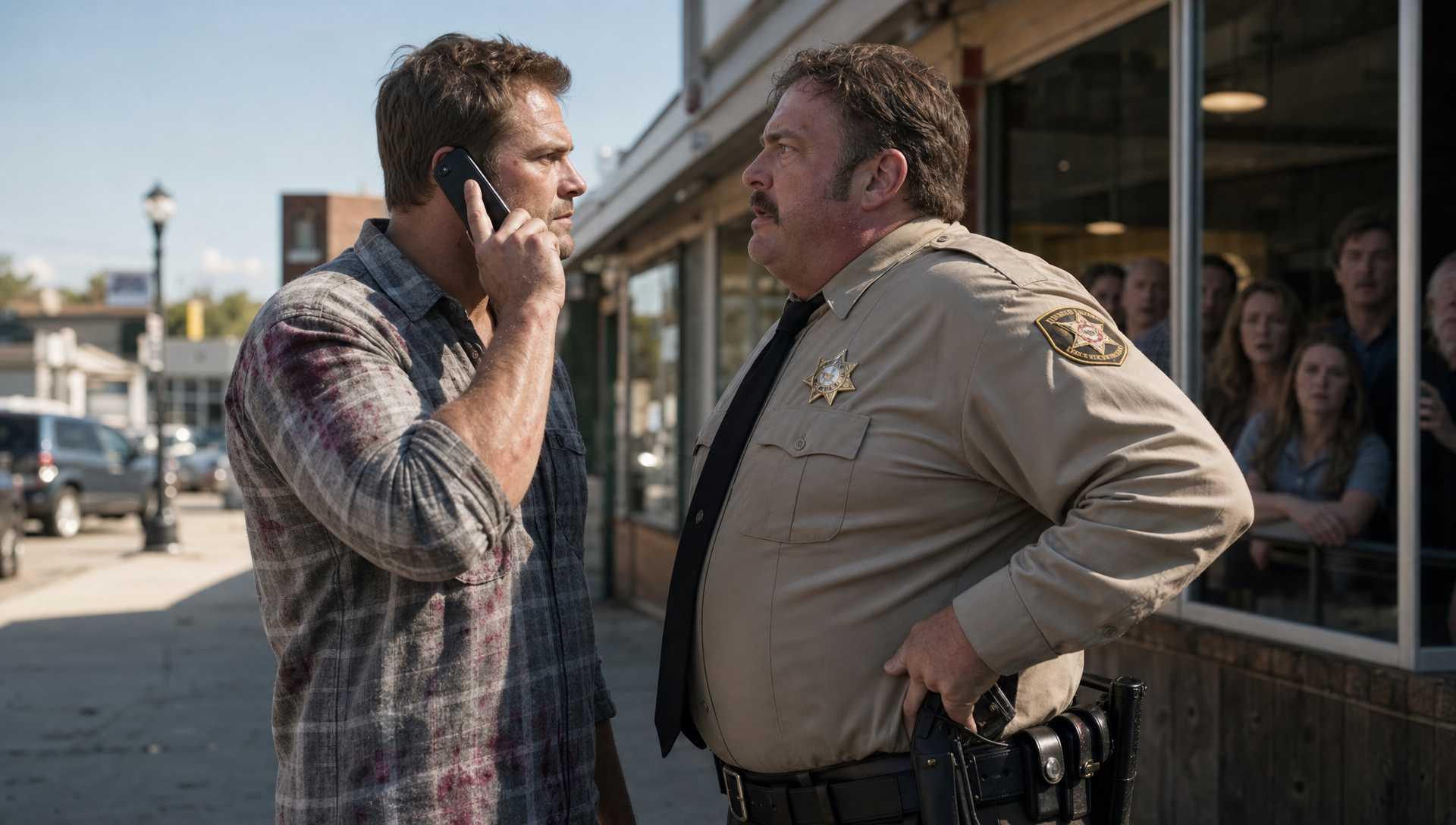
Sheriff Vance stood over my booth with a slow, satisfied smile. His tan uniform was crisp under the lunch lights. His badge caught the glare. He set the empty glass down on the table with a hard, deliberate clatter and leaned in close.
“Look at this trash,” he said, loud enough for the whole room. He pointed one thick finger at my face. “He won’t do a single thing about it.”
Nobody moved. Forks stopped mid-air. A child in a booth by the window started to say something and was silently pulled close by her mother.
Across from me, my wife Amelia sat with her hands folded around a cup of coffee. She looked at my soaked shirt. She looked away. A sharp sigh escaped her lips, and she reached for her handbag.
“You’re embarrassing me,” she said. “Sit there and keep your mouth shut.”
She stood up. Her chair scraped against the floor. She walked toward the cash register without a backward glance.
I watched her go. Then I looked back at Vance.
He was still smiling. He thought I was about to break.
I put both hands flat on the table and stood up slowly.
My full height put me a head above him. Vance took a half-step back before he caught himself. He reset his shoulders and crossed his arms.
“Where do you think you’re going?” he said.
I stepped forward until we were six inches apart. I looked directly into his eyes and held them. No anger. No panic. Just a flat, patient calm that had nothing to do with passivity.
Vance’s jaw tightened. He reached for his handcuff pouch.
“I will lock you up for resisting an officer,” he said. “Say the word.”
I didn’t say a word. I stepped around him — no contact, no rush — and walked to the door. My footsteps were even on the linoleum. Every person in that diner watched me go.
Waitress Nora was standing behind the counter holding a coffee pot. She set it down slowly. She had lived in this town her whole life. She had never once seen someone just walk away from Vance.
The glass door swung open into cool afternoon air. I stepped onto the sidewalk and reached into my pocket.
The phone was matte black titanium. It had no carrier branding, no visible markings. The screen lit up green with a secure display.
Three years ago I had been placed on indefinite undercover assignment by federal order. My cover was simple: local mechanic, new in town, unremarkable. My actual mission was to map a corruption network that had already cost twelve soldiers their lives.
I had not retired. I had relocated.
I tapped the priority override and raised the phone to my ear.
Vance came through the door behind me. His boots hit the concrete hard.
“You think you can ignore my orders?” he barked. “This is my county. I run this town.”
Amelia had followed him out. She stood on the porch steps, arms wrapped around her cream sweater.
“Logan, stop,” she said. “Apologize to him and let’s leave.”
I kept my eyes on the street.
The line picked up on the second ring. A sharp, professional voice answered.
“Judge Advocate General central command. State your clearance.”
“Priority override, Alpha Seven,” I said. “Commander Logan. Connect me to the duty general.”
The operator’s tone changed. “Connecting now, Commander.”
Vance heard it. He slowed down.
He looked at the phone in my hand. At the military seal engraved on the casing. At the small red light pulsing on the top edge — active federal recording in progress.
His hand drifted toward his service weapon.
“Who are you talking to?” he said. The booming confidence in his voice was gone.
“The United States Army JAG,” I said. “Everything you say is on record.”
The line clicked. A new voice came through, low and measured.
“Commander Logan. This is General Miller. We have your GPS coordinates. Report your situation.”
“I am at four-twelve Main Street, Pine Ridge,” I said, looking directly at Vance. “Local sheriff is interfering with active federal audit operations. Badge number four-four-eight-two. Subject has made verbal threats and is currently touching his service weapon.”
Vance’s hand froze on the grip.
“Logged and recorded,” Miller said. “Federal Marshals are en route. ETA under three minutes.”
Vance’s face had gone the color of old concrete.
Amelia stepped off the porch onto the sidewalk. She was watching my face, running calculations.
“Logan,” she said carefully, “you told me you retired years ago.”
“I never retired,” I said. “I was assigned here.”
The blood drained from her face.
The diner door opened again.
Waitress Nora stepped out onto the porch, one hand in her apron pocket. She walked down the steps and held out a folded paper document.
“Commander,” she said quietly. “You need this.”
Vance saw the paper. His eyes went wide.
“Nora, give that back to me right now,” he said. His voice cracked on the last word. “That is private department paperwork.”
Nora looked at him. She had been afraid of him for eleven years. She did not look afraid now.
“It is proof of your extortion ring,” she said. “Every business on Main Street. Cash every month. And you buried the complaints.”
I opened the document. Handwritten ledger columns. Dates, amounts, business names. Vance’s signature at the bottom of every page.
“Commander,” Miller said through the phone, “did you secure physical evidence?”
“Affirmative. Primary accounting ledger. Vance’s signature throughout.”
Vance drew his weapon.
The steel barrel came level with my chest. Amelia screamed and stumbled into the wall behind her. Nora stood her ground.
“Drop the phone,” Vance said. His hands were shaking. “Drop it and give me that ledger or I will shoot.”
I looked down the barrel without moving.
“Firing on an active federal commander is treason,” I said. “Your face and your weapon are live on military servers right now.” I paused one beat. “Pull the trigger and you face a court-martial. Put it down and you face federal prison. Those are your choices.”
The trigger finger trembled.
A high-pitched alarm crackled from Vance’s shoulder radio.
“Emergency federal override in progress, sector four. All local sheriff authority is hereby suspended. Repeat — local authority suspended by order of the Department of Defense.”
Vance’s gun arm dropped two inches. Then four. Then the pistol slipped from his fingers and cracked against the sidewalk.
He raised his hands.
Two black armored SUVs came around the corner hard. They braked in the middle of Main Street, blocking Vance’s cruiser on both sides. Four federal marshals stepped out in tactical gear, weapons trained.
“Federal Marshals! Hands behind your head!”
They hit Vance fast — kicked the gun clear, put him face-down on the cruiser hood, and had cuffs on him before he stopped groaning.
“You have no jurisdiction,” he said. His voice was a whisper.
The lead marshal, Harris, pulled a warrant from his vest. “Your county authority was revoked four minutes ago. You’re under arrest for extortion and interference with a federal investigation.”
Amelia stepped forward from the wall, wiping her eyes. She had switched expressions — the cold wife was gone, replaced by a trembling victim.
“Thank God you’re here,” she said to Harris. “He was threatening both of us. I had nothing to do with any of this.”
I turned to look at her.
“Stop,” I said.
She blinked.
“I pulled your offshore accounts this morning, Amelia. Your signature is on Vance’s transfer files. Two million dollars, wired from your father’s estate last week.”
The performance collapsed. Her face went white.
“You went through my private accounts?” she said. “You had no right—”
“Mrs. Whitmore,” Marshal Harris said, holding up his tablet. “The wire transfer records are federal evidence. Step forward, please.”
Amelia backed up. Her heels clipped on the sidewalk.
“You cannot arrest me. I am a Whitmore. My family owns half the property in this state.”
The female marshal took her wrist. The cuffs clicked.
Amelia began to cry — real this time, or close enough.
“Logan, tell them to stop. You swore to protect me.”
I looked at her for a long moment.
“You stood there while he poured a drink on my head,” I said. “You told me I was embarrassing you. You made your choice.”
They walked her to the second SUV.
Nora came to stand beside me. She let out a long, slow breath.
“Thank you,” she said. “You just freed this town.”
“You freed it,” I said. “You’re the one who walked down those steps.”
Marshal Harris returned and held up his tablet — a scanned intelligence report, red SECRET stamp across the top. My stomach tightened the moment I saw the format.
“Where did this come from?” I asked.
“Vance’s personal wall safe,” Harris said. “Behind a stack of cash.”
I read the summary. An ambush in Europe. Twelve men. A military leak from inside command. This was the file that had gone missing three years ago. The file my unit had died protecting.
Vance hadn’t produced this. He didn’t have the clearance.
Someone had handed it to him.
I looked at the black SUV where Amelia sat behind the tinted glass.
“It wasn’t Vance running this,” I said. “He was the enforcer. The source was someone above him.”
Harris nodded. “We traced the digital signature to a private server in Virginia.” He paused. “The server is registered to an estate belonging to Arthur Whitmore.”
Arthur Whitmore. Amelia’s father. The man who had funded our wedding. The man who gave speeches at veterans’ fundraisers and had his photo taken with senators.
“Call it in,” I said. “Tier One warrant. His estate, now.”
Harris was on the radio before I finished the sentence.
We were moving inside sixty seconds.
I watched the tactical feed on the dashboard screen as our SUV accelerated down the highway. Four helmet cameras, live. The Whitmore estate sat at the end of a private road in the Virginia foothills — stone walls, iron gates, a main house that looked like a small embassy.
Team Four hit the gates with ballistic vehicles. The guards opened fire immediately.
I gripped the handle above the door and watched.
Flashbangs cleared the front hall. Marshals swept room to room — library, study, dining room. Then they reached the basement door: reinforced steel, electronic lock, sealed from inside.
“He’s in the safe room,” the team leader reported. “We need cutting gear to breach.”
I leaned toward the dash mic.
“Check the left wall. There’s an oil painting on a brass hook — pull the frame. Manual override keyhole behind it.” I let that sit for a second. “I spent five Christmases in that house. I know every room.”
Thirty seconds later: “Found it, Commander.”
A shaped charge. A muffled crack. The vault door hissed and swung open.
Arthur Whitmore was standing in the middle of the room in a silk suit, feeding documents into a burning metal trash can. He had known they were coming. He had been burning files for hours.
Marshals tackled him away from the fire. Another marshal hit the flames with a chemical extinguisher.
White foam covered the trash can. Half the papers were saved.
Arthur screamed from the floor.
“You have no idea what you’re destroying. I kept this country’s financial alliances intact for forty years. Those soldiers were a liability—”
The team leader held a partially burned folder up to his helmet camera.
“Commander Logan. We have the evidence. Wire transfer receipts. Fifty million dollars to foreign accounts. Payments for stolen weapons designs.” He paused. “The paper trail is clean. This is prosecution-grade.”
I sat back in the seat and exhaled.
The SUV pulled up outside the federal courthouse in the early afternoon sun.
I got out onto the stone steps in the same gray flannel shirt I’d been wearing since morning. Pink stain dried into the collar. I hadn’t changed it on purpose.
I wanted the cameras to see it.
Reporters pressed against the barriers, shouting over each other.
“Commander Logan! How did you uncover the treason network?”
“Is it true your wife was part of the conspiracy?”
I walked up the steps without stopping.
General Miller was waiting inside the marble lobby in full dress uniform, four stars, ribbons chest to shoulder. He stepped forward and extended his hand.
“Outstanding work, Commander Logan,” he said. “You brought down a national security threat single-handedly.”
I shook his hand and kept my posture straight.
“The men we lost three years ago have justice now, General. That’s the whole of it.”
Through the side corridor, a guard detail was escorting Amelia in orange prison clothing. Her hair was loose. Her makeup was gone. She was watching the lobby, and she saw me standing beside the general. She saw Miller extend his hand. She saw the salute.
Her jaw dropped.
For the first time, she was seeing who she had actually married. Not the quiet man in the flannel shirt. Not the mechanic who embarrassed her in public. The person her father had tried to have eliminated. The person who had spent three years in her town, in her house, waiting.
“Logan,” she whispered through the iron door of the holding area. Her voice broke. “I didn’t know. I swear I didn’t know who you were.”
“You didn’t care who I was,” I said. “You only cared about money and position. And that cost you everything.”
She slid down the wall behind the bars. The guards moved her down the corridor.
I turned back to Miller.
“There’s one more thing, General. Pull up the secondary file on the laptop.”
We moved into a private briefing room. Encrypted laptop, oak table, no windows.
I opened the secondary data recovered from Vance’s desk drawer — a personal audio recorder he’d kept in his shirt pocket. The device had captured his conversation with Amelia that morning, before the diner. Before I arrived.
I pressed play.
Amelia’s voice: “Is everything ready?”
Vance: “Yes. The milk distraction will work. While he’s cleaning up, my men will take the satellite phone. He’ll never know the device was swapped.”
Amelia: “The evidence files are stored on that phone. Once they’re erased, there’s nothing left.”
Miller’s face hardened as the audio played.
“They designed the whole scene,” he said. “The humiliation was a cover to steal your phone.”
“They thought if they broke me in public, I’d retreat to the restroom. That’s when Vance’s men were supposed to make the switch.” I turned off the playback. “They miscalculated who they were dealing with.”
Miller let out a cold, satisfied sound.
“The prosecutor is adding conspiracy to steal federal property. All three of them — Vance, Amelia, Arthur — none of them will see the outside of a federal facility for the rest of their natural lives.”
I closed the laptop.
The town of Pine Ridge was clean. The leak that killed my soldiers was plugged. The people responsible were in custody.
I walked out of the courthouse into the afternoon sun and stood at the top of the stone steps.
I pulled the flannel shirt off over my head. Folded it once. Set it on the stone railing.
Underneath, a plain white military undershirt. I adjusted my posture and looked out at the street.
Then my phone buzzed.
A secure video feed, incoming from European intelligence. Night-vision footage, grainy, time-stamped three years ago — the exact night of the ambush.
A figure in a black coat handing a metal drive to an unknown contact near the bunker perimeter. The camera zoomed. The figure’s sleeve rode up at the wrist.
A tattoo. Silver ink. A trident with two sevens inside.
I stopped breathing for a second.
That tattoo belonged to a classified special operations unit. Twelve members, original roster. Nine killed in action. One missing, presumed dead. One retired with full honors.
And one standing on these courthouse steps right now.
A text scrolled across the bottom of the screen.
Target identified. Heading toward your location. Virginia woods.
I raised my head slowly and looked across the street.
A black sedan sat in the shadow of a large oak tree, engine running. The driver’s window came down two inches.
A hand rested on the door frame.
Silver trident on the wrist.
My brother Ethan had been dead for two years.
I stared at that hand for a long time.
Then I walked down the steps toward the car.
Original fictional stories. AI-assisted creative content.