Nora kept her eyes down. Five years of practice — quiet steps, empty smiles, invisible hands.
She had gotten good at disappearing.
The ballroom was full of people who owned things. Buildings. Companies. Other people’s futures. She moved between them like smoke, refilling glasses, collecting plates, pretending she wasn’t there.
Chloe was supposed to be in the kitchen.
“Let me play it.”
The voice was small and clear, and it cut straight through the noise.
Nora’s tray rattled. She turned.
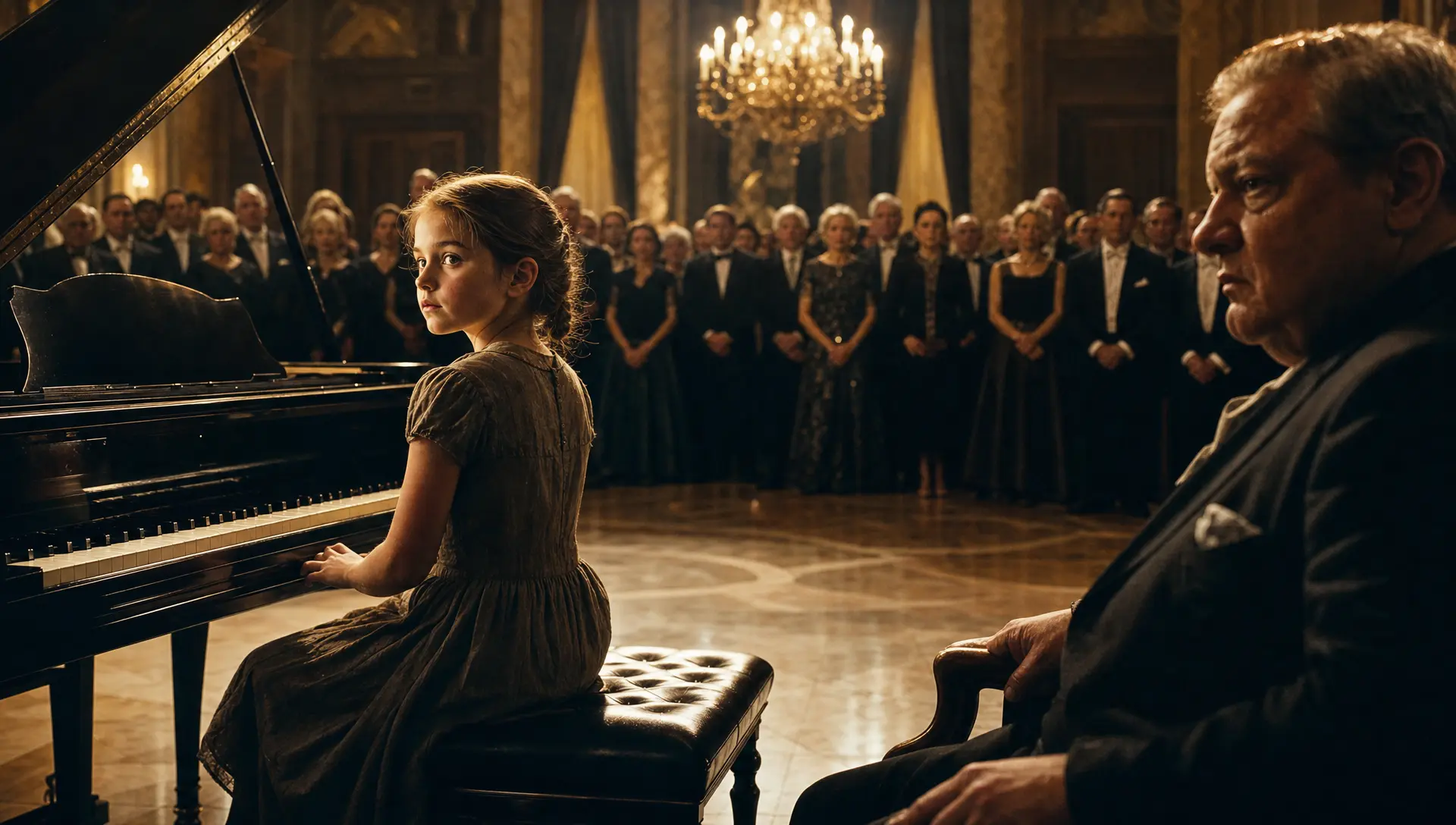
Her nine-year-old daughter stood ten feet from Victor Blackwood, chin up, hands folded in front of her faded cotton dress. Every face in the room had turned toward her. Most were smiling the way people smile at something they find amusing before they dismiss it.
“Chloe.” Nora crossed the floor fast, hissing through a forced smile. “I’m so sorry, Mr. Blackwood. She wandered in — I’ll take her right out—”
“Let her speak.” Victor raised one heavy gold-ringed hand. His expression had shifted from bored to curious. That was worse, somehow.
Nora froze.
“I can play,” Chloe said again, steadier this time.
Victor tilted his head toward the grand piano on the stage. Gleaming black lacquer. A Steinway concert grand, tuned that morning, untouched all evening. “That instrument? Do you even know what that is, sweetheart?”
“It’s a Model D. Concert grand. Nine feet. You use it for display, not for playing. The bench height’s set wrong.”
A beat of silence.
Then Victor smiled — the slow, calculating kind. “Alright.” He turned to his assistant. “Marcus.”
Marcus moved quickly, producing a folder from a briefcase. Victor pulled out a single sheet of music and held it up.
“This is an original composition. Unpublished. Considered technically unplayable by most concert pianists alive today.” He looked at Chloe. “If you play it — perfectly — I’ll write you a check for one hundred million dollars.”
Gasps. Laughter. Someone said, “You’re serious?” Someone else said, “This is cruel.” A third voice said, “Let her try. It’ll be quick.”
Chloe didn’t look at any of them.
“I don’t need to see the sheet music,” she said.
Victor’s smile held, but something moved behind his eyes. “Oh?”
“I already know it.” She looked directly at him. “My father wrote it.”
The laughter stopped.
Nora felt the blood drain from her face.
Victor’s hand lowered slowly. “Your father.”
“Elias Cole,” Chloe said. “He was your composer. Your business partner. Until you decided you didn’t need him anymore.”
“Chloe.” Nora’s voice came out broken. “Please—”
“Mom.” Chloe turned to her, and her expression was calm, almost gentle. “I know what I’m doing. I’ve been waiting for this for two years.”
She walked toward the stage.
The room was completely silent as Chloe climbed onto the bench, adjusted its height with two quick turns of the knob — the right way — and settled her hands over the keys.
She didn’t look at the sheet music. She didn’t look at Victor.
She closed her eyes.
Then she played.
The first phrase was a single, suspended line — quiet, almost questioning. A few people exhaled. Someone started to whisper. Then the second phrase came in underneath the first and the whisper died.
By the third minute, no one in the room was moving.
Her fingers didn’t rush. They didn’t stumble. They moved through the piece with the kind of precision that doesn’t come from practice — it comes from living inside something, from understanding it bone-deep. Every dynamic shift landed exactly where it should. Every silence was measured and deliberate.
Victor sat with his drink untouched.
The final chord rang out and dissolved.
Nothing.
Then the applause hit — sudden and full and almost desperate, like the room needed to do something with the feeling that had built up inside it.
Chloe stood. She turned to face Victor.
“You said one hundred million dollars.”
He looked at her for a long moment. “I did.”
“I don’t want it.”
The applause died.
“Then what do you want?” Victor asked quietly.
Chloe reached into the pocket of her dress and pulled out a folded document. She held it up.
“I want you to explain this. In front of all these people.” Her voice carried easily across the silent room. “It’s the fraud complaint my father filed against you in 2019. The one that disappeared three days later. Right before he disappeared.”
Victor stood up from his chair.
“Nora.” His voice was flat and cold. “Get your daughter and go.”
“She’s not going anywhere.” The words came out of Nora’s mouth before she’d decided to say them. Her hands were shaking. Her heart was hammering. But she stepped forward. “Five years, Victor. Five years of silence. You said if I stayed quiet, we’d be safe. You said if I kept the money and kept my mouth shut, nothing would happen to us.”
“Nora—”
“He didn’t abandon us.” Her voice cracked. “You forced him out. Your security team came to our apartment. They told Elias if he ever contacted us, if he ever testified, if he ever went public — they’d make sure neither of us lived through it.” Tears were streaming freely now. “He left to protect us. And you used that against me for five years.”
The back of the room was erupting. Phones out. Journalists typing. Victor’s assistant was on a cell phone, face tight, moving toward the exit.
Victor took one step toward Nora. “You have no idea what you’re doing—”
“There are seventeen copies of that document,” Chloe said. “I sent them this morning. To the DA’s office, three financial journalists, and the SEC. The email went out at 6 AM.” She paused. “I learned that part from you, actually. From the way you always send things before the other person is awake.”
Victor’s face had gone the color of ash.
“Marcus,” he said, turning — but Marcus wasn’t there anymore.
The double doors at the back of the ballroom opened.
Four officers in plainclothes moved in from the east entrance. Two more came through a service corridor. They weren’t looking at Nora. They weren’t looking at Chloe.
“Victor Blackwood.” The lead officer’s voice was calm and unhurried. “We have a warrant for your arrest on charges of securities fraud, conspiracy, and witness intimidation. Please come with us.”
Victor turned a full circle — looking for an exit, for Marcus, for anyone.
“I’ll have you disbarred,” he said to no one in particular. “I’ll have every one of you—”
“Sir.” The officer stepped forward. “Now.”
As they led Victor Blackwood out through the east doors in handcuffs, the room stood in perfect stillness. Not the polite stillness of an audience. The stunned stillness of people recalculating everything.
Nora sank into a chair. Her legs had stopped working.
Chloe walked back across the stage and sat down beside her. She took her mother’s hand. Neither of them spoke for a moment.
“How long have you been planning that?” Nora finally whispered.
“Since I was seven,” Chloe said. “When I found Dad’s notebook under the floorboard. The one with the composition in it. And the letter he left for me.”
Nora closed her eyes.
“He’s not dead,” Chloe said quietly. “I know you thought he was. But he’s not.”
Nora opened her eyes and looked at her daughter.
Before she could speak, someone stepped out from behind the piano.
He was taller than she remembered. Older. There was a scar along his jaw she’d never seen before. He moved slowly, carefully, like someone who had learned to be very deliberate about every action.
But she would have recognized him in any crowd.
“Elias.”
The word came out barely above a breath.
He stopped at the edge of the stage, ten feet away. His eyes were red.
“I watched through the monitors,” he said. His voice was rougher than she remembered. “The whole thing. I’ve been in the building since nine o’clock.”
Nora stood up. She didn’t know if she was going to walk toward him or run or collapse.
“You were here,” she said. “This whole time. Tonight—”
“And for two years before that.” He didn’t look away from her. “Rebuilding the case. Finding witnesses. Waiting until there was something that would stick. Something they couldn’t bury.” He glanced at Chloe. “I didn’t know she’d found the notebook. I didn’t know she was doing any of this until three days ago.”
Chloe had stayed seated. She was watching her father with an expression that wasn’t warm.
Elias took a step toward her.
She didn’t move.
“Chloe.” His voice broke slightly. “I know what I cost you. Both of you. I’m not — I’m not going to pretend it was the only way. Maybe it wasn’t. But I needed you to be safe while I—”
“You had a choice,” Chloe said. “Every day for five years, you had a choice.”
Elias stopped.
“You could have found a way to tell Mom you were alive. Even once. Even one message.” Her voice was steady. “She thought she’d lost you. She worked in that man’s house for five years thinking she’d lost you. And you let her.” She looked down at her hands. “I understand why you built the case. I’m glad you did. But that wasn’t why you stayed hidden.”
“Chloe—”
“You stayed for the music.” She looked up. “The composition. The rights. The proof that it was yours. You needed to win it back completely, not just get out.” Her voice wasn’t angry. It was just certain. “And that mattered more than telling Mom you were alive.”
Elias didn’t answer.
Because it was true, and they all knew it.
Nora looked at him — this man she’d spent five years grieving, standing fifteen feet away from her, older and scarred and present. She felt grief and relief and something else she didn’t have a name for.
“I need time,” she said finally. “I can’t do this tonight.”
He nodded. “I know.”
“You can call me,” she said. “When the legal process starts. We’ll need to talk.” A pause. “But not tonight.”
Elias looked at Chloe one more time.
Chloe had already turned away.
He walked back into the shadows behind the stage and didn’t come back out.
The journalists had their story. Victor Blackwood’s stock collapsed before the market opened the next morning. Three of his board members resigned by noon. The fraud case that had “disappeared” in 2019 was reinstated with full federal backing.
The composition — all forty-seven pages of it, in Elias Cole’s unmistakable hand — was authenticated and registered under his name within sixty days.
Chloe never performed it again.
She didn’t need to.
She’d already played it once, for the right audience, at exactly the right moment.
And everyone in that room knew what they’d heard.
Original fictional stories. AI-assisted creative content.