The Georgia heat was brutal at 2 PM, but nothing compared to the rage boiling inside me when I saw that mutt destroying my foundation again.
“That’s it,” I muttered, stomping toward the scruffy golden mix. He was digging frantically next to the master bedroom wall, red clay flying everywhere.
“Get out of here!” I roared.
The dog whined but didn’t run. He stood his ground over the hole, cowering but defiant.
I drew my leg back to kick him. I’m not violent, but divorce, my silent son, this heat—it all boiled over.
The dog squeezed his eyes shut.
I swung.
But something caught the sunlight. A flash. A glint.
I stumbled, barely stopping myself. The dog tapped the hole with his paw.
I looked down.
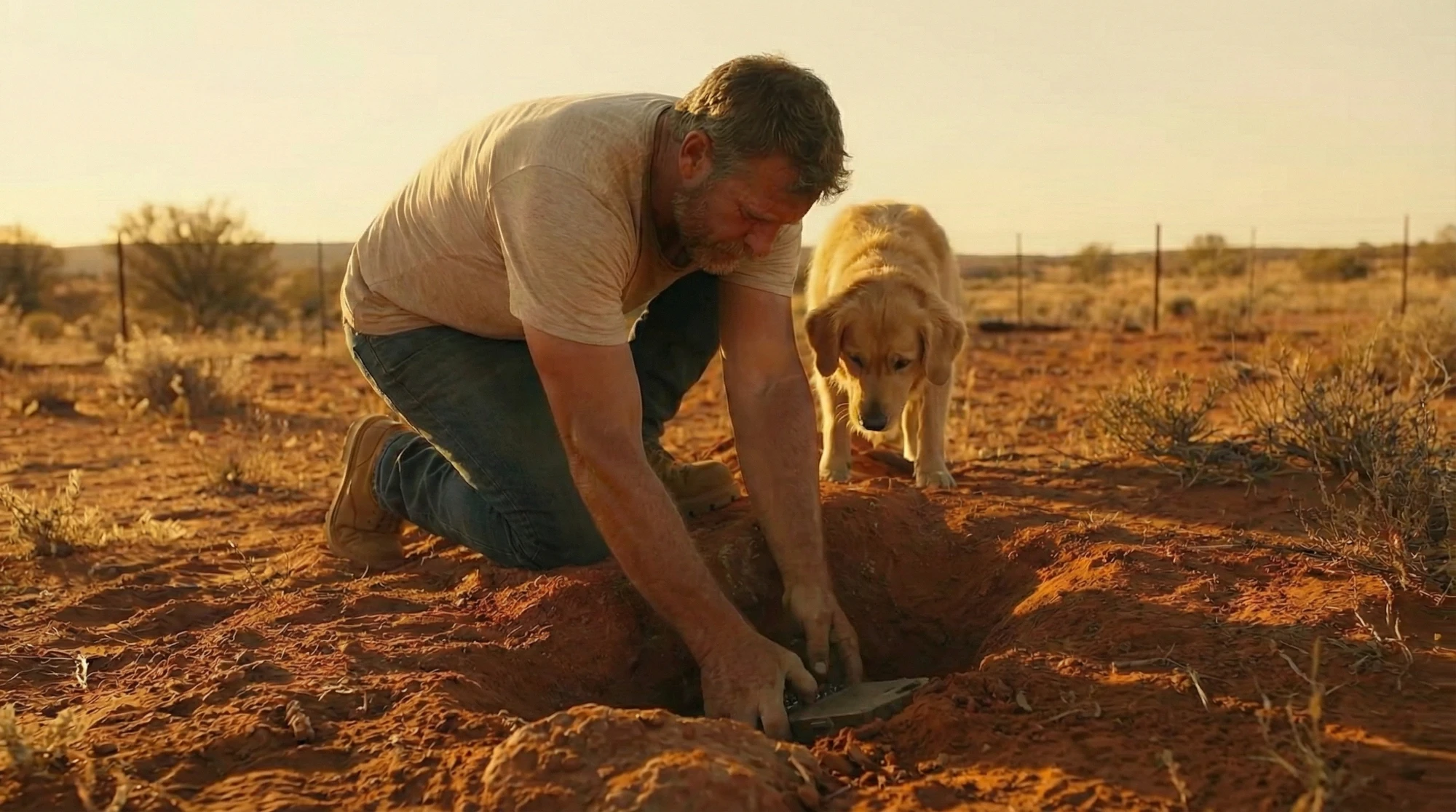
Buried a foot deep was a rusted Star Wars lunchbox. And sitting on top—a gold chain.
My father’s locket. The one he swore he’d lost in a poker game in 1995.
“What the hell?” I whispered, dropping to my knees.
Inside the locket was a water-damaged photo. My father and me, standing by a blue Ford truck.
But Dad died ten years ago in Seattle. He’d never been to Georgia. He hated the South.
So why was this buried under my new house, two thousand miles from home?
I pulled out a plastic-wrapped letter from the lunchbox.
“My Dearest Martha…”
My mother’s name was Susan.
I read it three times. July 14, 1995. My father’s handwriting. He was leaving his mistress to protect me—his fifteen-year-old son.
“I’m choosing the lie. I’m burying this where we said the front porch would be. The deed is in your name. Please forgive me.”
Under the letter? A .38 Special. Rusted but loaded. And an engagement ring that must have cost six months’ salary.
I looked at the dog. “You knew this was here.”
He thumped his tail once.
“Get in the truck,” I said.
At Earl’s Hardware, I asked about the property’s history.
Earl’s hand stopped counting nails. He dropped one. It clinked loudly.
“Why do you ask?” His voice dropped an octave.
“I found a box. With a letter to Martha.”
Earl sighed. “Folks don’t talk about the Holloway place. Martha was a sweet girl. Waitressed at the diner. Summer of ’95, she met a big-shot architect. Said he’d build her a castle in the woods.”
“And then?”
“She vanished. July. Car in the driveway, purse inside. No note. Just gone.”
My stomach dropped. “They find a body?”
“Nope. Just silence. Thirty years’ worth.” Earl leaned closer. “If you found something of Martha’s, talk to her sister. Janice. Runs the florist next to the post office.”
At the flower shop, I showed Janice the locket.
She gasped. “That was our mother’s. Martha wore it every day.” She opened it, saw the photo. “He put this inside?”
“He buried it. Under the foundation.”
Janice’s eyes widened. “If he left, why is this here? Martha would never bury this.”
She rushed to the window, staring at my dog.
“Martha had a golden retriever. Barnaby. Went missing the same day. Look at your dog’s ear. The torn left one.”
I looked. Jagged tear, healed ugly.
“Barnaby had the same tear. Caught it on a fence.”
“It’s a coincidence,” I said. “That dog’s only three or four.”
“Maybe,” Janice whispered. “Or maybe blood remembers.”
She turned back. “You need to know something. Martha was pregnant when she disappeared.”
The world stopped.
“With his child. Your… sibling.”
I stumbled out, hands shaking.
Back at the property, the dog stared into the woods. He let out a low growl.
“What is it?” I grabbed my flashlight.
He walked into the trees. I followed.
Ten minutes later, we reached a clearing choked with kudzu.
Under the vines sat a rusted blue Ford. Georgia plates. 1995.
I shone my light inside.
On the passenger seat: a baby rattle.
Under the truck: bones.
I called 911.
Sheriff Brody arrived with crime scene techs. He was built like a vending machine, all granite and suspicion.
“A stray dog led you straight to a thirty-year-old murder?” he asked flatly.
“I was fifteen in Seattle when this happened,” I snapped.
Brody held up an evidence bag. “We ran the serial on this .38. Registered to Robert Jackson Miller. Your father. Purchased June 1995.”
My throat tightened. “And?”
“Two rounds fired. Four live.” He gestured to the tent over the bones. “Skull shows gunshot trauma.”
“Sheriff!” A deputy waved. “Found something.”
They’d pried open the glove box. Inside was a planner.
Brody flipped to July 14th. “Meeting with R.M. – The Ridge. 2:00 PM.”
Robert Miller.
In the margin, scrawled in shaky handwriting: “He knows. He’s coming to take it.”
“Who knows?” I asked.
Brody pulled out another bag. A silver baby rattle. Engraved: J.M.
“Jackson Miller?” he asked.
“I was fifteen. Why would she have my initials?”
“Maybe for the baby she was carrying. Named after his father. Or his brother.”
“The bones,” I choked. “Was the baby…?”
Brody’s face softened. “No fetal remains. The pelvic bone shows she’d given birth. Hours, maybe days before she died.”
“She had the baby?”
“Someone took that child thirty years ago, Jackson. Shot Martha, dumped the truck, and walked away with a newborn.”
At the Oakhaven Motel at 3 AM, I pried the photo from the locket.
On the back: “Atlanta Clinic – June 20th” and a phone number.
I dialed.
“Hello?” An elderly woman, irritated.
“I found this number on a photo belonging to Robert Miller.”
Sharp intake of breath. “Robert is dead.”
“I’m his son. Jackson.”
“Jackson,” she whispered. “You have his voice. I’m Eleanor. I was a nurse in ’95. At the clinic where Martha gave birth.”
“Where’s the baby?”
“Robert took him. Martha was terrified of Her.”
“Her?”
“Your mother. Susan.”
The room spun. “My mother was a schoolteacher.”
“She came from old money. She found out in May. Threatened to destroy Robert’s career. Told him if that bastard child went public, she’d burn his life down.”
“So Dad took the baby?”
“He paid me to falsify records. Said the baby was stillborn. He took the boy to hide him.”
“Where?”
“I don’t know. He said he’d come back for Martha when it was safe.”
“She was murdered, Eleanor.”
“I know. Robert was a coward, but not a killer. Your mother, though…” She paused. “Rich women have ways. A woman scorned is capable of anything.”
The line went dead.
The dog whined at the door. I opened it.
At the far end of the lot, a black sedan idled. Tinted windows.
The headlights flashed. Blinding.
Then it accelerated. Straight at me.
“Hey!” I grabbed the dog and threw us backward.
CRASH.
The car slammed into the wall, inches from my door. Then it reversed and peeled out.
On the ground sat a white envelope.
Inside: a polaroid of a baby in a blue blanket.
Holding the baby was Earl. The hardware store owner. Younger, smiling.
On the back, red marker: “LET SLEEPING DOGS LIE.”
“We’re not leaving,” I told the dog. “We’re finishing this.”
I drove to Earl’s house. He met me at the door with a shotgun.
“I figured you’d come,” Earl said, lowering it. “Coffee’s on.”
In his kitchen, I slammed the photo down. “Tell me about my brother.”
Earl’s hands shook. “Your daddy was a good man. Weak, but good.”
“He left her to die.”
“No. He left her to save the boy.” Earl leaned forward. “June 20th. Your mother called Robert. Said she’d hired people. People who solve problems.”
“My mother was a teacher.”
“She was old Seattle money. She told Robert: disappear the bastard child or she would. And she wouldn’t be gentle.”
“So Dad gave you the baby?”
“Fifty thousand cash. He said, ‘Hide him. Raise him. If Susan finds out, she’ll kill him.'”
“And Martha?”
“He was supposed to meet her July 14th. They were going to run. But she never made it. He waited two days, then buried the box and went home.”
“Who drove the car tonight?”
Earl’s face went pale. “The Sheriff. Brody.”
“He’s investigating the case.”
“He was a deputy in ’95. Took the missing persons report. Told everyone she ran off.” Earl grabbed my arm. “Who had power to make a truck disappear? Who could intercept a woman on a back road?”
“You think my mother hired Brody?”
“Where’s the boy, Earl?”
Tears spilled. “He’s closer than you think.”
The kitchen window shattered.
CRACK.
Earl jerked back, blood blooming on his shoulder.
“Get down!” I flipped the table.
Another shot thudded into the refrigerator.
“It’s Brody,” Earl gasped. “He knows I know.”
“Where’s the boy?”
“It’s Clay. Deputy Clay.”
The young deputy. The one with the familiar eyes.
“Clay is your son?”
“I raised him. Told him his parents died in a wreck. He became a cop to find them.”
I looked at the dog. He was low, lips pulled back, growling.
“Back door. Go.”
The dog bolted.
I ran out the side door.
Sheriff Brody was spinning, trying to shake seventy pounds of furious dog off his arm. The dog had his rifle arm clamped in his jaws.
“Get off me!”
I rushed him. Swung the tire iron into his ribs.
CRUNCH.
He dropped the rifle. The dog went for his leg.
I stood over him. “Why? For money?”
Brody laughed. “Your mother paid well. Better than the county. She wanted the problem gone.”
“So you killed a pregnant woman?”
“She wasn’t pregnant anymore. I was supposed to take the baby too. She wouldn’t tell me where it was. She died protecting that brat.”
Blue lights flashed. Sirens.
Deputy Clay jumped out, gun drawn. “Drop the weapon! Step away from the Sheriff!”
“Clay!” Brody yelled. “Shoot him! He shot Earl!”
I dropped the tire iron, hands up. “Check inside, Clay. Earl’s shot. Brody shot him.”
“Liar!” Brody screamed.
The dog trotted to Clay. Sat. Whined softly.
“Check the rifle, Clay,” I said calmly. “And ask yourself why Earl has a picture of you as a baby in his safe.”
Clay’s gun lowered. “What?”
“Go check on your father, Clay. Earl needs you.”
Clay stared at Brody. At the sniper rifle. At the desperation in his boss’s eyes.
“Don’t move,” he told Brody.
He holstered his gun and ran inside.
Six months later, I sat on my finished porch throwing a tennis ball.
“Go get it, Scout!”
The dog—renamed Scout, golden coat shiny and healthy—scrambled after it.
A truck pulled up. Deputy Clay, out of uniform in jeans and flannel.
“Hey. How’s Earl?”
“Good. Shoulder’s stiff in the rain, but he’s back at the store. Telling me stories about ’95.”
Clay sat beside me. We didn’t look alike—he had Martha’s dark features, I had Dad’s sharp angles.
“Brody took a plea deal. Life without parole. Gave up the wire transfers from your mother’s estate. It’s over.”
“Yeah. It’s over.”
Clay pulled out the locket. “Earl gave me this. Said it belongs to the family.”
I pushed his hand back. “He left that for Martha. For you. You keep it.”
Clay closed his fingers around it. “Thanks… brother.”
Scout barked, nudging Clay with the ball. Clay laughed and threw it.
We watched the dog run—fast, free, chasing wind.
I thought about Dad. His mistakes. His cowardice. But also his love. He left Martha because he loved his son more. He sacrificed his happiness to keep Clay alive.
And Mom… the woman who raised me was a monster in disguise. But we aren’t our parents. We’re the choices we make when the dirt is cleared.
“You know,” I said. “I was thinking of building a guest house out back. Could use a second pair of hands.”
Clay smiled. “I’m pretty good with a hammer.”
“Good. Welcome home.”
Scout dropped the ball at our feet, looked up with wise amber eyes, and thumped his tail.
The ghosts were resting. The living were found.
And for the first time in a long time, the house was quiet—not the silence of emptiness, but the silence of peace.
Original fictional stories. AI-assisted creative content.