Rain hammered the windows of Rosie’s Diner like it was trying to get in.
Inside, the place smelled like burnt coffee and bacon grease. Neon buzzed pink against the checkered floor. A jukebox in the corner hadn’t worked since Clinton was president, but nobody had the heart to move it.
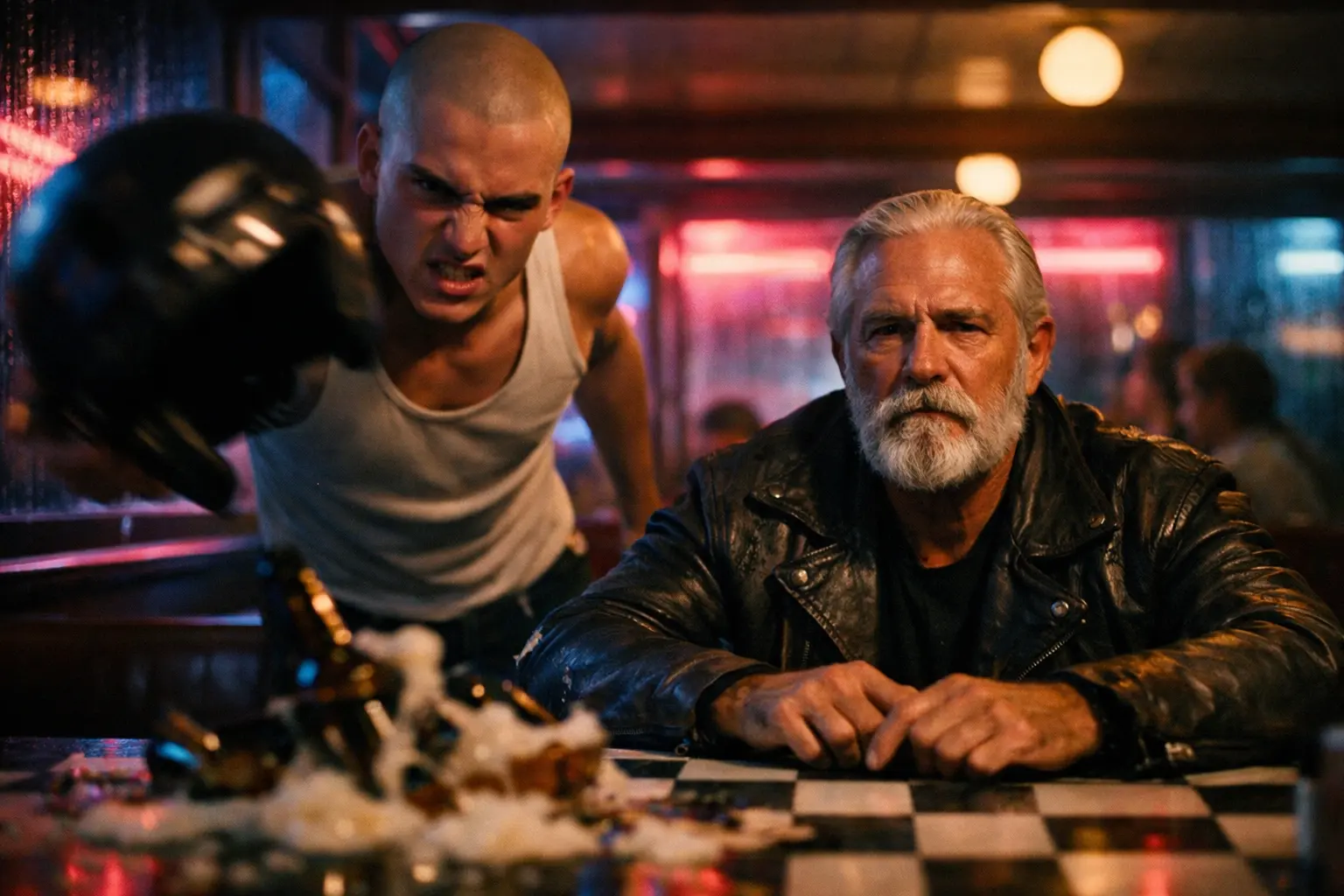
At the counter stool by the window sat an old biker. Sixty, maybe older. Silver beard down to his chest. Leather jacket cracked at the elbows, patches faded from a hundred highways. His black helmet rested on the table next to a half-empty beer.
He didn’t look at anyone. He watched the rain.
Four young men loitered near the register. White tank tops, jeans hanging low, eagle and lightning-bolt tattoos crawling up their necks. Local trouble. Everyone in town knew to cross the street when they saw the group coming.
Their leader was eighteen, shaved head, a scar through one eyebrow. He clocked the helmet on the old man’s table and grinned at his friends.
“Watch this.”
He walked over, snatched the helmet off the table, and knocked the beer bottle to the floor. Glass shattered. Foam spread across the tile like a wound.
The old man didn’t move.
“Old timer lost his toy,” the kid said, tossing the helmet to one of his friends, who caught it laughing.
The waitress behind the counter froze mid-wipe. The cook glanced up through the pass window and said nothing — smart man.
The kid leaned in close to the biker’s face. “What you gonna do about it, huh? Old man?”
Silence.
Then the biker lifted his eyes. Calm. Steady. Like he’d been waiting for this exact moment his whole life.
“What was your mother’s name?” he asked.
The kid blinked. “What?”
“Your mother,” the biker said, quiet as a confession. “What was her name?”
“The hell kind of question is that?” The kid’s fists clenched. His friends went still behind him, sensing something had shifted in the air, though none of them could say what.
The biker tilted his head. “Esther?”
The word landed like a slap.
The kid’s face drained of color. His jaw went slack. The helmet slipped from his friend’s hands and clattered against the floor tile, forgotten.
“How do you—” His voice cracked in half.
“Sit down,” the biker said. “Please.”
“Who the hell are you?”
“Sit down, Danny.”
Nobody had said that name to him in six years.
Danny’s knees found the stool across from the old man without his permission. His friends stood frozen by the register, tattoos and bravado suddenly meaningless in the face of something none of them understood.
“You don’t know my name,” Danny whispered. “Nobody here knows that name.”
“I do. Your mother gave it to me. Along with three years, forty thousand miles, and every dollar in her savings account.”
“What are you talking about?”
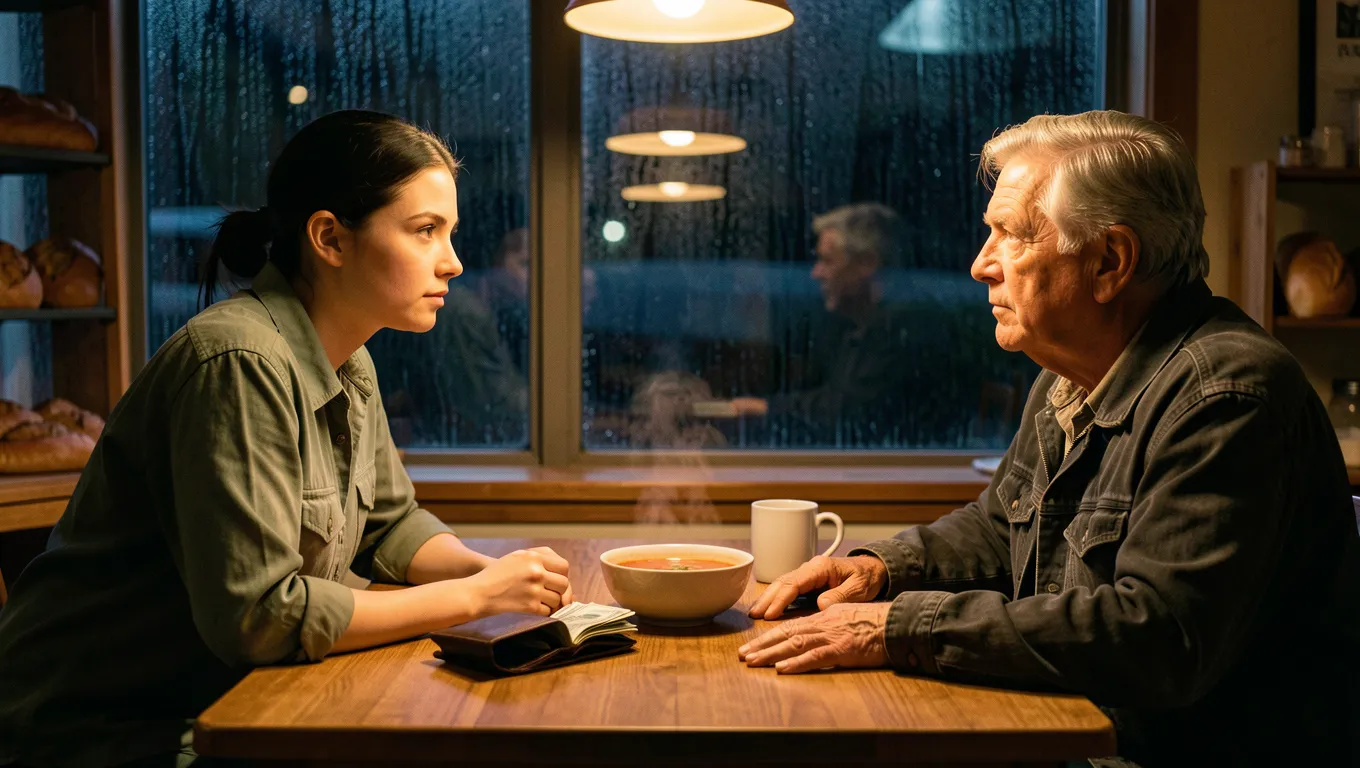
The biker reached into his jacket — slow, deliberate, so nobody would mistake the motion for a threat — and set a worn photograph on the table. A woman, maybe fifty-five, gray threading through dark hair, standing on a porch that Danny hadn’t seen since he was twelve.
His hands started shaking.
“I’m a private investigator,” the biker said. “Name’s Walt Cutter. Your mother hired me four years ago to find you. You’d already been gone two years by then. She’d tried everything — police, shelters, hospitals. Nobody could find a trace of you.”
“I didn’t want to be found.”
“I know.”
“Then why are you here?” Danny’s voice rose, cracking between anger and something rawer underneath. “Why now?”
Walt’s eyes didn’t waver. “Because six months ago your mother was diagnosed with stage three ovarian cancer.”
The diner went dead silent. Even the rain seemed to pause.
Danny stared at him. “You’re lying.”
“I wish I was.”
“She’s — she’s fine. She has to be fine.” His voice broke completely on the last word.
“She’s fighting,” Walt said. “Hard. But the doctors gave her eighteen months, maybe less, if the treatment doesn’t take. And the only thing she asked me — the only thing, Danny, in four years of paying me to search — was to bring you home before she runs out of time.”
One of Danny’s friends, a lanky kid with a fresh eagle tattoo on his forearm, took a step closer. “Danny, man, is this real?”
“Shut up, Marcus.” Danny didn’t look at him. His eyes were locked on the photograph. On his mother’s face, older than he remembered, tired in a way that had nothing to do with age.
“Where’d you find this picture?” Danny asked.
“Her nightstand. She keeps it next to a stack of letters she wrote you every year on your birthday. Never had an address to send them to.”
“Stop.” Danny pressed his palms against his eyes. “Just — stop.”
“I’ve been in this town three days,” Walt said. “Followed a lead from a mechanic in Tulsa who remembered fixing a bike with your description on it. Then a bartender in Springfield. Then a parole officer who wouldn’t give me your name but confirmed I had the right city. This morning I walked into a gas station and the clerk told me about four guys who terrorize this diner every Tuesday afternoon.”
“We don’t terrorize—”
“You knocked an old man’s beer off his table thirty seconds ago because you thought I couldn’t fight back.”
Danny had no answer for that.
Walt leaned forward, and for the first time his voice lost its detective-calm and turned into something almost fatherly. “Son, I’ve found a lot of people in this line of work. Runaways, deadbeats, people hiding from debts or exes or themselves. Most of them don’t want saving. But your mother — she never once asked me to bring you home for her sake. Every time we talked, she said the same thing: I just want him to know I never stopped loving him, even when he made mistakes.“
Danny’s shoulders started shaking.
Marcus put a hand on his back. “Dude—”
“I said shut up.” But there was no venom left in it. Just a boy trying to hold himself together in front of people who’d only ever known him as untouchable.
The waitress quietly set down two cups of coffee, one in front of each man, and retreated without a word.
“I left because I hated her,” Danny said finally, voice hoarse. “My dad walked out when I was ten. She worked two jobs, and I blamed her for never being there, and I was a stupid, angry kid who thought running was the same thing as being strong.”
“You were fifteen,” Walt said. “Kids that age aren’t supposed to know the difference.”
“I’m eighteen now. I run this—” he gestured vaguely at his friends, at the diner, at the life he’d built out of nothing “—whatever this is. I thought if I couldn’t go back, I’d just become someone she wouldn’t recognize. Someone who didn’t need her.”
“You still need her,” Walt said. “Every kid does. Doesn’t matter how old you get.”
Danny looked down at the helmet, still sitting where it had clattered to the floor, and something in his chest cracked wide open.
He picked it up.
There was a small strip of duct tape on the inside, peeling at the corner — his mother had put it there years ago to cover a crack, back when this had been his father’s helmet, back when the family had still been whole.
“She kept a helmet like this?” he asked, voice barely above a whisper.
“No,” Walt said. “That one’s yours. She asked me to bring it. Said you left it in the garage the night you ran, and she couldn’t bring herself to throw it out. Kept it by the door for six years, in case you ever came back for it yourself.”
Danny’s face broke.
Not the practiced sneer he wore for his friends, not the bravado he used like armor — his real face, the one belonging to a scared boy who’d spent six years pretending not to miss home.
“I don’t know how to go back,” he said.
“You don’t have to know how,” Walt said gently. “You just have to get in the truck.”
Outside, the rain had softened to a drizzle. A thin seam of gold light broke through the clouds over the parking lot, catching the wet asphalt in long streaks.
Danny stood, and for a moment his friends didn’t recognize him — not the leader who’d ruled their corner of town for two years, but someone smaller, younger, more human than any of them had ever seen.
“What about us?” Marcus asked, and it wasn’t a threat. It sounded almost like fear — fear of losing the only structure he’d known.
Danny turned to them. “You’re not my problem to fix, man. But you can stop pretending this—” he gestured at the tattoos, the swagger, the small cruelties they inflicted on strangers to feel powerful “—is who you actually are. I did it for two years. It’s not.”
He tucked the helmet under his arm.
Walt rose from his stool, dropped a twenty on the counter for the broken bottle and the coffee, and nodded to the waitress. “Sorry for the mess.”
“Sweetheart,” she said, eyes glassy, “that’s the best mess I’ve seen in this diner in twenty years.”
Danny and Walt walked to the door together. Behind them, the three remaining thugs stood in stunned silence, their leader’s absence already changing the shape of the room.
“You never know who’s walking through that door,” the waitress murmured to the cook, wiping her eyes with the corner of her apron.
Outside, Walt’s old pickup truck sat under a flickering streetlamp, engine idling, rain sliding down the windshield in easing sheets. Danny climbed in, helmet on his lap, hands still trembling.
“She’s really sick?” he asked as Walt pulled onto the road.
“She’s really sick,” Walt said. “But she’s tougher than the diagnosis. And she’s been waiting six years for this exact drive to happen.”
Danny stared out the window at the town sliding past — the pawn shop, the laundromat, the diner shrinking in the side mirror — and felt something loosen in his chest that had been clenched since he was fifteen years old.
“What if she doesn’t forgive me?”
Walt didn’t answer right away. He drove another mile before he spoke, and when he did, his voice was steady with the certainty of a man who had watched this exact scene rebuild broken people for thirty years.
“Son, she forgave you the day you left. She’s just been waiting for you to forgive yourself.”
Three hours later, the truck pulled into a driveway Danny hadn’t seen in six years. The porch light was on. A woman stood in the doorway, illuminated in yellow against the dark, one hand pressed to her mouth.
Danny got out of the truck slowly, helmet clutched to his chest like a shield he no longer needed.
“Mom,” he said, and his voice broke on the single syllable.
Esther crossed the porch steps faster than a woman fighting cancer should have been able to move, and pulled her son into her arms before either of them could say another word. She was thinner than the photograph. Frailer. But her grip was fierce, unwilling to let go.
“You came back,” she sobbed into his shoulder. “You came back.”
“I’m sorry,” Danny said, over and over, the words finally finding their way out after six years of silence. “I’m so sorry, Mom. I’m sorry.”
“Shh.” She pulled back just enough to hold his face in both hands, studying every line of it like she was memorizing a miracle. “You’re here. That’s all that matters. You’re here.”
Behind them, Walt leaned against the truck, watching the reunion with the quiet satisfaction of a man who’d just closed his final case — not with a badge, not with a gun, but with a name whispered across a diner counter and a mother’s unbroken love.
Two months later, Danny sat beside his mother’s hospital bed every single day. He held her hand through the chemotherapy, drove her to appointments, learned to cook the meals she used to make when he was small. The cancer didn’t disappear overnight — there was no fairy-tale ending waiting at the hospital doors — but Esther fought it with a strength that had been waiting six years for her son to come home and witness it.
Marcus and the others drifted apart within weeks, the group unable to survive without the fear that had held it together. One of them got a job at the auto shop in town. Another enrolled in community college. None of them ever forgot the afternoon a stranger’s whispered question dismantled everything they thought they knew about power.
Danny kept the helmet on a shelf by his bed, duct tape and all, a reminder that going home didn’t mean forgetting who you’d been — it meant choosing, every single day, to become someone worth coming back to.
And every Tuesday afternoon, if you walked into Rosie’s Diner, you’d find an old biker in a cracked leather jacket sitting at the same window stool, watching the rain, waiting for the next person who needed finding.
THE END.
Original fictional stories. AI-assisted creative content.