Tyler “Red” Malone thought he owned that block of the French Quarter.
He was thirty-four, loud, drunk, and dressed like money — red silk shirt open at the chest, thick gold chain, the kind of smile men wear when nobody weaker has ever told them no.
His three boys trailed behind him, laughing too hard, bumping shoulders with tourists, flicking ash onto restaurant menus.
They stopped at a folding stool under a gas lamp.
An old man sat there with six easels and a wooden sign.
PORTRAITS — PAY WHAT YOU CAN.
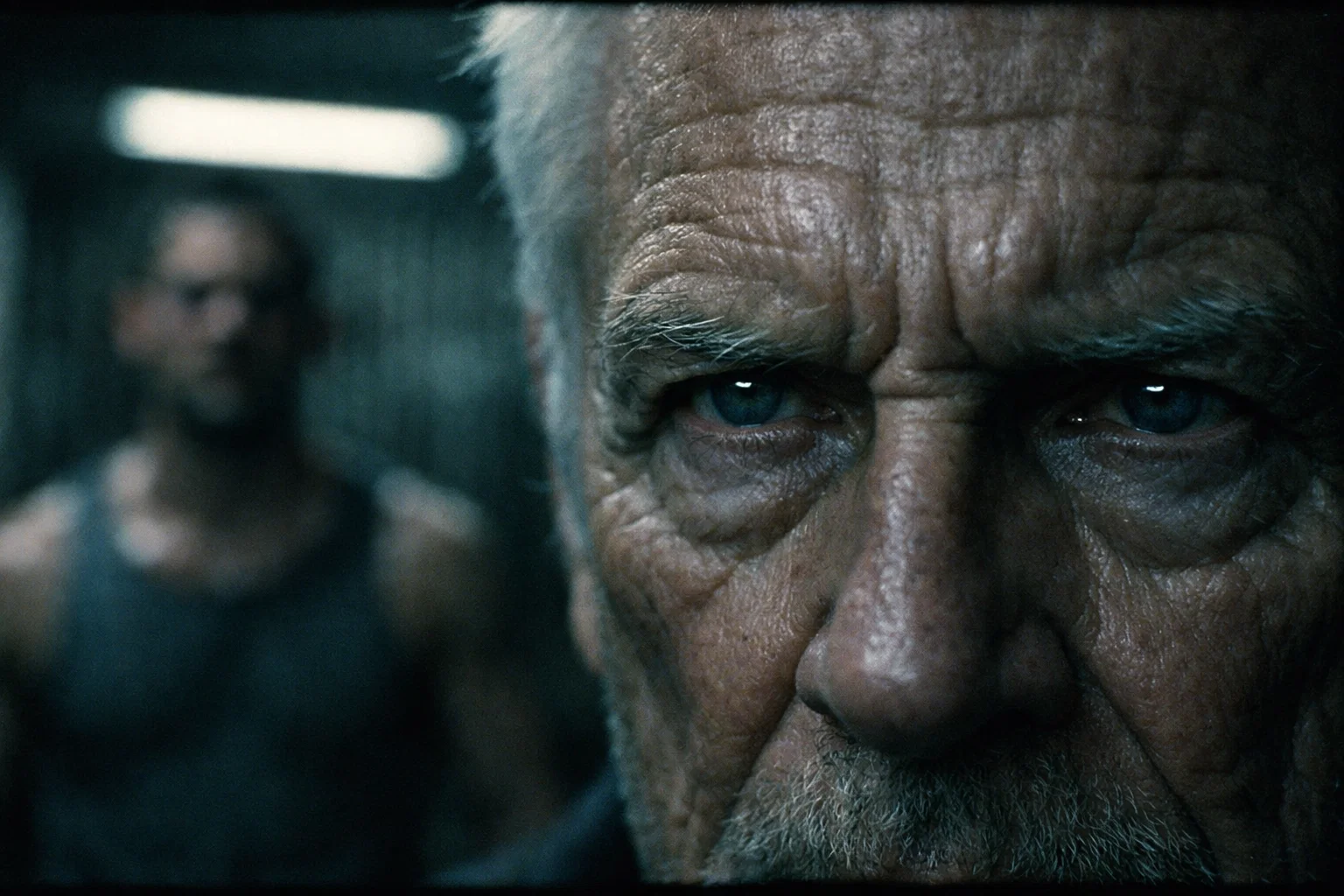
His name was Elias Crowe. Frayed coat. Split shoes. Paint under every fingernail.
Most people decided his whole life story just from that coat.
Homeless. Harmless. Forgotten.
That night Elias was finishing a sketch of a little girl holding a bag of beignets. Her father had tears in his eyes.
“That looks exactly like her grandmother,” the man said.
“Then it belongs to your family,” Elias said quietly.
The father reached for his wallet.
Red leaned over the easel before the man could pay.
“You selling on my block?”
The father froze. Elias kept drawing.
Red tapped the sign with two fingers. “Old man, I asked you a question.”
Elias looked up. Pale gray eyes. Tired, not weak.
“I heard you.”
Red grinned at his crew. “Oh, he heard me.”
One of the boys laughed. “Maybe he’s deaf in the other ear.”
The little girl hid behind her father’s leg.
Elias set down his pencil, slow and deliberate. “Sir, you’re scaring the children on this street. That’s bad business, even for you.”
The crowd went quiet.
Red’s smile dropped. “You think you can talk to me like that?”
“I think somebody should,” Elias said.
Red grabbed the easel and threw it into the gutter. The little girl’s half-finished portrait landed face-down in a puddle of beer and rainwater.
A gasp went through the crowd. Phones came up.
Elias didn’t move to save the drawing. He looked at Red instead, steady, almost sad.
“You didn’t need to do that.”
“Apologize,” Red said.
“For what?”
Red slapped him.
The sound cracked across Bourbon Street. A trumpet player stopped mid-note. A drunk tourist lowered his phone in shock, then raised it again to film.
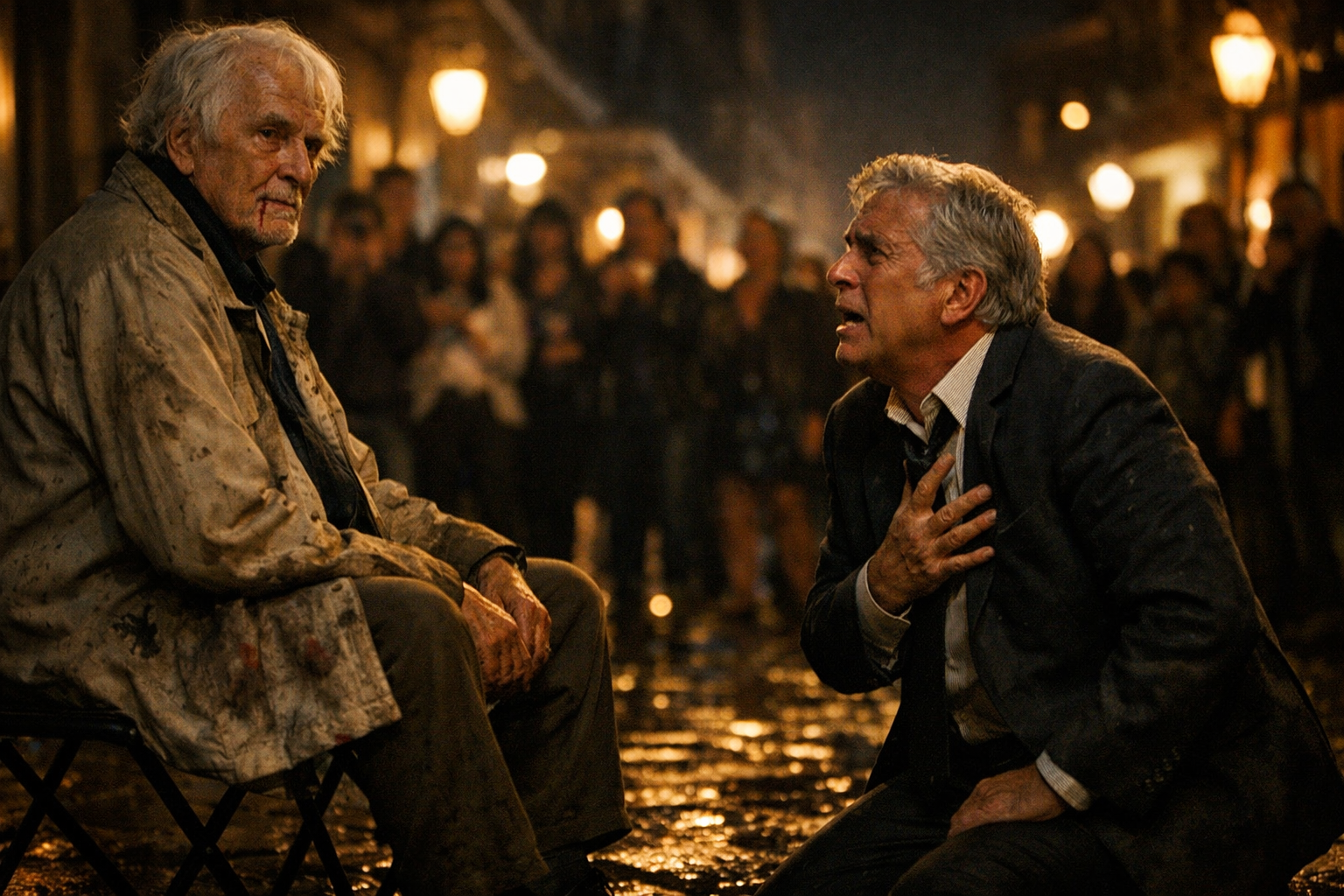
Elias’s head turned with the blow. A thin line of blood opened at the corner of his mouth.
He didn’t fall. He didn’t fight. He straightened his collar with two fingers, like a man adjusting a tie before a meeting.
“Careful,” he said. “That’s the second time in your life you’ve hit someone smaller than you and thought it made you bigger.”
Red laughed, but it was thinner now. “Second time? I don’t even know you, old man.”
“You will,” Elias said. “Give it five minutes.”
That was when Marlene Price, who ran the coffee stand across the street, quietly made a phone call. Not to the police. To someone else entirely.
Red’s boys were still laughing when the first black SUV rolled up onto the curb.
Then a second.
Then a third.
Doors opened in sync. Six men in dark suits stepped out, fanning across the sidewalk like they’d rehearsed it. Behind them came a tall man in his sixties, silver hair, tailored charcoal suit, a face the whole city knew from newspapers nobody dared print bad things about.
Victor Moreau.
Red’s face went white. “Mr. Moreau — I didn’t know you were coming down here tonight, I swear, we were just—”
Victor didn’t look at Red. He looked past him, at the old man standing by the folding stool with blood at the corner of his mouth.
The color drained from Victor’s face.
“No,” he whispered. “No, it can’t be.”
He walked straight past Red like the man wasn’t there.
He stopped in front of Elias.
And Victor Moreau, a man three police commissioners had personally been afraid to question, dropped to his knees on the wet pavement so fast his bodyguards nearly reached for their jackets.
Red’s mouth opened. No sound came out.
The whole French Quarter seemed to hold its breath. A trumpet player stopped mid-note. A drunk tourist lowered his phone. The old street artist, still bleeding from the slap, looked down at the kneeling man and said, “Took you long enough, Victor.”
Nobody understood what they were seeing. Not Red. Not his crew. Not the tourists filming from the sidewalk.
“Sir,” Victor said, his voice cracking, “I didn’t know. I would have come the second I heard your name, I—”
“Get up,” Elias said, gently. “You’re embarrassing both of us.”
Victor rose, unsteady, staring at the old man like he’d seen a ghost climb out of a grave.
“Everyone thought you were dead,” Victor said.
“Everyone was wrong.”
Red finally found his voice. “Somebody want to tell me what’s happening?”
Victor turned on him with a fury that made every bodyguard on the sidewalk go rigid.
“You hit him.”
“He was — he was disrespecting me on my own block—”
“Your block?” Victor’s laugh had no humor in it at all. “This whole street belonged to him before you were born. Before I was born. He built the network that built the men who built you.”
Red’s crew took a step back without meaning to.
“That old man,” Victor said, pointing at Elias with a shaking finger, “ran half this city for twenty years without ever raising his voice. He retired the day he decided he was done making people afraid. I begged him not to walk away. He did it anyway. And you—” Victor’s voice dropped to something dangerous. “You just slapped him in front of a hundred cameras.”
Red looked down at his own hand like it belonged to someone else.
“I didn’t know,” he said.
“You didn’t ask,” Elias said. “That’s the difference between men who last and men who don’t.”
Marlene Price stepped forward with her phone still recording, quietly documenting everything from a careful distance.
“Mr. Moreau,” she said, “for what it’s worth, he wasn’t just selling portraits on this block. He’s been sending half his earnings to the vendors Red’s crew has been extorting all year. Ask any of them.”
Victor’s jaw tightened.
“Is that true?”
“They needed help,” Elias said simply. “You know how it is.”
Victor turned back to Red. “How long have you been running a shakedown on this street?”
Silence.
“How long.”
“Eight months,” Red muttered.
“Show me the books,” Victor said. “Tonight.”
“Sir, I can explain—”
“You can explain to him,” Victor said, nodding at Elias. “Every dollar. Every vendor. Every name.”
Red’s face had gone gray. His crew had already started backing toward the alley, but the bodyguards closed the gap before they got three steps.
“Nobody’s running,” Victor said quietly. “Not tonight.”
Elias bent down and lifted the ruined portrait from the puddle, wiping beer and rainwater from the little girl’s painted face with the sleeve of his coat.
“I can redo this,” he told the father, who was still standing frozen with his daughter pressed against his leg. “Give me ten minutes.”
The father just nodded, too stunned to speak.
Elias sat back down on his folding stool like nothing had happened, picked up a fresh sheet, and began sketching again, his hand perfectly steady despite the blood still drying on his lip.
Victor watched him work for a long moment.
“You’re really not going to say anything else to me?” Victor asked.
“I already said what needed saying,” Elias replied, without looking up. “The rest is between you and him.”
Victor turned to Red.
“You have one hour to return every dollar you’ve taken from every vendor on this street, with interest. You have until morning to be out of this parish. If I hear your name near this block again, I won’t be the one who comes to collect. He will. And unlike me, he never forgets a debt.”
Red’s legs nearly buckled.
The bodyguards escorted him and his crew into the black SUVs. No handcuffs. No badges. Just silence, and the particular kind of fear that comes from finally understanding exactly how small you’ve always been.
The crowd that had gathered to film a beating stayed to watch something else entirely — a king kneeling to a man in a torn coat.
Within a week, the video Marlene had filmed reached six million views. Nobody outside the Quarter understood the context. They just saw an old street painter slapped in public, and a powerful man on his knees in front of him seconds later.
The internet called it karma.
The neighborhood knew it was something older than that.
Marlene Price built a private restitution fund within the month, working with three former vendors who’d been paying “protection” to Red’s crew for the better part of a year. Every dollar came back. The city, embarrassed by the viral footage, fast-tracked approval for a protected street-artist zone stretching two full blocks.
Red Malone was never formally charged with anything a courtroom could touch — the extortion had run in cash, off the books, exactly the way his old bosses had taught him. But he lost the only thing that had ever mattered to him. His crew scattered within a week. His reputation cratered. He left the parish before sunrise the next morning and never came back.
People who knew him said he blamed everyone except himself. That was his real punishment — not the exile, not the poverty that followed, but the fact that he still believed respect was something you beat out of people weaker than you.
Elias never mentioned him again.
The French Quarter did, for months — the old man, the slap, the phone call, the boss on his knees. But Elias didn’t build a business out of the fame. He kept the same wooden sign.
PORTRAITS — PAY WHAT YOU CAN.
Only one thing changed. Nobody bothered the artists on that block again. Not the vendors. Not the musicians. Not the old men with shaking hands trying to make rent one sketch at a time.
Every night, Elias sat under the gas lamp. Sometimes tourists paid hundreds. Sometimes broke college kids paid nothing. Sometimes he drew children for free, the way he always had.
One evening, the little girl from that night came back with her father. She carried a small bouquet of white roses and a folded piece of paper — a school essay she’d written about him, titled “The Man Who Didn’t Hit Back.”
Elias read the first page. His eyes went wet.
“Were you scared?” she asked.
He looked down Bourbon Street, where music drifted from an open door and a carriage horse clopped slowly past.
“Yes,” he said.
She seemed surprised. “But you didn’t look scared.”
“That’s because being brave doesn’t mean your hands don’t shake,” Elias said. “It means you still choose what kind of man you’re going to be.”
Her father asked if he could commission another portrait. Elias nodded, and this time he drew all three of them — the girl, her father, and the old painter reflected faintly in the shop window behind them.
When the man tried to pay, Elias pushed the money back across the easel.
“Buy her beignets instead.”
The father smiled. “Yes, sir.”
A year later, Victor Moreau died quietly after a stroke. No headlines that mattered outside the city. But in his final months, records would later show he’d quietly paid back far more than the restitution fund had ever asked of him.
Elias went to the funeral. People were shocked to see him there.
A reporter, one of the few who recognized his face from the old viral clip, asked why he’d come.
“Because a man can do wrong his whole life,” Elias said, “and still leave behind one unpaid debt worth collecting.”
“What debt?”
Elias looked toward the casket for a long moment.
“The warning I never finished giving him.”
Then he walked away, and never explained it further.
Years from now, most people won’t remember Red Malone’s name, or the exact footage, or the black SUVs that lined up on a wet street in the French Quarter. But the ones who were there that night will remember the lesson well enough.
A poor coat doesn’t mean a poor soul.
A quiet man isn’t always a weak man.
And the person you humiliate in public might be the only one left who remembers exactly who taught you everything you think you own.
Original fictional stories. AI-assisted creative content.