Dorothy Mills had worked at Rourke’s Diner long enough to know the sound of trouble before it reached the door.
Sometimes it laughed too loudly. Sometimes it wore expensive shoes.
That afternoon, it wore a badge.
Officer Officer Rick Harlan pushed through the front door at 2:14 p.m. on a Tuesday—not to eat, not to ask questions. He came to finish something he should have finished years ago.
Dorothy stood behind the stone counter in her teal uniform, both hands resting flat on the surface. Sixty-eight years old. Thin. Tired in the way people get when stopping isn’t an option.
Harlan stopped directly across from her.
“I told you to stop asking questions.”
“My husband asked questions,” she said. “I only kept his papers.”
Harlan leaned in. “You don’t know what you’re holding.”
“I know enough to hide it from men like you.”
At booth seven, near the window, Cole Briggs set down his fork.
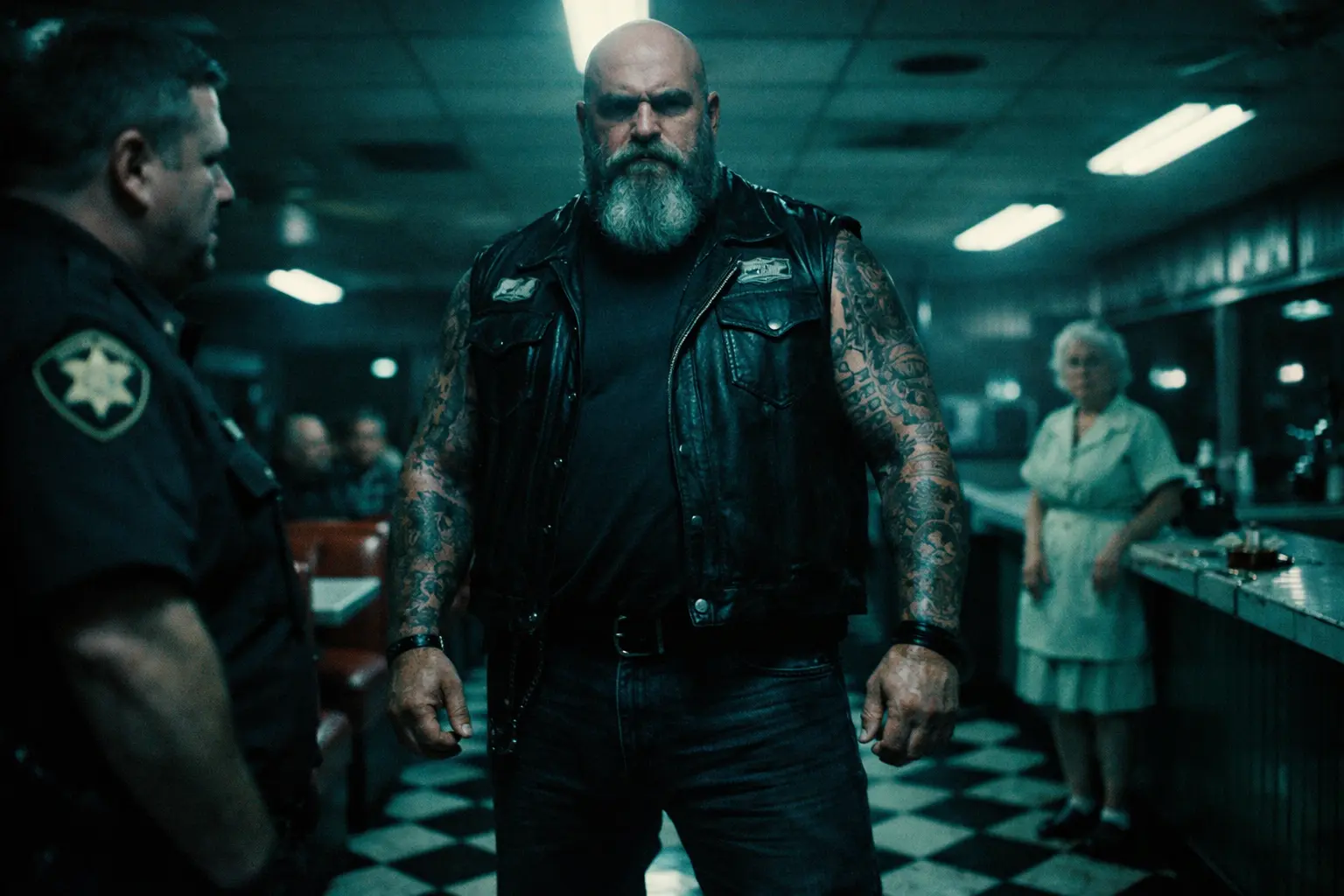
He’d been sitting there for nearly twenty minutes—a big man in a black leather biker jacket, tattooed arms, thick beard. The word PRESIDENT was stitched across his chest. EAST VALLEY spread across his back.
Most people had noticed him when he walked in. Most had decided not to stare. He looked dangerous in the quiet way—the kind of man who didn’t need to raise his voice because everyone had already imagined it.
But Cole hadn’t come for breakfast.
He’d come for Harlan.
And when he heard Dorothy say the word “papers,” his hand went still.
Harlan smiled. Not the smile of a police officer. The smile of a man who had learned a uniform made cruelty easier.
“You should have taken the warning.”
Dorothy lifted her chin. “My husband didn’t raise me to bow to cowards.”
The cup moved before anyone understood what was happening.
Harlan grabbed it and threw the hot coffee straight into her face.
A sharp cry broke from her. Brown liquid splashed across her cheeks, her neck, her uniform. She stumbled backward. Her hip hit the lower cabinet. Then she fell onto the black-and-white tile floor.
The diner froze.
A woman in the corner covered her mouth. A man at the counter half-stood, then stopped when Harlan turned his head.
Harlan stepped around the counter and stood over her.
She sat on the floor, shaking, soaked, one hand pressed to her face. Humiliation hurt almost worse than the burn.
He pointed down at her. “You should have remembered who runs this town.”
That was when Cole set his fork down.
Not quickly. Not dramatically. Just slowly enough that everyone heard the metal touch the plate.
He stood. The red leather booth creaked behind him. He stepped into the aisle—heavy boots, calm pace, no rush—and as he walked, the whole diner saw EAST VALLEY across his back.
Harlan finally turned.
Cole stopped directly in front of him.
He was taller than Harlan. Broader. But it wasn’t size that changed the officer’s expression. It was recognition.
Harlan’s arrogance flickered.
Cole looked down at him and spoke in a low voice. “Wrong move.”
Harlan swallowed once. Then forced a laugh. “You want to threaten a police officer?”
“No.” Cole looked past him at Dorothy on the floor. “I want you to turn around and apologize to the woman you just assaulted.”
Harlan’s face hardened. “You don’t give orders here.”
“Neither do you.” Cole leaned closer. “Not anymore.”
The words were quiet. But they shifted the room.
Harlan’s eyes moved to the jacket. “Iron Ridge,” he muttered. “You people still pretending you’re a charity?”
“We stopped pretending years ago.”
Harlan reached for his radio.
Cole raised one hand—not to grab him, not to strike—only to point. “Before you call backup, you should know your microphone has been live for seven minutes.”
Harlan froze.
The diner went cold.
Cole tapped the small silver button sewn beneath the collar of his jacket. “State investigators are listening.”
Harlan’s face drained.
Dorothy looked up through pain and tears. She hadn’t known that part.
Cole turned gently toward her. “Mrs. Mills, paramedics are already on the way. Stay still.”
Harlan stepped back. “No. No, this is staged.”
“You walked in,” Cole said. “You spoke. You threw the coffee.”
A phone started recording openly from the third booth. Then another. Then a third.
Fear had finally found witnesses.
“Put those phones down,” Harlan ordered.
Nobody did.
The front door opened.
Two men in dark suits entered first. Behind them came a woman in a navy blazer with a badge wallet already open. Two state police officers followed.
The woman stopped beside Cole. “Officer Officer Rick Harlan. I’m Special Investigator Special Investigator Dana Reeves, State Attorney General’s Office.”
Harlan stared at her. “This is a misunderstanding.”
She looked at Dorothy on the floor. “No. It’s an escalation.”
Cole crouched beside Dorothy and picked up a clean towel from the nearest table. He didn’t touch her face without asking. “May I?”
She nodded, trembling.
He handed it to her carefully. “I’m sorry I waited.”
She looked at him. “You were supposed to.”
That sentence made Harlan look at both of them differently.
“You know each other?”
Dorothy answered before Cole could. “I knew him when he was seventeen and hungry.”
Cole’s face tightened. For just a moment, the dangerous biker looked less dangerous. More human. More wounded.
Twenty-two years earlier, Cole Briggs had been Kevin Briggs—a runaway sleeping behind garages, stealing sandwiches from gas stations. Dorothy Mills found him behind Rourke’s Diner in the rain and fed him. Her husband, Chief Chief Walter Mills, found him work at a repair shop. For the first time in Kevin’s life, adults helped without calculating what they could take in return.
Chief Walter Mills had been the only honest chief Iron Ridge ever had.
That was why he died.
The official report said Walter crashed his patrol car during a late-night pursuit. No suspect. No evidence. No foul play.
But Dorothy never believed it. Neither did Cole.
Because three days before the crash, Walter told them both the same thing:
“If anything happens to me, Officer Rick Harlan is not just a bad cop. He’s the smallest piece of a bigger machine.”
Harlan had been a young officer then. Ambitious. Protected. His father was a judge. His uncle owned half the commercial property in Iron Ridge. His brother ran the security company that collected protection fees from businesses after police response times mysteriously slowed.
Walter had been building a case.
Then he died. And the evidence disappeared.
Or so Harlan thought.
Dorothy had spent twenty-two years pretending she knew less than she did. Cole had spent twenty-two years becoming the kind of man people underestimated differently.
The Iron Ridge Riders weren’t saints. Many had records. Many had scars. But they had one rule: no one preyed on the weak in their town. Not gangs. Not landlords. Not men with badges.
Reeves stepped toward Harlan. “For eighteen months, we’ve investigated extortion, evidence suppression, illegal intimidation, and targeted harassment involving members of your department.”
“This is nonsense,” Harlan said.
Cole reached into his jacket and produced a folded document. “No.” He set it on the counter. “This is your signature.”
Harlan recognized it instantly.
A report from 2003. The night Chief Walter Mills died. Filed by Officer Officer Rick Harlan.
Reeves opened her folder. “Your original report states you arrived after the crash.”
Cole pointed at the paper. “But Walter’s dispatcher logs show you called in from the scene eleven minutes before impact.”
Harlan looked at Dorothy. For the first time, fear replaced anger.
Dorothy stood slowly, helped by a state officer. Her face was red from the coffee. Her uniform soaked. But her voice was steady.
“Sam kept copies.”
Harlan whispered, “Where?”
She looked at the stone counter. “Under the place you stood every Friday.”
Cole reached beneath the counter edge and pressed a hidden latch. A narrow panel opened. Inside sat a metal lockbox.
Harlan lunged.
Two state officers caught him before he reached it.
“Don’t touch that!” he shouted.
Cole smiled without warmth. “There he is.”
Reeves opened the lockbox with a key Dorothy wore on a chain beneath her uniform.
Inside were cassette tapes. Photographs. Property records. Payment ledgers. Names of officers. Names of judges. Names of businessmen who had used the police department like private muscle.
And one small envelope marked: IF DANIEL CROSS EVER WEARS A STAR.
Dorothy stared at it. “He knew.”
Reeves opened the envelope carefully. Inside was a handwritten note from Chief Walter Mills.
Officer Rick Harlan does not want justice. He wants rank. If he ever gets close to command, he will turn the badge into a weapon. Do not wait for him to become powerful. Expose him while people can still see his hands.
The diner was silent.
Harlan struggled against the officers holding him. “You can’t use twenty-year-old garbage.”
Reeves looked at him evenly. “We can use today’s assault.”
Cole glanced toward the customers still recording on their phones. “And the whole town saw your hands.”
Harlan was arrested in front of the red booths, the stone counter, and the waitress he thought would be too old to fight back.
As they cuffed him, he turned toward Cole. “You think you’re clean because you wear a club jacket?”
Cole stepped closer. His voice dropped. “No. I think I’m useful because men like you only look for angels or criminals. You never notice the people in between.”
Harlan was taken outside as sirens filled the parking lot.
For the first time in years, Rourke’s Diner could breathe.
But the case was only beginning.
The lockbox reopened Chief Walter Mills’s death investigation. The tapes held recorded conversations between Harlan, his uncle, and several senior officers. The ledgers matched cash withdrawals from local businesses. The property records showed a clear pattern: intimidate owners, force sales, let Harlan’s relatives buy cheap, then resell to developers.
Walter had found all of it. That was why he had to be removed.
The crash scene was reexamined. A retired mechanic came forward and admitted he’d been paid to tamper with Walter’s brakes. He’d stayed silent for twenty-two years because Harlan’s family had threatened his daughter. With Reeves’s protection, he testified.
Harlan was charged with assault, extortion, conspiracy, evidence tampering, obstruction, and involvement in Chief Walter Mills’s death. Three senior officers resigned before they could be arrested. The mayor denied knowing anything.
The ledgers disagreed.
Dorothy became famous for exactly one week. Local news played the diner footage on a loop—the old waitress falling, the biker standing, the officer freezing, Cole saying two words: Wrong move.
But Dorothy hated being called helpless.
At a press conference, a reporter asked how it felt to be rescued by a biker.
Dorothy looked at Cole, then back at the cameras. “He didn’t rescue me,” she said. “He kept his promise.”
Cole looked down.
Years earlier, standing beside Chief Walter Mills’s grave, he had promised Dorothy one thing. If the truth ever comes back, I’ll be there.
And he was.
Harlan’s trial lasted six weeks. His lawyers tried to paint Dorothy as confused. They tried to paint Cole as dangerous. They tried to paint Walter as obsessed.
Then prosecutors played the diner recording. Harlan’s own voice filled the courtroom. You should have remembered who runs this town.
The jury didn’t need long. Guilty. On nearly every count.
When Harlan was sentenced, Dorothy stood before the judge. Her face had healed. Her hands still shook. But her voice did not.
“My husband believed a badge should protect people who had no power,” she said. “Officer Rick Harlan believed a badge was power. That difference cost my husband his life, and it nearly cost this town its soul.”
Harlan stared straight ahead.
Dorothy continued. “I am old. I am tired. I was afraid. But I was never weak.”
Cole sat behind her. The Iron Ridge Riders filled the back row—leather jackets, tattooed arms, hard faces, quiet respect.
After the trial, Rourke’s Diner changed.
Not the booths. Not the counter. Not the coffee.
Patty, Dorothy’s niece, took over most of the shifts so Dorothy could finally work only when she chose. A small plaque was mounted beneath the stone counter.
SAMUEL PARKER STOOD HERE FOR THE TRUTH. EVELYN PARKER KEPT IT SAFE.
The Iron Ridge Riders came every Thursday morning. They paid in cash. They tipped too much. They fixed broken locks for elderly customers. They walked waitresses to their cars after dark.
One morning, Dorothy brought Cole a plate of pancakes without asking.
He looked at them. “I didn’t order.”
“You never do when you’re sad.”
“I’m not sad.”
“You’re always sad. You just grew a beard around it.”
For the first time in days, Cole laughed.
Dorothy sat across from him. “You did good, Kevin.”
Only she still called him that.
He swallowed. “I should’ve been there sooner.”
She reached across the table and tapped his hand. “You were there when it mattered.”
Outside, gray-blue light fell across the parking lot. Inside, coffee steamed under fluorescent lights. The diner was still ordinary. That was the beautiful part.
A place didn’t have to look sacred to hold courage. Sometimes it was just red booths, tired waitresses, chipped mugs, and one old lockbox beneath a counter.
Years later, people in Iron Ridge still told the story of the day Officer Officer Rick Harlan threw coffee at Dorothy Mills—and learned the entire diner had been waiting for him to show his true face.
Some remembered the biker. Some remembered the badge. Some remembered the hidden papers.
But Dorothy remembered one simple thing.
When she fell, the room froze.
Then the right man stood up.
Original fictional stories. AI-assisted creative content.