The tray in Leah’s hands was shaking before she even understood why.
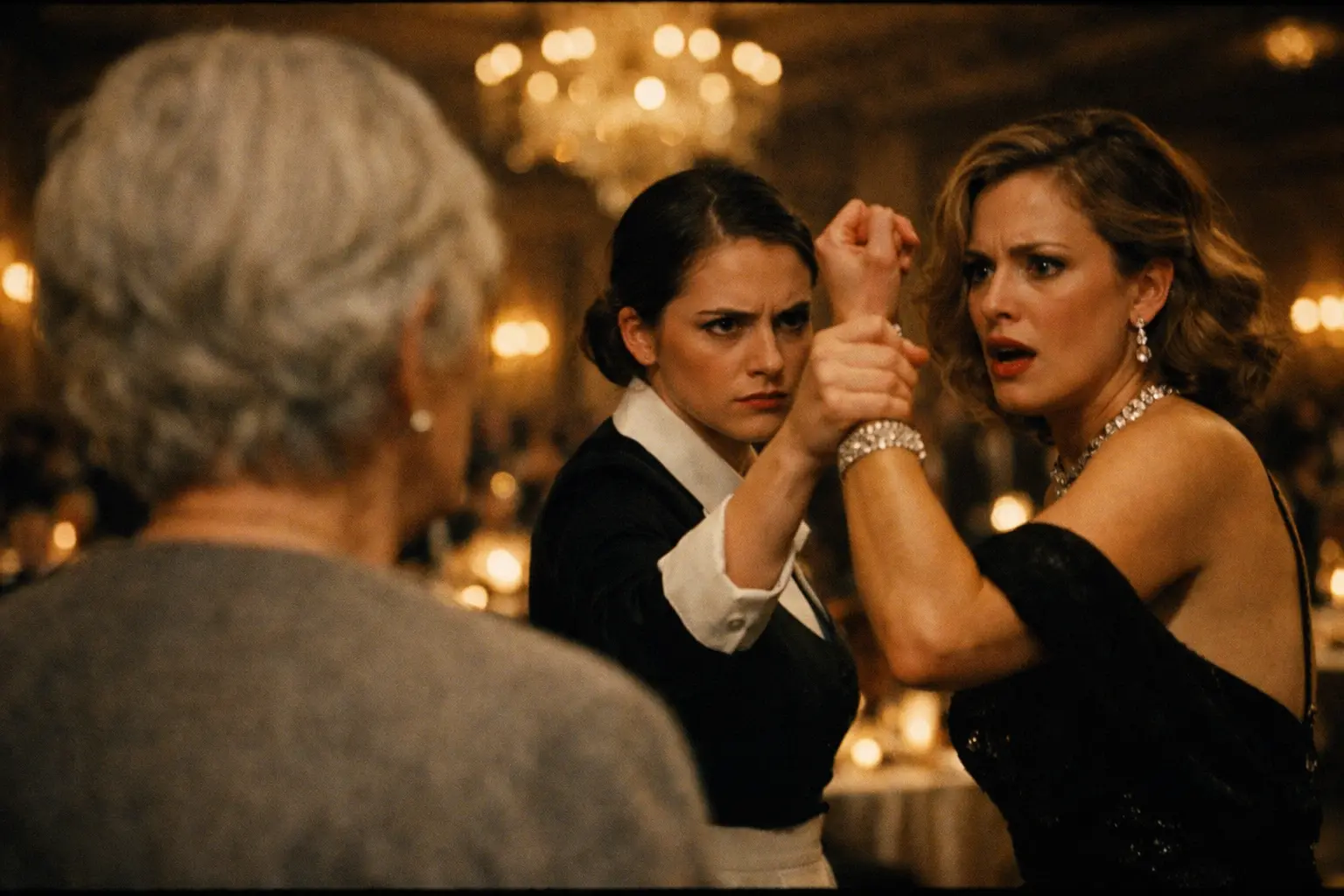
“Get her a chair in the back,” Vanessa Brooks said, waving two manicured fingers at the old woman in the gray cardigan. “She’s blocking the photo line.”
The old woman didn’t move. She just held her small paper cup of water like it was the only thing keeping her upright.
“I’m fine standing, dear,” she said quietly.
“You’re not fine,” Vanessa said, louder now, so the cluster of donors nearby would hear. “You’re confusing my gala with a soup kitchen.”
Laughter. Thin, nervous, cruel laughter.
Leah set her tray down on the nearest table.
“That’s enough,” she said.
Vanessa turned, diamonds flashing under the chandeliers. “Excuse me?”
“She said she’s fine standing. That should be the end of it.”
“This isn’t your table to manage, sweetheart. You’re staff.”
“I’m a person,” Leah said. “So is she.”
A murmur rolled through the crowd near the bar. Someone lifted a phone.
Vanessa’s smile went thin and sharp. “Cute. Truly. But this gala has a dress code and a guest list, and she is on neither.”
“Then check the list again,” Leah said. “Because I’d bet everything I make this year that she’s on it.”
“She wandered in off the street in a cardigan from a discount rack—”
“Vanessa.”
The voice cut through the room like a blade through silk.
Every head turned.
A man in a black tuxedo was crossing the marble floor, and the crowd parted the way crowds only part for money. Security stepped back instead of forward. Someone near the string quartet whispered his name before he even reached the center of the room.
Nathan Sinclair.
CEO of the Sinclair Foundation. Thirty-four years old. The kind of wealthy where people stopped saying a number and just said “old money, new empire.”
He stopped beside the old woman and put a hand gently on her shoulder.
“That’s my mother,” he said. “You were humiliating my mother.”
The room went so silent the ice in someone’s glass cracked audibly.
Vanessa’s face drained of color in real time. “I… Nathan, darling, I had no idea, I was only—”
“You were mocking a woman for what she was wearing,” Nathan said. “In a room my family built.”
“I didn’t recognize her,” Vanessa said, voice cracking.
“Exactly,” Nathan said. “That’s the part that should scare you.”
He turned to the old woman, and his whole posture changed — the CEO dissolving into a son.
“You okay, Mom?”
Margaret Sinclair patted his hand. “I’m alright, Nathan. Truly.”
Leah stood frozen between them, tray forgotten, heart pounding so hard she could feel it in her ears.
Margaret Sinclair. The name on the pediatric wing of three hospitals. The name on three separate scholarship funds Leah had actually applied to once, back when she thought college might still happen for her.
Nathan turned to Leah.
“You didn’t know who she was.”
“No,” Leah said honestly. “I still would’ve said something.”
Something shifted in his expression — surprise, then something that looked a lot like respect.
“That’s exactly why I need to talk to you,” he said. “Both of you.”
Vanessa tried one more time, grabbing at composure like a woman grabbing at a falling necklace.
“Nathan, the foundation’s ten-million-dollar pledge to the Youth Arts Initiative — my board is counting on—”
“Cancelled,” Nathan said, without even looking at her.
“You can’t be serious—”
“The Sinclair Foundation doesn’t fund organizations that let dignity get auctioned off for a photo op,” Nathan said. “Effective immediately.”
The organizer, a thin man in wire glasses, looked like he might faint into the shrimp tower. “Nathan, please, we can discuss—”
“There’s nothing to discuss,” Nathan said. “You all watched it happen. Nobody said a word until a waitress did.”
He didn’t raise his voice again. He didn’t need to. The silence in the room did the rest.
Someone’s phone was already recording. By the time Leah got home that night, the clip had eleven thousand views. By morning, it had two million.
Leah showed up for her six a.m. shift at Corner & Vine anyway, because rent didn’t care that she’d gone viral overnight.
Her manager, Denise, met her at the door holding her phone up like a torch. “Leah. Leah. You’re everywhere.”
“I need to make coffee, Denise.”
“You’re being called ‘America’s Most Courageous Waitress’ on three different morning shows.”
“I need to make coffee.”
She tied her apron with hands that hadn’t fully stopped shaking since the night before. Regulars came in throughout the morning, some just to stare, a few to shake her hand. A man tried to pay for his coffee with a hundred-dollar bill and refuse the change. She gave it back to him anyway.
At eleven-fifteen, the bell over the door rang, and Margaret Sinclair walked in.
No security. No driver visible outside. Just a plain wool coat over the same gray cardigan, and a small handbag that had clearly seen twenty years of use.
She sat at the counter like any other customer.
“Tea, please. If it’s not too much trouble.”
Leah blinked. “You came.”
“I wanted to see,” Margaret said, “if the kindness was for the cameras, or for the person.”
“I didn’t know there were cameras.”
“I know,” Margaret said. “That’s why I came.”
Leah made the tea herself, hands steadier now. When she set it down, Margaret slid an envelope across the counter.
“From my son.”
Leah didn’t open it. “I don’t want money.”
“It’s not money,” Margaret said. “Well. It’s not only money.”
“I mean it. I didn’t do it for a reward.”
Margaret studied her for a long moment, eyes glassy in a way that had nothing to do with age.
“That,” she said softly, “is precisely the answer I was hoping you’d give.”
Nathan called her personally that afternoon, and against every instinct telling her this was too strange, too fast, too much, Leah agreed to come to Sinclair Tower.
She expected lawyers. Contracts. A check with a lot of zeroes and a lot of strings.
Instead, Nathan led her down a long hallway lined with photographs. Hundreds of them. A boy in a hospital bed, grinning, IV tube taped to his arm, a plaque behind him reading SINCLAIR PEDIATRIC WING. A family standing in front of a modest house with a red door, holding a giant novelty key. A row of veterans in caps, diplomas in hand.
“My mother built this foundation after my father died,” Nathan said, stopping in front of the wall. “Thirty-one years. It used to be about the work.”
He turned to face her.
“Lately it’s been about the guest list.”
Leah frowned. “The gala.”
“Every person on that invite list last night believed they were being scouted for a major partnership announcement,” Nathan said. “Real money on the table. Real opportunity.”
He opened a folder and handed it to her. Inside were photographs of the ballroom, timestamped, along with a single typed page.
“They were being scouted,” he said. “Just not for what they thought.”
Leah looked up slowly. “The whole gala was a test.”
“My mother’s idea,” Nathan said. “She wanted to know who in this city still had character when there was nothing obvious to gain from showing it.”
“And Vanessa failed.”
“Spectacularly,” Nathan said. “You were the only person in that entire room who passed.”
A week later, Sinclair Tower announced a second gala.
This one had no red carpet. No photographers stationed at the entrance. No velvet rope, no seating chart organized by net worth.
The invitations went out instead to a third-grade teacher who’d spent eleven years buying school supplies out of her own paycheck. A retired firefighter who still drove two hours every week to check on elderly neighbors from his old station’s district. A hospital janitor who’d learned sign language on his own time so he could talk to a deaf patient nobody else could reach. Nurses. Volunteers. A teenage boy who’d organized a coat drive at his high school without telling a single teacher about it.
And Leah.
She almost didn’t go.
“I’m not this,” she told Nathan over the phone. “I’m not a foundation person. I’m a waitress who said one true thing at the wrong party.”
“That’s not smaller than what we do here,” Nathan said. “That’s the entire point of what we do here.”
She went.
The ballroom looked nothing like the last one. No ice sculptures. No orchestra of imported musicians. Just warm light, long tables, and six words projected on the wall behind the stage:
CHARACTER IS THE GREATEST FORTUNE.
Margaret walked to the podium in the same gray cardigan she’d worn to both the gala and the diner. She didn’t bother changing for either room, and Leah realized now that had never been an accident.
“This foundation began with wealth,” Margaret said, voice carrying clean and steady across the room. “But wealth without compassion is only decoration. It looks like something from a distance and means nothing up close.”
Her eyes found Leah’s.
“A young woman working a night shift for tips reminded my family what greatness actually looks like. It isn’t inherited. It isn’t purchased. It’s chosen — usually in a moment when nobody’s watching and there’s nothing to gain.”
The applause that followed didn’t stop for almost a full minute.
Nathan stepped up beside his mother.
“In recognition of her integrity and her courage,” he said, “Leah Carter will be joining the Sinclair Foundation Board, overseeing our new National Community Outreach Program.”
Leah’s mouth actually fell open. “I’ve never run anything. I’ve never managed a foundation.”
“No,” Nathan agreed, smiling. “You’ve managed something much harder than a foundation.”
“What’s that?”
“You kept your heart intact in a city that tries very hard to take it,” he said. “That’s rarer than any degree we could ask for.”
The outreach program launched eight months later. Neighborhood grocery vouchers. Free after-school meal programs in eleven cities. Emergency rent assistance processed within seventy-two hours instead of the usual six weeks. Leah refused the corner office. She refused the company car. She spent most of her time exactly where she’d always been most useful — in rooms with people, not in rooms about people.
Vanessa Brooks quietly vanished from the charity circuit within a season. It wasn’t really the viral video that ended her run, though the headlines liked to say so. It was every sponsor who had been standing in that ballroom, who had heard the words come out of her mouth with no cameras required, and simply decided they didn’t want their name next to hers anymore.
Margaret kept doing exactly what she’d always done. She rode the subway sometimes. She sat in diners in her plain wool coat and ordered tea and let people underestimate her, because that was usually the fastest way to find out who they really were.
Most strangers she met never learned her last name.
She preferred it that way.
Because the truth she’d spent thirty-one years learning was simple enough to fit on six words on a wall — the people who offer kindness to a stranger never do it expecting a reward.
And somehow, every single time, it found its way back to them anyway.
THE END
Original fictional stories. AI-assisted creative content.