Joseph pulled into the driveway on Alder Lane at 3:47 p.m.
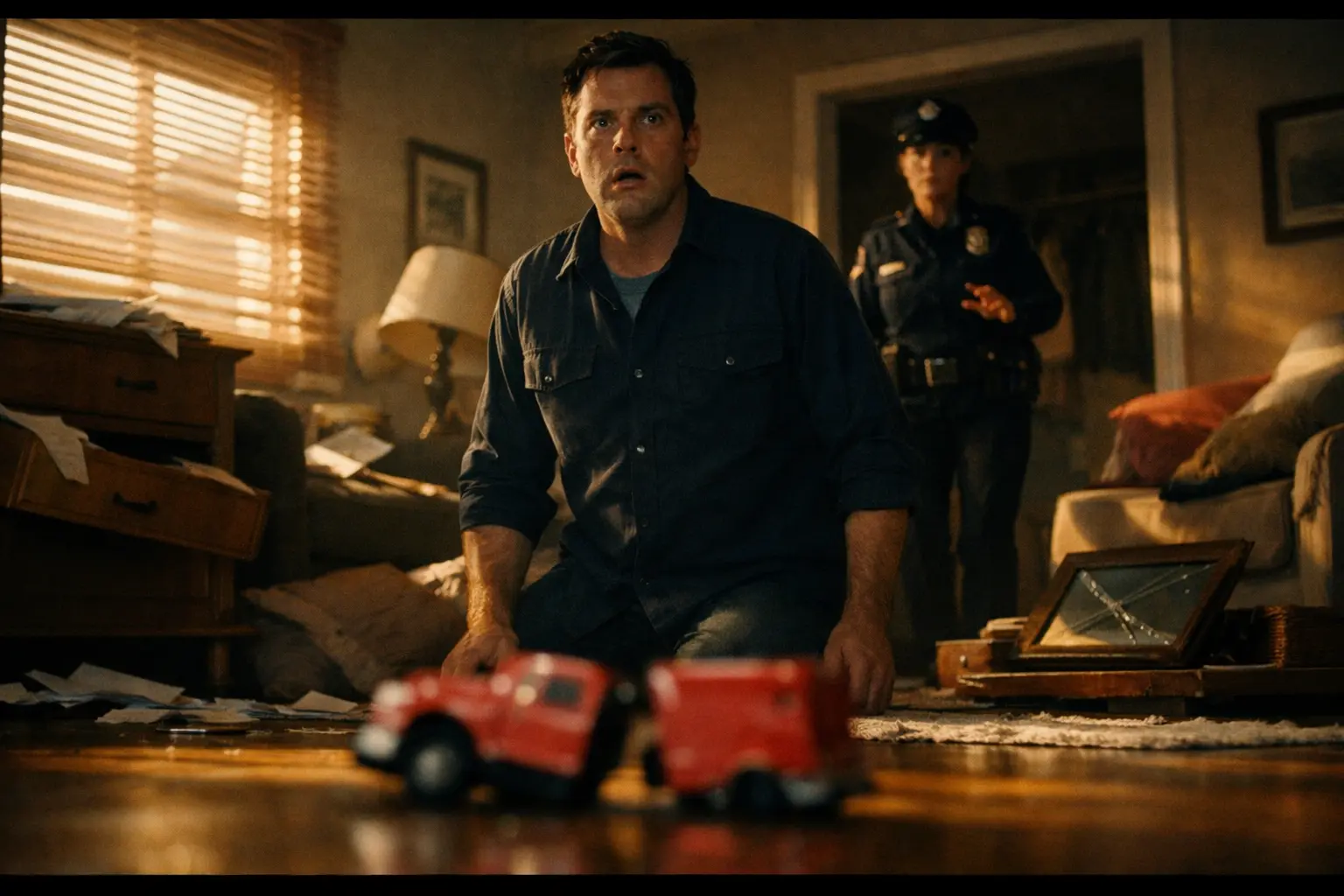
The red toy truck was on the front step. Broken in half.
Mark never left that truck behind.
“Naen?” he called, pushing the door open.
The living room looked wrong. Drawers half-open. Cushions on the floor. A lamp tilted against the wall.
But the TV was still there. The laptop on the counter. Naen’s purse on the chair.
“Mark? Buddy?”
Nothing.
Joseph moved fast. Kitchen. Bathroom. Guest room. The back door was locked from the inside.
He called 911 with his hand shaking.
“My son. He’s five. He was at his grandmother’s. The house is trashed and they’re both gone.”
Sergeant Delgado arrived in eleven minutes.
He walked the rooms with Joseph two steps behind.
“Anything valuable missing?”
“I don’t know. The TV’s here. Her jewelry box is on the dresser.”
Delgado stopped in the living room and looked around slowly.
“Mr. Pierce, this doesn’t look right to me.”
“What do you mean?”
“Drawers pulled but nothing dumped. Cushions moved but not searched. A real burglar tears the place apart. This looks like someone wanted it to look torn apart.”
Joseph felt something cold settle in his chest.
“Then where’s my son?”
Ruth arrived twenty minutes later.
She saw the police tape and started running before the car stopped.
“Where’s my mother? Where’s Mark?”
“We don’t know yet,” Joseph said.
“Someone took them?”
“Ruth—”
“Someone took them. Someone broke in and took my mother and my baby.”
“Ruth, listen to me. The house doesn’t look right. The police think it’s staged.”
She stared at him.
“Staged by who?”
He didn’t answer.
Her face went hard.
“Don’t you say it. Don’t you dare say it, Joseph.”
At 5:02 p.m., dispatch called Delgado on his shoulder radio.
A woman had walked into a gas station on Route 6, two towns over. Said she was disoriented. Said her grandson was in the car outside.
Mark was unconscious in the back seat.
The ER at St. Luke’s smelled like antiseptic and coffee gone cold.
Joseph and Ruth sat in blue plastic chairs while a nurse spoke fast and low.
“Severe concussion. Skull fracture along the temporal bone. He’s stable. But we need to keep him under observation, and the neurosurgeon wants to talk to you.”
“He’s alive,” Ruth whispered.
“He’s alive.”
She broke down against Joseph’s shoulder.
He held her. But over her head, he was staring at the wall, and his jaw was locked so tight it ached.
Naen was in a separate room down the hall, being treated for “shock.”
Detective Morrison, plainclothes, met Joseph in the corridor.
“Mr. Pierce, can we talk?”
“Where?”
“Family room. Your wife too.”
The family room had beige walls and one sad plant.
Morrison sat across from them with a laptop.
“Mrs. Harlo says she and Mark were watching TV. She says two men in masks came through the back. She says one of them shoved Mark against the coffee table. She says they took her out to the car and forced her to drive.”
“That’s what happened,” Ruth said.
“Ma’am, we ran a canvass on Alder Lane. Your mother’s neighbors across the street have a porch camera. It faces her front door.”
Ruth’s hand tightened around Joseph’s.
“What did it show?”
Morrison turned the laptop toward them.
“I need you to see this. Both of you.”
The footage was time-stamped 2:14 p.m.
Naen’s front door. No one entering. No one leaving. No masked men. No van. No struggle.
At 2:47 p.m., the door opened.
Naen walked out.
Alone.
She got in her car.
She drove away.
She came back at 3:09 p.m.
She walked inside.
She came back out at 3:22 with Mark in her arms. His head was against her shoulder and his arm was hanging down.
She put him in the back seat.
She went back inside.
She stayed for eleven minutes.
Then she came out with her purse, locked the door behind her, and drove away.
The room was silent.
Ruth was breathing like she’d been running.
“Play it again.”
“Ma’am—”
“Play it again.”
Morrison played it again.
When it ended, Ruth put both hands over her mouth.
“She left him in the car,” she said. “She hit him and she left him in the car and she drove around for two hours.”
Joseph said nothing.
“She was going to say it was a break-in,” Ruth said. “She was going to say strangers did this.”
“Yes,” Morrison said.
“She would have let them put out an APB. She would have let us think somebody was after my son.”
“Yes.”
Ruth looked at Joseph.
“You knew.”
“I suspected.”
“When?”
“When I saw the truck on the step.”
The neurosurgeon came in at 8:14 p.m.
Dr. Halpern. Gray beard. Kind eyes. Tired.
“Mark is going to make it.”
Ruth started crying before he finished the sentence.
“The fracture is clean. No bleed. He’ll need close monitoring for forty-eight hours and follow-up scans. Kids his age recover remarkably well from this kind of injury when it’s treated fast.”
He paused.
“If he’d gone another hour without care, we’d be having a different conversation.”
Joseph felt something inside him turn to iron.
Mark opened his eyes at 11:20 that night.
He looked at Ruth first.
“Mama.”
“Baby. Baby, I’m here.”
“My head hurts.”
“I know, sweetheart. I know.”
“Where’s Grandma?”
Ruth couldn’t speak.
Joseph leaned in.
“Buddy, do you remember what happened at Grandma’s?”
Mark’s eyes went unfocused for a moment.
“I didn’t put the truck away. She got the mad voice. Then… my head.”
“That’s okay. You don’t have to remember more.”
“Is Grandma mad at me?”
“No, buddy. Grandma is not mad at you. None of this is because of you.”
Mark closed his eyes again.
Ruth put her face against the hospital blanket and sobbed without making a sound.
Naen was arrested at the hospital that night.
She was not permitted to see Mark.
She asked to see Ruth.
Ruth walked to the door of her mother’s room, looked through the small window, and walked away without going in.
The charges came down two days later.
Child endangerment. Assault on a minor. Evidence tampering. Filing a false police report.
Naen’s attorney, a soft-spoken man named Callahan, tried to reach out to Ruth privately.
“Your mother is devastated. She’d like a chance to explain.”
“Tell her the porch camera already explained,” Ruth said, and hung up.
Mark came home nine days later.
He wore a small soft helmet for the first two weeks. He napped a lot. He asked why Grandma wasn’t coming over.
“Grandma made a very bad choice,” Ruth said. “She hurt you and then she didn’t get you help. She has to talk to a judge about it.”
“Is she going to say sorry?”
“I don’t know, buddy.”
“If she says sorry, do I have to see her?”
“No. Never. Not unless you decide, when you’re much older, that you want to.”
Mark thought about that.
“Okay.”
Then he asked for chocolate ice cream, and Joseph went to the store.
The trial started four months later.
Naen wore a gray dress and no makeup. Her hair had gone almost white in custody.
She looked at Ruth when she came in.
Ruth looked at the wall.
The prosecutor, Diana Reeves, walked the jury through it without theatrics.
The porch cam. The time-stamp on the gas station security footage. The medical report. The staged living room. The false statement to Delgado.
Then the pattern.
Two prior CPS calls when Ruth was a child, both closed without action. A neighbor’s testimony about hearing a young Ruth cry through the wall. A cousin who remembered Naen “losing it” over a broken cup at a family dinner in 2004.
Ruth listened with her hands folded.
Some of it she remembered. Some of it she had made herself forget.
Naen took the stand on day three.
Callahan led her gently.
Yes, she loved Mark.
Yes, she’d panicked.
Yes, she wished she could take it back.
Then Reeves stood.
“Mrs. Harlo. Why did you strike your grandson?”
“He wouldn’t put the truck away. I told him three times.”
“So you struck a five-year-old in the head because he was slow with a toy.”
“I didn’t mean for him to fall.”
“When he fell and lost consciousness, what did you do?”
“I panicked.”
“Did you call 911?”
“No.”
“Did you call his parents?”
“No.”
“You opened drawers. You moved cushions. You tipped a lamp. You composed a story about masked men. You loaded your unconscious grandson into your car. You drove for over two hours before someone in a gas station saw him and called for help.”
Naen was crying.
“Mrs. Harlo, at any point during those two hours, did you consider his condition?”
Silence.
“Or were you considering yours?”
Naen did not answer.
The jury took four hours.
Guilty on all counts.
Ruth exhaled like she’d been holding her breath for a year.
At sentencing, Joseph gave the impact statement.
He set his notes aside.
“My son is five. He likes dinosaurs and chocolate ice cream and a red toy truck that we had to glue back together. He is alive because a stranger at a gas station looked in a back seat. Not because of anything the defendant did.”
Naen kept her eyes down.
“The defendant hit my son. Then she made a choice. She chose to protect herself instead of him. She chose a story about strangers instead of a call to 911. She chose two hours of driving around instead of a hospital that was fifteen minutes away.”
He looked at the judge.
“My son will recover. The doctors say so. But he will grow up knowing that the person who was supposed to keep him safe was the person who hurt him. That’s the injury that doesn’t heal on its own.”
He paused.
“I am not asking the court for revenge. I am asking the court to say clearly, on the record, that what she did was not panic. It was calculation. And a five-year-old’s life was worth less to her than her own reputation.”
Judge Winters sentenced Naen to twelve years.
Six for the assault. Four for endangerment. Two for tampering. Consecutive.
Naen turned toward Ruth as the bailiff took her arm.
“Ruthie. Please.”
Ruth stood up, took Joseph’s hand, and walked out of the courtroom without looking back.
They sold the house on Maple Ridge six weeks later.
Ruth couldn’t drive past her mother’s street. Joseph couldn’t sleep in a room where he’d once heard Mark laughing through the wall.
They bought a small cottage near Clearwater Lake, two hours out.
It needed everything. Loose porch steps. A dripping faucet. Cracked tile.
Joseph was grateful for all of it.
Mark’s follow-up scans came back clean at six months. Clean at nine. Clean at twelve.
He started kindergarten in the fall.
He made a friend named Ollie whose front tooth was missing.
He learned to ride a bike with training wheels on the gravel by the dock.
He asked about Grandma twice in the first year.
The second time, he said, “I don’t really remember her face.”
Ruth didn’t answer. She just held him for a long time.
Naen wrote from prison.
Ruth returned the letters unopened.
Then, one week, she opened one.
She read three lines and stopped.
I want you to know I’ve been thinking a lot about what happened, and I—
Ruth put the letter down.
She walked to the kitchen, opened the trash, and dropped it in.
Joseph watched from the doorway.
“You okay?”
“She’s still explaining herself,” Ruth said. “After everything. She’s still making it about her.”
“Yeah.”
“I don’t want any more of her words in this house.”
Joseph nodded.
Ruth walked out to the porch and stood looking at the lake.
He followed her out.
“I used to think forgiveness was something you owed people,” she said. “Because they were family. Because you’d known them your whole life.”
“And now?”
“Now I think forgiveness is a door. And she’s the one who nailed it shut.”
On the two-year anniversary of the day at Alder Lane, they took Mark fishing at Clearwater Lake for the first time.
He was seven. He wore a life jacket that was too big.
He caught one small bass and screamed so loud a heron took off from across the water.
Joseph took a picture with his phone.
Ruth cried a little, quietly, so Mark wouldn’t see.
Mark saw anyway.
“Mama, why are you sad?”
“I’m not sad, buddy. I’m happy.”
“Then why are you crying?”
“Sometimes people cry because something is so good they can hardly believe it’s happening.”
Mark thought about that.
“That’s weird.”
“Yeah,” Ruth said, laughing through her tears. “It is.”
That night, Joseph sat on the dock with the red toy truck.
Repaired. Cracks still visible if you looked close.
He set it on the wood beside him.
“Hey, buddy,” he whispered, even though Mark was asleep in the cottage. “I know you’re safe. I know you’re right up there in bed. But I need to say this out loud, one time.”
The lake was quiet.
“I’m sorry I didn’t see it coming. I’m sorry the person who was supposed to love you the most was the one who hurt you. I’ll carry that.”
He picked up the truck.
“But you’re here. You caught a fish today. You laughed so loud you scared a bird. She’s where she can’t reach you. And you’re going to grow up. You’re going to grow up all the way.”
He set the truck on the railing.
Above him, the first stars were coming out over Clearwater Lake.
Behind him, in the yellow window of the cottage, Ruth was reading Mark a book about dinosaurs.
He could hear Mark laughing through the screen door.
Joseph closed his eyes.
He was not healed.
But his son was in that room, alive, laughing, and the woman who had hurt him would be behind a wall for twelve years.
That was not everything.
But it was enough for tonight.
And tonight, he decided, was where he was going to live.
Original fictional stories. AI-assisted creative content.