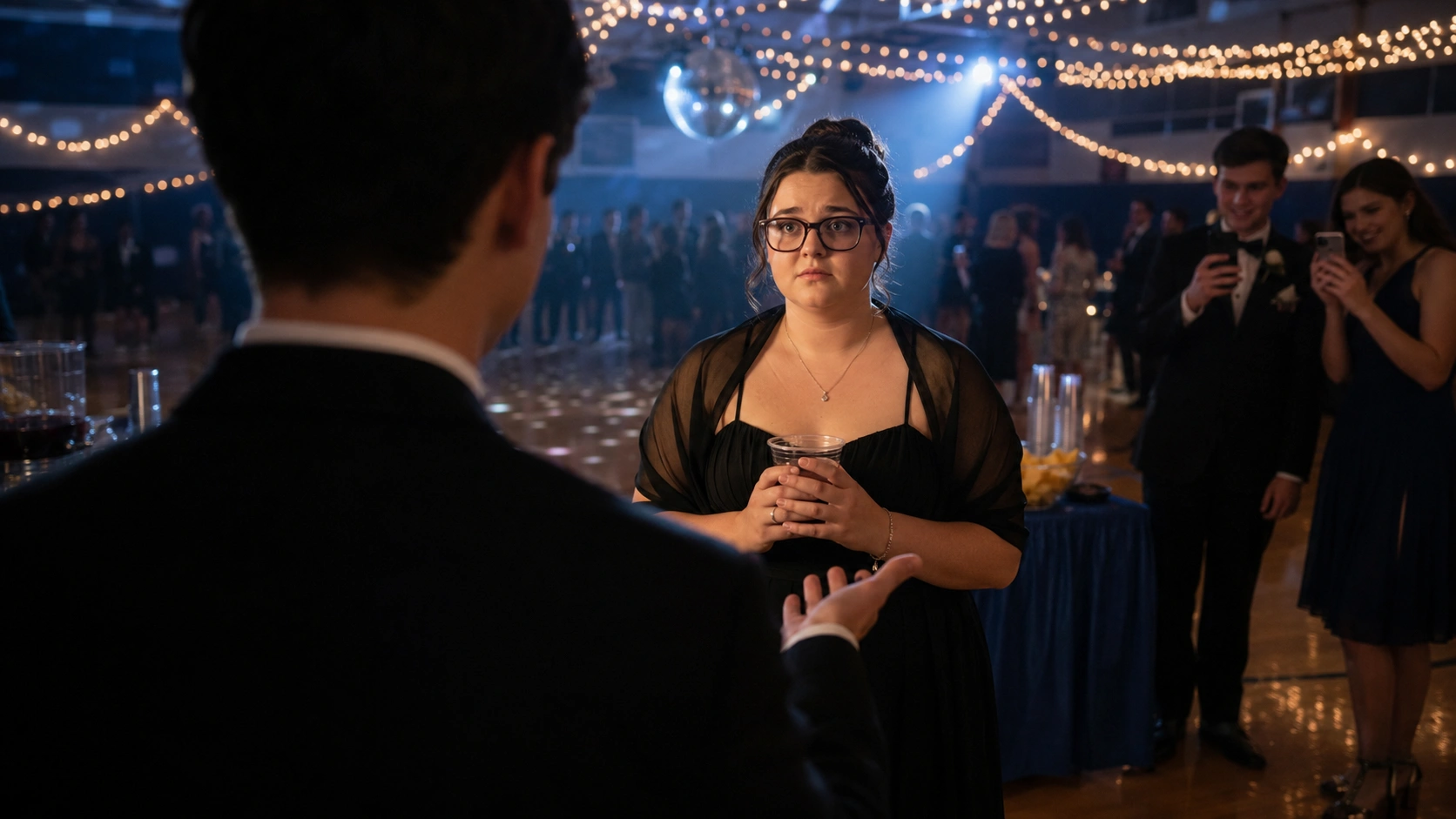
The gym looked like a snow globe someone had shaken too hard.
White lights hung from the rafters. A disco ball threw silver flecks across the polished floor. Bass thumped through the speakers, and two hundred seniors pretended this was the best night of their lives.
Lena Parker stood beside the punch table.
She hadn’t touched her cup in twenty minutes.
She wasn’t waiting for anyone.
She was counting the minutes until it would be acceptable to leave.
She was a big girl. She’d been a big girl her whole life. At fourteen she’d stopped trying to shrink herself and at sixteen she’d stopped apologizing for the space she took up, but she still knew, walking into a room, that she was the first thing people noticed and the first thing they judged.
Tonight she was wearing a black dress her mother had helped her pick out. It fit. It fit her, specifically. Not a hand-me-down. Not a compromise. Her own.
She still hated being here.
“You okay?” the girl at the table asked, refilling a bowl of chips.
“Fine.”
“You want me to grab someone?”
“No. Thanks.”
The girl gave her a small, pitying smile and walked away.
Lena hated that smile more than she hated the laughter.
Pity was worse than cruelty.
Pity meant they’d already decided who you were.
She adjusted her glasses. Pulled the thin black shawl tighter around her shoulders. Made herself smaller. Four years of practice.
Across the gym, Jason Miller was holding court.
Captain of the soccer team. Class president. Nine hundred thousand followers on TikTok since a highlight reel went viral in October. He wore his letterman like a crown. His friends laughed at everything he said.
He was talking about his commitment to Stanford.
“Full ride,” he said, loud enough that six other tables could hear. “Coach Peterson said I’m the highest recruit they’ve ever pulled from Ohio.”
“Bro, that’s insane.”
“I know.”
His eyes drifted across the gym. Bored. Hungry for a new game.
They landed on Lena.
The smile that crossed his face was the smile of a boy who had never once been told to stop.
“Watch this.”
“What are you gonna do?”
“Trust me.”
“Miller, don’t—”
“Just watch.”
He crossed the floor like he owned it. Because in the eyes of everyone in that gym, he did.
Lena saw him coming and looked down at her cup.
Not me. Not me. Not me.
He stopped in front of her.
“Hey.”
She looked up.
“Hey.”
“Dance with me.”
She blinked.
“What?”
“Dance with me.”
Around them, the volume of the room dropped. Not because the music got quieter. Because everyone else did.
Phones started coming out.
She saw them. She’d been seeing them her whole life.
“Why?”
“Why what?”
“Why do you want to dance with me?”
Jason laughed. Loud enough for the phones.
“Because it’s prom. Because you’re standing here alone. Because I’m a nice guy. Pick one.”
“You’re not a nice guy.”
“Ouch.” He grinned at his friends. “She’s got jokes.”
“I’m serious.”
“So am I.” He held out his hand. “One dance.”
She looked at the hand.
She looked past it.
Six phones. She counted them. Six kids she’d sat next to in homeroom for four years, filming her like she was the halftime show at their entertainment.
She should have said no.
She wanted to say no.
But there was a smaller, quieter part of her — the part she’d tried to kill for years — that whispered: what if he means it.
She put her hand in his.
The gym erupted.
Four hours earlier, she’d been standing in her bedroom, looking at herself in the mirror.
The black dress. Fitted. New. Her mother had cried a little when she’d tried it on the week before, because Lena hadn’t let her buy a “real” dress since junior high.
The shawl was on the bed. Thin. Black. Something to hide behind, if she needed to.
Her hair was pinned up in a tight, careful bun.
Her mother was in the doorway.
“You don’t have to go.”
“I know.”
“You’ve been saying you weren’t going to go for three weeks.”
“I know.”
“So why are you going?”
Lena looked at the shawl.
Then at herself in the mirror.
Then at her mother.
“Because if I don’t go tonight, I’m going to spend the rest of my life running from a room I didn’t walk into.”
Her mother didn’t answer.
“I have to walk into it, Mom. One time. On my terms.”
“And if it goes bad?”
“Then I have a plan.”
“What plan?”
Lena picked up her phone.
She showed her mother the recording.
She’d taken it that afternoon. Two hours before prom. From inside the janitor’s closet, where she’d been picking up an extension cord. She’d heard Jason’s voice through the wall and pressed record before she even knew why.
Her mother listened to twelve seconds.
She closed her eyes.
“Oh, Lena.”
“Yeah.”
“He said this about you.”
“Yeah.”
“And you’re still going.”
“Because now I know exactly what I’m walking into. And so does he. He just doesn’t know that I know.”
Her mother opened her eyes.
“Sweetheart. Whatever you’re going to do tonight. I trust you.”
“Thank you.”
“But if it goes wrong—”
“It won’t.”
“If it does—”
“Mom.”
“Yes?”
“I’ve been practicing four years for a room to be quiet.”
Her mother nodded, slowly.
“Then go make it quiet.”
Lena picked up the shawl.
She draped it over her shoulders.
One last time.
Back in the gym, the crowd was still erupting.
Not applause.
The other thing.
Whistles. Hoots. Someone yelled “GET IT, MILLER” from the bleachers. Someone else was already laughing into their phone camera.
Jason pulled her onto the floor with a flourish. He was a good dancer. That was the worst part. He knew how to make a girl look like she was floating and he knew how to make a girl look like she was drowning, and tonight he was doing the second one on purpose.
He spun her out too fast.
Her flats slid on the polished wood.
The crowd howled.
“CAREFUL, MAN!”
“DON’T BREAK HER!”
“OH MY GOD.”
He pulled her back in and dipped her, one hand cupping the back of her neck, the other on her waist, holding her too low, at an angle that made her look ridiculous instead of beautiful. He held it. Long enough for the phones to get it. Long enough for laughter to build.
Then he pulled her upright.
“See?” he called to the room. “Prom magic.”
The gym roared.
Lena’s ears were ringing.
She leaned in close, so only he could hear her.
“You told me this wasn’t a joke.”
He smiled at his friends over her shoulder.
“Relax. It’s just prom.”
“Just prom.”
“Yeah.”
“To you.”
“To everyone, Lena. Chill out.”
She stepped back.
Her hand was still in his.
She pulled it free.
“Let go.”
“What?”
“Let go of me.”
He let go. Held both hands up. Playing to the crowd.
“Whoa. Okay. Wow.”
Someone laughed.
“She’s mad, bro!”
“He tried to be nice!”
“UNGRATEFUL.”
Jason spread his arms, mock-innocent.
“I asked her to dance. I don’t know what I did wrong.”
Lena stood in the middle of the floor.
Two hundred faces.
Twenty phones.
Her ride wasn’t coming for another hour.
She could walk out. She could go to the bathroom and cry. She could call her mother.
She’d done all three, at various dances, at various points in her life.
Tonight she was tired.
Something inside her clicked into place.
Something that had been loading, quietly, for four years.
The music was still going. She looked at the DJ.
“Cut it.”
He blinked. “Huh?”
“Cut the music.”
“I can’t just—”
“Please.”
Something in her voice.
He cut the music.
The gym went silent.
Two hundred people, all staring.
Jason laughed once, uncertain.
“Okay, drama queen.”
She ignored him.
She walked to the DJ booth.
The DJ was a senior. Tyler. She’d tutored him in Algebra II sophomore year, back when he was failing and his parents were talking about pulling him from the soccer team. He’d passed with a B.
“Tyler.”
“Yeah?”
“Do you still have that file I sent you last week?”
His face changed.
“Wait. Right now?”
“Right now.”
“Are you sure?”
“I’ve never been more sure of anything in my life.”
He looked past her, at Jason, at the crowd, at the phones.
Then he looked at her.
“Yeah. I got it.”
She turned back to face the room.
She took off her glasses.
Folded them.
Set them on the DJ’s table.
Then she reached up and pulled the pins out of her hair.
Dark hair, thick, past her shoulders, fell loose down her back.
She reached for the collar of the thin black shawl she’d been wearing over her dress all night — the one her mother had told her she didn’t need — and she pulled it off her shoulders.
Bare arms. Bare shoulders. The dress fit her the way it was supposed to fit her.
She dropped the shawl on the DJ’s table like it weighed nothing.
Because it didn’t.
Not anymore.
Two hundred people were watching.
Some of them expected her to cry.
Some of them expected her to run.
Not one of them expected what came next.
She stepped back onto the dance floor.
She looked at Tyler.
She nodded.
The music that came next was not the wedding-reception pop the DJ had been running all night.
It was hers.
A track she’d chosen. A track she knew every beat of.
Because for four years, while everyone in that gym had been busy having a life, Lena Parker had been in a studio.
Six days a week.
Two hours a day.
Contemporary. Jazz. Hip-hop. Ballet on Saturdays.
Her instructor had told her, at fourteen, that she moved better than dancers half her size and twice her experience. Her instructor had also told her, at fifteen, that if she wanted to compete, she’d have to stop hiding.
Lena had said: not yet.
Tonight was yet.
She moved.
The first eight counts, she moved slow. Just enough to make sure everyone was watching.
Then she opened it up.
She hit a turn sequence that made a girl in the front row gasp out loud.
She dropped into a floorwork combination that had taken her six months to learn and eight weeks to make her own.
She was fast. She was precise. She was in control of every inch of her body — every pound of it, every line of it, every angle — and she moved with a confidence that made half the room forget what they thought they’d been watching for.
She wasn’t dancing at Jason.
She wasn’t dancing at the room.
She was dancing the way she danced when she was alone in the studio at nine p.m. with the mirrors and no one else.
The gym was silent.
Two hundred people, and not one of them was laughing.
She finished on a slow, precise line. Arms extended. Chin up.
The music faded.
For three seconds, nothing.
Then somebody in the back yelled — actually yelled — “OH MY GOD.”
The applause hit like a wave.
Not polite applause. Not “aren’t you a good sport” applause.
The real kind.
The kind that comes out of you before your brain has time to decide to be jealous.
Even Jason’s friends were clapping.
Jason was not.
Jason was standing exactly where she’d left him, and his face had gone gray.
Lena walked toward him.
Slowly.
The room quieted again.
The phones stayed up.
She stopped three feet from him.
“Jason.”
“Lena, look—”
“I’m going to say something. Then I’m done.”
He closed his mouth.
“You asked me to dance because you wanted a story. You wanted your friends to laugh. You wanted a viral clip. I know that. Everybody in this room knows that.”
He glanced at his friends. None of them were looking at him.
“Lena—”
“I’m not done.”
He shut up.
“I said yes because I was tired.”
She let that sit.
“I was tired of being invisible. I was tired of hiding. I was tired of you. All of you.” Her eyes moved across the room. “For four years I let you decide what I got to be. I’m done.”
“It was a joke,” Jason said. His voice cracked at the edge. “It was just—”
“It wasn’t a joke to me.”
“Lena. Come on. I didn’t mean—”
“Tyler.”
“Yeah?”
“Play the other file.”
Jason’s face changed.
“What other file?”
Tyler hit a button.
The gym’s big projector screen — the one they used for pep rallies and slideshows — lit up behind the DJ booth.
And Jason Miller’s own voice filled the gymnasium.
“Bro, watch this. I’m gonna ask the fat girl to dance. My follower count’s gonna go crazy.”
His voice.
Clear as day.
Through the speakers.
Two hundred people heard it.
“Which one?”
“Black dress. By the punch table. You know who I mean.”
“Dude.”
“What? It’ll be funny. I’ll spin her out, she’ll eat it, we clip it, done. Free content.”
“You’re a psycho.”
“I’m an artist.”
Laughter, on the recording.
Not in the gym.
The gym was dead silent.
Jason’s face was the color of the concrete wall behind him.
“How did you—”
Lena spoke quietly.
“You said it in the locker room hallway. Two hours before prom. Right next to the janitor’s closet, which is where I was, because I was picking up the extension cord Tyler asked me to grab.”
“Lena—”
“I recorded it on my phone.”
“You can’t— that’s illegal—”
“Ohio’s a one-party consent state, Jason. I was there. It’s legal.”
Somebody in the crowd said “oh my God” very quietly.
Jason looked around the gym.
Everyone was looking back.
His friends had physically stepped away from him. One of them was holding up a phone, but it wasn’t pointed at Lena anymore.
“Delete it,” Jason said.
“No.”
“Lena. I’m asking you. Please.”
“You’re not asking. You’re begging. There’s a difference.”
“My scholarship—”
“I know about your scholarship.”
His mouth opened.
Closed.
“Stanford’s code of conduct is public, Jason. I read it this afternoon. Your commitment isn’t official until August. Coach Peterson can pull it. Coaches have pulled scholarships for less than this.”
“You wouldn’t.”
“I already did.”
He stopped breathing.
“I emailed him the file forty-five minutes ago. Before I walked in here.”
“You— what—”
“I wanted to see what you’d do first. If you’d apologized in the first ten minutes, I would’ve emailed him again and told him to delete it. I gave you a chance, Jason. You spun me on the dance floor and called it prom magic.”
Jason took a step back.
Somebody in the crowd said, softly, “holy shit.”
“You didn’t have to do that,” Jason said. His voice was very small now. “You didn’t have to send it before you even knew if—”
“I did know.”
“You didn’t.”
“I’ve known you since we were nine, Jason. I sat behind you in Mrs. Ellman’s fourth grade class. I know exactly who you are. So did everyone else. Nobody wanted to say it out loud because you were fun and you were popular and you scored goals. But I know you.”
She held up her phone.
“And now they do.”
She tapped it once.
Every phone in the gymnasium chimed at the same time.
Two hundred notifications.
Every senior at Roosevelt High had just gotten a group text.
The recording. Attached. Twelve seconds long.
Somebody in the back started to laugh. Not at Lena. At Jason.
The sound spread like fire.
Jason turned in a slow circle.
His friends wouldn’t meet his eyes.
The girl he’d taken to prom — Ashley, blonde, homecoming court, dating him since October — was already walking toward the exit with her heels in her hand.
“Ashley—”
“Don’t.”
“Ash, come on—”
“Don’t touch me, Jason.”
She left.
The doors thumped shut behind her.
Jason turned back to Lena.
His eyes were wet.
“You’ve ruined my life.”
Lena tilted her head.
“No, Jason.”
“You have. You just—”
“I told the truth about what you said.”
“You—”
“You ruined your own life. I just stopped covering for it.”
Somebody in the crowd clapped.
One person.
Then two.
Then twenty.
Then the whole gym.
Not for Jason.
For her.
Lena didn’t smile.
She wasn’t done.
She turned to face the room.
“Before I go. One more thing.”
The applause died.
“Every one of you filmed me tonight. Every one of you laughed. Every one of you has been laughing for four years.”
Nobody said anything.
“I’m not going to remember most of you. I’m going to Juilliard in the fall. I got in three months ago. Full scholarship. Contemporary dance.”
The gasps were audible.
“I didn’t tell anyone because I didn’t want you to be nice to me for the wrong reason. I wanted to see who was decent when they thought I was nothing.”
She looked around the room.
“A few of you were.”
Her eyes found a girl near the bleachers — quiet, in a green dress. The girl who’d once given Lena her lunch when Lena forgot hers. The girl who had never laughed. Not once.
“Maya.”
Maya looked up.
“Thanks for junior year.”
Maya’s eyes filled with tears.
Lena walked to the DJ booth.
Picked up her glasses.
Left the shawl where it lay.
She walked past Jason without looking at him.
At the doors, she stopped.
She looked back one time.
Jason was still standing in the middle of the floor. Alone. Two hundred people, and not one of them was near him.
He looked exactly the way she’d felt for four years.
She held the door open for herself.
She walked out.
Behind her, before the door swung closed, she heard one of Jason’s friends — Dylan, the one who’d told him “you’re a psycho” on the recording — say, loud and flat:
“I told you, man.”
“Dylan—”
“No. I told you. In the hallway. I told you not to.”
“Dude, come on—”
“Don’t ‘dude’ me. My cousin goes to Stanford. She’s gonna hear about this by tomorrow.”
“Dylan, please—”
“I gotta go.”
“Dylan—”
“I said I gotta go.”
Footsteps. The other door. Somebody else leaving.
Then somebody else.
Then somebody else.
Lena didn’t look back.
She let the door close behind her.
Her mother was in the parking lot in the old Honda, exactly where Lena had asked her to be.
“Sweetheart? How did—”
“Drive.”
“Are you okay?”
“I’m okay, Mom. Drive.”
Her mother drove.
Two blocks from the school, Lena finally exhaled.
Her hands were shaking.
Not from fear.
From adrenaline finally leaving her body.
“Lena. Talk to me.”
“I did it.”
“You did what?”
“I did the thing. All of it. The dance. The recording. The email.”
Her mother was quiet for a long time.
Then: “And?”
“And I feel like myself. For the first time. In four years.”
Her mother took one hand off the wheel and put it on Lena’s.
They didn’t say anything else the whole way home.
Her phone had one hundred and forty-seven unread messages by the time she got home.
She scrolled through them at the kitchen table while her mother made her tea.
Most were from numbers she didn’t recognize.
I’m so sorry.
Lena, this is Mrs. Kessler from AP English. I just saw the video. Please come see me Monday.
hey it’s Brandon from bio. i was there tonight. i didn’t laugh but i didn’t stop it either. i’m sorry. that’s it.
Ms. Parker, this is Coach Peterson at Stanford. Please call this number Monday morning at your earliest convenience.
She read that one twice.
She showed it to her mother.
“Should I call him?”
“Do you want to?”
“I don’t know.”
“Then wait until you do.”
She waited.
Sunday morning she still didn’t know.
She called anyway.
He picked up on the second ring.
“Coach Peterson.”
“Hi. This is Lena Parker.”
A pause.
“Ms. Parker. Thank you for calling.”
“You wanted to talk to me?”
“I did. I wanted to say two things, if that’s all right.”
“Okay.”
“First. I received your email. I’ve spoken with our compliance office and with Jason’s family. His offer is rescinded. That decision was already made before your recording became public. I want you to know that.”
“Okay.”
“Second.”
He paused.
“I’ve been coaching at this level for twenty-one years. I have seen a lot of talented young men make one bad decision and be forgiven for it. Jason didn’t make one bad decision. He described, in detail, a plan to publicly humiliate a classmate for internet content. Then he did it. Then he laughed about it. That is not a bad decision. That is who he is right now. Maybe he grows out of it. I hope he does. But he doesn’t get to grow out of it at my program.”
Lena didn’t say anything.
“You don’t owe me a response, Ms. Parker. I wanted you to hear it from me directly.”
“Thank you.”
“Take care of yourself.”
“You too.”
She hung up.
Her mother was standing in the doorway.
“Well?”
“He said Jason was already cut. Before the video went public.”
“Because of your email.”
“Yeah.”
“Do you feel bad?”
Lena thought about it.
“No.”
“Good.”
By Sunday morning, the twelve-second clip had ninety-one million views.
The full video of Lena’s dance — someone had posted it in HD — was at a hundred and forty million.
Stanford issued a two-sentence press release. Jason Miller’s National Letter of Intent has been rescinded. The university has no further comment.
Roosevelt High’s principal called Lena on Monday.
“Ms. Parker. I want to apologize. On behalf of the school.”
“For what, specifically?”
“For… for not seeing what was happening.”
“You saw. You just didn’t do anything.”
Silence on the line.
“You’re right. I didn’t. I’m sorry.”
“Thank you.”
“Is there anything the school can do to make it right?”
“Yes.”
“Anything.”
“Fund a real anti-bullying program. Not an assembly. A program. With counselors. And follow-up. And consequences that actually happen.”
“…I’ll bring it to the board this month.”
“Do it this week.”
He did it that week.
Monday morning, Lena walked into Roosevelt High for the first time as herself.
No shawl.
No oversized glasses.
Dark hair loose. Jeans. A plain white T-shirt that fit.
She’d expected stares. She got something stranger.
She got silence.
People moved aside for her in the hallway.
Not because they were afraid of her.
Because they didn’t know what to say.
At her locker, a girl she’d never spoken to — Rachel from the yearbook committee — stopped beside her.
“Lena.”
“Hi.”
“I have to tell you something.”
“Okay.”
“Junior year. Homecoming. I was one of the girls who laughed when your dress ripped.”
Lena remembered.
She remembered every one of them.
“Okay.”
“I’m sorry. That’s all. I know it’s not enough. I just — I needed to say it.”
“Thank you.”
“Are you mad?”
“I was.”
“And now?”
“Now I have a plane ticket.”
Rachel almost laughed. Then she saw Lena wasn’t joking, and she didn’t.
“Good luck at Juilliard.”
“Thanks.”
Rachel walked away.
Six other people said some version of the same thing before third period.
Lena said “thank you” to all of them.
She didn’t say “it’s okay.”
Because it wasn’t.
But she didn’t need it to be, anymore.
That was the difference.
At lunch, Maya slid into the seat across from her in the cafeteria.
“Hi.”
“Hi.”
“Can I sit?”
“You already are.”
“Right.”
Maya was carrying an entire lunch tray of things she probably wasn’t going to eat.
She looked at Lena for a second.
“I have a question.”
“Okay.”
“Did you know? About Juilliard? When I gave you my sandwich last spring?”
“No. I applied in October.”
“Would you have taken the sandwich anyway?”
“Yes.”
“Why?”
“Because you weren’t offering it because you felt sorry for me. You were offering it because you’d made two by accident.”
“I did make two by accident.”
“I know. That’s why I took it.”
Maya laughed, a small startled sound.
“You were paying attention.”
“I was always paying attention, Maya. That was the whole problem.”
Maya looked down at her tray.
“Lena.”
“Yeah.”
“I should have said something. Sooner. About Jason. About all of them. I saw it and I didn’t say anything because I didn’t want them to start on me.”
“I know.”
“That’s not an excuse.”
“No. It isn’t.”
“Are you mad at me?”
“No.”
“Why not?”
“Because you gave me a sandwich, Maya. You didn’t have to do that either. Nobody else did that.”
Maya’s eyes got wet.
“Please don’t cry in the cafeteria.”
“I’m trying.”
“Try harder.”
Maya laughed and wiped her eyes.
“When you go to New York—”
“Yeah?”
“Can I text you?”
“Yes.”
“Really?”
“Maya. Yes.”
“Okay.”
“Eat your lunch.”
Maya ate her lunch.
They didn’t talk much after that.
They didn’t have to.
Across the cafeteria, at a table by the windows, Ashley — Jason’s ex — sat by herself.
Nobody was sitting with her.
Two weeks ago, that table had held six people.
Lena watched her for a moment.
Then, quietly, she picked up her tray, walked across the cafeteria, and sat down opposite her.
Ashley looked up, startled.
“…What are you doing?”
“Eating.”
“With me?”
“You’re alone.”
“So?”
“So I know what that feels like.”
Ashley’s mouth opened.
Closed.
“You could sit anywhere else.”
“I know.”
“Why are you sitting here?”
Lena unwrapped her sandwich.
“Because when he was humiliating me on Saturday, you were the first person to walk out. You didn’t laugh. You didn’t film. You picked up your shoes and you left.”
Ashley looked down at her tray.
“I dated him for eight months.”
“I know.”
“I thought I knew him.”
“You did know him. You just didn’t want to.”
Ashley didn’t answer for a while.
“Are we friends now or something?”
“No.”
“Then what is this?”
“This is one lunch.”
“Why?”
“Because a year from now you’re going to remember whether anyone sat with you this week.”
Ashley’s eyes filled.
She wiped them fast.
“Thank you.”
“You’re welcome.”
They ate in silence.
When the bell rang, they went to different classes.
They never sat together again.
Lena had done what she came to do.
That was enough.
Jason didn’t come back to school.
His parents pulled him for the last three weeks and he graduated on a technicality, in the counselor’s office, alone. He deferred a year. He tried out at three D-II schools. Two passed. The third gave him a walk-on tryout and cut him after preseason.
Lena heard about it from Maya, who heard about it from her cousin, who worked at the college.
She didn’t feel anything.
That was the strangest part.
She’d thought she’d feel something.
She just felt free.
The night before she left for New York, her mother knocked on her bedroom door.
“Can I come in?”
“Yeah.”
Her mother sat on the edge of the bed. Looked at the packed suitcase in the corner. The plane ticket on the nightstand.
“I want to tell you something. And I don’t want you to interrupt.”
“Okay.”
“I’m sorry.”
“Mom—”
“I said don’t interrupt.”
Lena closed her mouth.
“When your dad left, and it was just us, and money was tight, and you started coming home from school crying — I told you to keep your head down. I told you not to make waves. I told you that if you were quiet enough, they’d leave you alone.”
“Mom, you did your—”
“I taught you to hide.”
Lena didn’t answer.
“I was scared. I didn’t know what to do. I told you the thing that had worked for me. And you did it. For four years. You did exactly what I told you to do.”
Her mother’s eyes were wet.
“I saw you on that video. Standing in the middle of that gym. And I realized — you didn’t do what I taught you. You did the opposite. And you were right. And I was wrong. For a really long time. I am so, so sorry.”
Lena reached over.
Took her mother’s hand.
“You did your best.”
“It wasn’t good enough.”
“You’re here now.”
“That’s not the same thing.”
“It is to me.”
Her mother cried.
Lena let her.
Then Lena said, very quietly:
“Mom.”
“Yeah.”
“I’m not hiding anymore.”
“I know.”
“I’m never hiding again.”
“I know, baby.”
They sat like that for a long time.
One week before she left for New York, Lena drove out to the studio.
Marisol was in the small office at the back, doing schedules.
“You’re not on the calendar today.”
“I know. I came to say goodbye.”
Marisol set down her pen.
“Sit down.”
Lena sat.
“You’ve been on the internet.”
“Yeah.”
“A lot.”
“Yeah.”
“I saw the video.”
“Which one?”
“Both.”
Marisol laced her fingers on the desk.
“When you first came in here at fourteen, do you remember what you told me?”
“I told you I wanted to learn to dance.”
“You told me you wanted to learn how to move so no one could ignore you.”
Lena blinked.
“I don’t remember saying that.”
“You did. It’s why I took you on for free the first year, when your mom couldn’t pay.”
“You did that for free?”
“You didn’t know?”
“Mom said you had a scholarship.”
“She lied. Bless her.”
Lena didn’t say anything for a long moment.
“Marisol.”
“Yeah?”
“Thank you.”
“Don’t thank me. You did the work.”
“I couldn’t have done the work without a room.”
“Fine. You’re welcome.”
Marisol reached into her desk and pulled out a small wrapped box.
“Don’t open it here.”
“What is it?”
“Something for New York. Open it when you’re homesick.”
Lena took the box.
“I’m going to miss this place.”
“I know.”
“I’m going to miss you.”
“I know.”
“Marisol—”
“Lena. Listen to me.”
“Okay.”
“You are going to go to Juilliard. You are going to sit in class next to people who have been on television since they were nine. You are going to feel small for a week.”
“Okay.”
“Do not shrink.”
“I won’t.”
“You already know how to shrink. You spent four years doing it. You are very good at it. Do not do it in that room.”
“I won’t.”
“Promise me.”
“I promise.”
Marisol stood.
She hugged her.
Neither of them said anything else.
Lena left with the box under her arm.
She opened it on the plane.
Inside was a pair of ballet shoes, worn thin, signed on the sole.
Marisol’s own pair, from the last stage she’d ever been on before she blew her knee out at twenty-two and started teaching.
Lena cried quietly for the last hour of the flight.
The woman next to her pretended not to notice.
That was kindness too.
Three months later, Lena posted one photograph.
A studio. Mirrors. Wood floor. Her, mid-turn, hair loose, no glasses, one arm extended in a line so clean it looked like it had been drawn.
The caption was one sentence.
I was never late. I was just waiting until I chose to be seen.
It got a million likes in six hours.
She didn’t check it again.
She was already in the studio the next morning at seven a.m., working on a piece nobody would see for another year.
She had a lot of catching up to do.
Not on being seen.
On being herself.
And this time, she was doing it out loud.
Original fictional stories. AI-assisted creative content.