“Don’t say anything. Keep walking and stay quiet.”
The man’s hand tightened around the little girl’s shoulder.
Emma Carter kept her eyes on the floor.
She was eight years old, wearing a yellow sweater, jeans, and a backpack that looked too heavy for her body. Her lips trembled. She did not cry.
“Move. Don’t look at anyone.”
He pushed her forward through the crowded station, fingers digging into her shoulder.
People passed without noticing.
Families. Travelers. A woman with coffee. A man reading headlines on his phone.
Then Emma saw him.
White hair. Kind eyes. A name tag that read FRANK. A phone resting beside his elbow at the information booth.
She stumbled on purpose.
Her shoulder bumped the counter. A folded paper slid from her sleeve and landed beside his cup.
HELP ME.
Frank did not gasp. He did not shout. He watched the man pull the girl toward the exit, then slowly picked up the phone.
“Yes, this is an emergency. There’s a little girl in danger.”
His voice stayed calm. His eyes never left them.
“She’s with a man in his thirties. They’re heading toward the exit.”
For the first time that morning, Emma let herself hope someone had seen her.
Emma had learned three rules before sunrise.
Do not cry. Do not run. Do not say Mom’s name.
Ryan had told her all three, standing in her bedroom doorway, her backpack in one hand and her mother’s phone in the other.
To Emma, he had been “Mom’s friend” for almost a year.
At first he brought groceries. He fixed the cabinet door that never closed right. He made pancakes shaped like hearts and told her mother she deserved someone who could take care of her.
Emma never liked him. She couldn’t explain why — only that he smiled too fast, watched too closely, and lowered his voice the second her mother left the room.
Adults wanted reasons. Emma only had feelings. So she stayed quiet.
Then her mother got quiet too.
Maya Carter used to sing while she cooked. She danced badly in the kitchen. She let Emma wear mismatched socks because “life’s too short for matching everything.”
After Ryan moved in, the singing stopped. The socks had to match. The apartment turned clean, cold, and full of rules.
Emma noticed the bruises first. Small ones. A purple thumbprint on a wrist. A red line near a collarbone, gone before anyone could ask twice.
“I bumped the door,” Maya would say, smiling too fast — the same fast smile Ryan wore.
Emma checked every door in the apartment after that. None of them looked mean enough to leave a mark like his.
The night before everything changed, Emma woke to whisper-shouting — the kind adults use when they think children are asleep.
She crept down the hall and found her mother in the kitchen, a folder pressed to her chest. Ryan blocked the door.
“You had no right to go through my bag,” he said.
“You said you were paying rent. You said you were helping us.” Maya’s voice shook. “These are my mother’s checks.”
Emma didn’t understand all the words. She understood the folder.
Her grandmother had died two years earlier and left a small insurance payment for Emma’s future. Maya kept the papers in a blue box under her bed.
Ryan had taken them.
“You forged my signature,” Maya said, holding up a page.
Something flat and ugly replaced the sweet man Emma had never trusted. “You don’t know what you’re talking about.”
“I’m calling the police.”
“No. You’re not.”
Emma made a sound before she could stop herself. Both adults turned. Maya’s face went white.
“Emma. Go to your room.”
Ryan looked at Emma — not angry. Worse. Interested.
The next hour blurred.
Maya pushed Emma into her bedroom. “Pack your school bag. Put your grandmother’s envelope inside. Don’t let him see.”
Then she took Emma’s face in both hands. “If something happens, you find a grown-up. You write it if you can’t say it. Do you understand?”
Emma nodded, already crying.
“You are not in trouble. None of this is your fault.”
Ryan’s footsteps came down the hall. Maya stood in the doorway to block him while Emma hid the envelope in her backpack — and a torn notebook page in her sleeve. Two words, written in purple marker.
Help me.
At 5:42 a.m., Ryan woke her. The apartment was too quiet. Her mother wasn’t in the kitchen, the bathroom, the living room.
Ryan stood by the bed, smiling like nothing was wrong. “Get dressed.”
“Where’s Mom?”
“She’s resting.”
“I want to see her.”
The smile vanished. “Your mother asked me to take you to school.”
Emma looked at the window. Still dark. School didn’t open for two hours.
He tossed her backpack onto the bed. “Now.”
In the hallway, she saw a smear near the kitchen tile. Small. Almost cleaned. Her stomach turned.
“Where’s Mom?”
Ryan crouched in front of her. For one second she thought he might pretend again.
He didn’t.
“Listen carefully. You’re going to walk with me. You’re going to keep your mouth shut. If you scream, your mother gets worse. If you run, your mother gets worse. If you tell anyone, you will never see her again.”
Emma couldn’t breathe. “Is she dead?”
His hand closed on her shoulder. “Not if you behave.”
That was why she didn’t scream when they left. That was why she walked down the stairs with him, why she sat in the back of his car while he drove toward the central station instead of school.
The station was crowded with morning travelers. That scared her at first.
Then it gave her an idea. Crowds meant people. People meant maybe someone would see.
Ryan parked in a side lot and took her hand too tightly. “You’re going to stay quiet.”
She nodded. Her sleeve brushed the note hidden against her wrist.
Help me.
Inside, announcements echoed overhead. Suitcases rolled across polished floors. A child laughed near the coffee stand. A security guard stood by the far entrance, but Ryan kept her angled away from him.
“Don’t say anything. Keep walking and stay quiet.”
His fingers dug in harder.
Emma’s eyes moved fast. Ticket counter. Coffee cart. Restrooms. Information booth.
An older man sat behind it — silver hair, glasses, a paper cup of tea by his phone, a name tag that read FRANK.
Ordinary. Exactly what she needed.
“Move. Don’t look at anyone.”
He pushed her forward. Her heart pounded so hard she thought he could hear it.
As they passed the booth, she let her foot catch the wheel of a stranger’s suitcase. She stumbled. Her shoulder hit the counter. Ryan muttered under his breath and grabbed her arm.
“Watch it.”
Her hand opened. The note slid onto the counter beside Frank’s tea.
She didn’t look at it. She didn’t look at Frank. She kept walking.
But she heard the smallest sound behind her. Paper, unfolding.
Frank Dawson had worked that booth for eleven years. Before that, twenty-six years as a police dispatcher.
He knew panic — not the loud kind. The quiet kind that sits in a child’s shoulders while an adult smiles too hard.
He’d clocked the man before the note ever landed. Thirties. Brown jacket. Hand gripping the girl’s shoulder like a leash. Eyes scanning exits, not storefronts.
When the paper hit the counter, Frank already knew he wouldn’t chase. Twenty-six years had taught him not to chase panic with panic.
He read it under the counter.
HELP ME.
He picked up the phone. His hand didn’t shake.
“Yes, this is an emergency. There’s a little girl in danger.”
The operator asked for details. Frank kept his eyes on Emma.
“She’s with a man in his thirties. They’re heading toward the exit.”
“Location and description?”
“Central station, east concourse, near Gate 12. Girl’s about eight, yellow sweater, black backpack. Male suspect, brown jacket, jeans, dark hair, hand on her shoulder. She passed me a note. It says help me.”
Frank stood, slow enough not to alarm anyone. “They’re moving toward the bus exit. I’m following at a distance.”
Officers were already in the building. Seconds mattered. Doors mattered. If Ryan got her onto a coach, the whole city would become a map of missed chances.
Frank set the phone low on speaker and stepped out from the booth. He didn’t run. Running would make Ryan run.
Ahead, Ryan tightened his grip. “Did you drop something?”
“No,” Emma said. “I tripped.”
He glanced over his shoulder. Frank had stopped at a vending machine, studying snacks like a man with nowhere to be.
Ryan turned back — and saw two officers near the far entrance. Too far. But close enough to change him.
“Faster.”
Emma stumbled again. This time he didn’t stop.
The bus gate was twenty feet away.
Frank knocked his own cup of tea to the floor, hot liquid spreading across the tile near the gate. “Ah, damn it,” he said, loud enough to turn heads. A cleaner spun around. A woman with a suitcase stopped dead.
For three seconds, the path narrowed.
Ryan tried to steer Emma around the spill. Frank stepped into his way.
“Sorry about that.” He looked straight at Emma — the first time all morning. “You okay, sweetheart?”
“She’s fine,” Ryan snapped.
“I asked her.”
Emma’s lips trembled. Ryan’s hand slid from her shoulder to the back of her neck. A warning.
If you tell anyone, you will never see her again.
Her throat closed.
Ryan smiled at Frank. “My daughter’s shy.”
“What’s her name?”
“Lily,” Ryan said, too fast.
Emma flinched. Frank saw it. So did the operator, still listening on the line.
“Funny,” Frank said evenly. “She looks like an Emma to me.”
Ryan’s face went still.
He hadn’t guessed. The dispatcher on the line had already pulled a fresh report — a neighbor’s call about an injured woman and a missing child. Emma Carter. Mother Maya Carter. Suspect Ryan Cole.
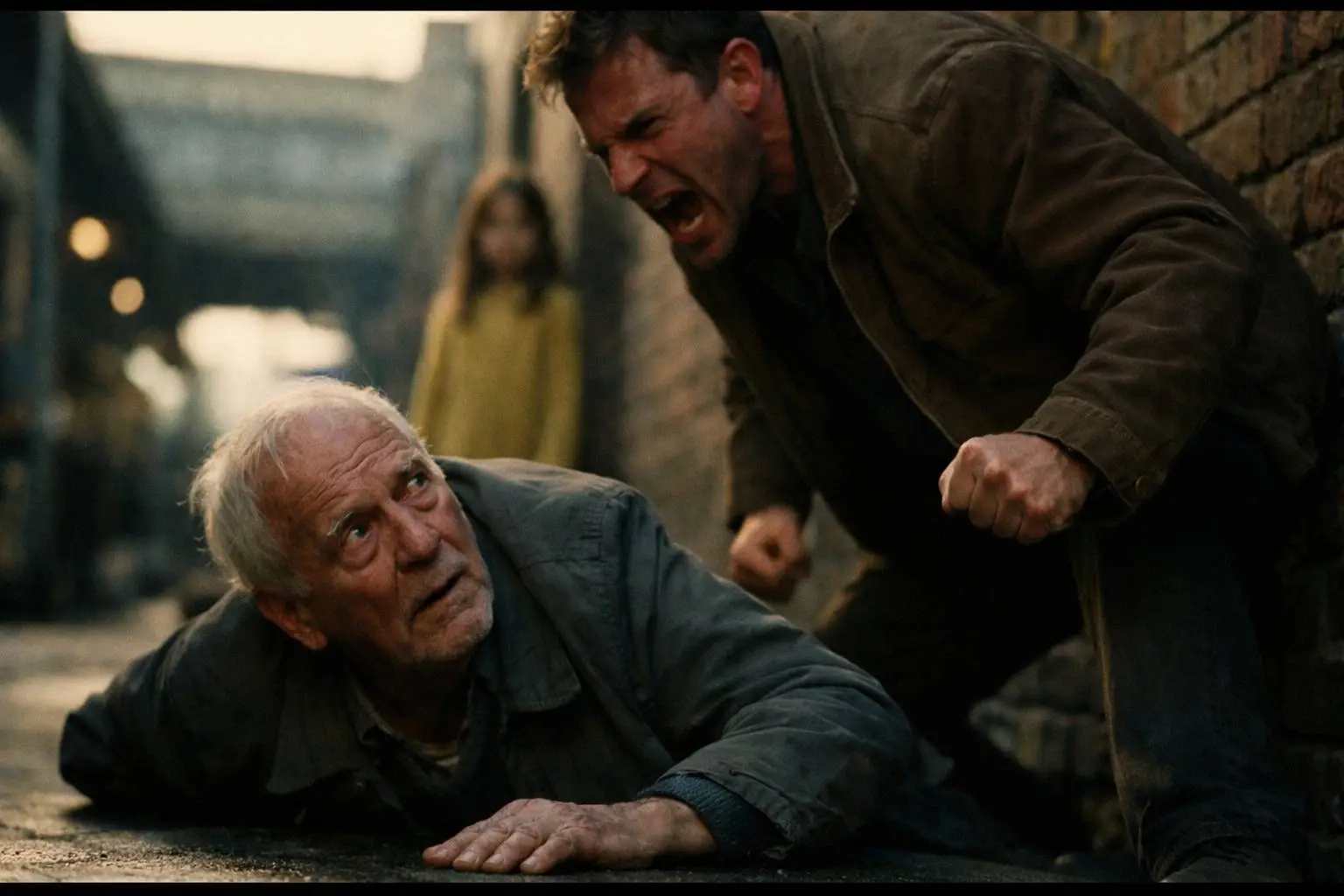
Ryan shoved Frank hard. The old man stumbled back through the side doors and went down on the pavement outside, his shoulder hitting concrete, breath knocked out of him.
Ryan loomed over him in the narrow alley beside the station, fists clenched, fury breaking through the calm mask he’d worn all morning.
“How dare you get in my way?”
Frank didn’t answer. He just breathed hard, eyes wide but steady, refusing to look away.
A few feet back, Emma stood pressed against the brick wall of the alley — but only for a second. Her face stopped shaking. Something in her settled.
“I have to help him,” she said, quiet and clear.
Then she screamed.
Ryan grabbed her wrist and ran — but the delay had already done its work. Police flooded the alley.
“Stop!”
He dragged her toward the doors. She let her legs go heavy, the way her mother once taught her for tantrums when she was small. Make yourself heavy.
He yanked harder. She screamed the only thing she could think of.
“My name is Emma Carter! He’s not my dad!”
Heads turned. A transit officer hit Ryan before he reached the doors. Emma went down hard, scraping her knees on the tile.
Frank reached her first. He knelt slowly, hands open and visible. “You’re safe. Don’t move too fast.”
She sobbed. “My mom. He hurt my mom.”
“I know, honey.” His jaw tightened. “Help is going there too.”
Ryan fought until three officers pinned him. Even then he kept shouting. “She’s confused! Her mother asked me to take her!”
Frank pulled the folded note from his pocket and held it out to the nearest officer.
“She asked for help.”
That ended the performance.
Within twenty minutes, police confirmed what Emma had feared and dreaded in equal measure. Maya Carter was alive. Barely.
A neighbor had heard a crash after Emma left and called 911. Officers found Maya unconscious in the bedroom, bleeding but breathing. Ryan had locked the door behind him and taken her phone before he left.
She was rushed to St. Mercy Hospital. Emma went there too, under police escort, still refusing to let go of her backpack.
A child advocate tried gently to take it from her.
“My mom said not to let him see,” Emma said, shaking her head.
The detective crouched to her eye level. “What’s inside?”
She opened it with trembling hands. A blue envelope — forged checks, insurance papers, bank records, and a flash drive Maya had pulled from Ryan’s bag the night before everything broke apart.
The detective looked through it, then back at Emma. “You protected this?”
“Mom told me to.”
Frank, who had insisted on riding along until Emma was safely surrounded by people who could help her, stood in the hallway outside and wiped his eyes. Thousands of emergency calls in his life. This was the one that would stay.
Maya woke after surgery. Her first word was a name.
“Emma?”
The nurse brought her in. Emma climbed onto the bed beside her mother, careful of the tubes and bandages.
“I gave the note,” she sobbed. “I gave it to the man at the counter.”
Maya touched her daughter’s hair with a bandaged hand. “You did so good.”
“I was quiet like you said.”
“No.” Maya’s voice broke. “You were brave like I hoped.”
Ryan’s arrest pulled at a thread that didn’t stop unraveling.
He’d been draining Maya’s mother’s insurance money for months — forged documents, opened accounts, planned to leave the state with Emma as leverage if Maya survived. Detectives found bus tickets under a false name. One adult. One child. Destination six hundred miles away.
They also found messages to a cousin.
If the woman talks, the kid keeps her quiet.
That message became the spine of the prosecution’s case.
At trial, Ryan tried the same performance he’d used at the station. Soft voice. Sad eyes. Concerned tone. He claimed Maya was unstable. He claimed Emma misunderstood. He claimed he’d only been trying to protect the child.
Then the prosecutor played the station surveillance footage.
Ryan’s hand on Emma’s shoulder. His mouth near her ear.
“Don’t say anything. Keep walking and stay quiet.”
Then: “Move. Don’t look at anyone.”
Emma stumbling at the booth. Frank unfolding the note. The 911 call.
“Yes, this is an emergency. There’s a little girl in danger.”
“She’s with a man in his thirties. They’re heading toward the exit.”
Frank asking the child’s name. Ryan saying, “Lily.” Emma flinching.
And finally — Emma’s voice, cracking across the courtroom speakers.
“My name is Emma Carter! He’s not my dad!”
The jury stopped looking at Ryan after that.
Maya refused to let Emma testify in front of him. The court accepted a recorded statement instead — Emma seated with a therapy dog beside her, hands folded in her lap.
“I was scared because he said Mom would get worse if I told. But Mom said find a grown-up. So I found one.”
Frank testified too. The defense tried to suggest he’d overreacted to a frightened child.
He adjusted his glasses. “I was a dispatcher for twenty-six years. Children don’t slip notes saying help me because they’re shy.”
The courtroom went quiet.
Ryan was convicted of kidnapping, assault, coercive control, fraud, unlawful restraint, and attempted witness intimidation. The financial charges multiplied when prosecutors discovered he’d run the same scheme on two other single mothers before Maya — charm first, control second, theft last. This time, the pattern made it into the record. His name. His face. His transcripts.
At sentencing, Ryan looked at Emma’s empty seat. “She was never in danger from me,” he said.
Maya stood with a cane, still healing, and answered before the judge could stop her.
“She was in danger because of you the moment she learned to be quiet.”
The judge let it stand.
After the trial, Maya and Emma moved across town. No Ryan. No locks he knew. No footsteps in the hallway that made Emma freeze mid-breath.
Frank visited once a month at first, telling himself it was just to check in. He’d become family by accident.
Emma called him “Mr. Frank” until the afternoon she made him a birthday card and wrote Grandpa Frank by mistake. She tried to scribble it out. Frank stopped her hand.
“I like that,” he said.
It stayed.
A year later, the station held a safety training day for staff. Frank didn’t want a ceremony. The station manager insisted anyway. They mounted a small sign near the information booth:
If someone silently asks for help, believe them.
Maya came with Emma, who wore a yellow sweater again — this time by choice.
When the small crowd applauded Frank, he looked embarrassed and shifted his weight like a man waiting for it to be over. Then Emma walked up and handed him a folded piece of paper.
For one terrible second his heart seized.
He opened it.
Thank you for reading it.
His eyes filled. He knelt and hugged her gently. “Thank you for being brave enough to write it.”
She shook her head. “Mom says brave doesn’t mean not scared.”
“Your mom’s right.”
Maya stood behind them, crying quietly — not from fear this time, but from the strange, aching relief of watching her daughter stand whole in the exact place she’d almost been taken.
Years later, Emma would remember the station in fragments. The sound of suitcase wheels. The smell of spilled tea. A hand too tight on her shoulder. A folded paper sliding off her sleeve. A calm voice on a phone, saying the words that started everything.
“Yes, this is an emergency.”
For a long time she had nightmares about the exit doors — always reaching them, always being pulled through.
Then one night the dream changed. She stumbled. The note fell. Frank picked it up.
And the doors disappeared.
She went to her mother’s room that night. Maya was already awake — mothers often are.
Emma climbed in beside her. “Do you think I saved you?”
Maya pulled her close. “You saved both of us.”
Emma was quiet for a while. “I didn’t feel brave.”
“Most brave people don’t.”
Because sometimes courage isn’t loud. Sometimes it’s a child keeping her eyes down while her hand opens. Sometimes it’s just two words on a torn piece of paper.
Original fictional stories. AI-assisted creative content.