Rain hit the windows of Carter’s Diner at exactly six-fifteen.
Maddie Reyes balanced three plates on one arm and a coffee pot in the other hand.
She’d been on her feet since four that morning.
In the corner booth, an old man in a worn canvas coat nursed a cup of black coffee.
Nobody recognized him.
Nobody ever did.
“Refill?” Maddie asked, already pouring before he answered.
“Thank you,” the old man said. “You didn’t have to ask twice.”
“You looked like you needed it.”
He studied her for a second too long. “Busy night.”
“Always is on Fridays.”
She moved on before he could say more.
At table six, a man in a charcoal suit snapped his fingers.
“Excuse me. Excuse me.”
Maddie turned. “Be right with you, sir.”
“I’ve been sitting here for twelve minutes.”
“I’m sorry, we’re a little short-staffed tonight.”
“That’s not my problem.”
She forced a smile. “What can I get you?”
“The steak. Medium rare. And don’t mess it up like last time.”
Maddie didn’t remember a last time. She’d never served him before.
But she nodded anyway. “Coming right up.”
In the corner booth, the old man watched.
He always watched.
Thirty minutes later, Maddie carried the steak out herself.
The suited man — his name tag from a conference badge clipped to his jacket read DEREK VANCE — barely looked up from his phone.
She set the plate down.
It slipped.
Not far. Just enough.
The plate tipped, and half the steak juice splashed onto the edge of his sleeve.
The diner went quiet.
Derek Vance stood up so fast his chair scraped backward.
“Are you kidding me?”
“I’m so sorry — let me—”
“Don’t touch me.” He held his arm away from her like she carried something contagious. “This is a four-hundred-dollar jacket.”
“I can get it cleaned, I’ll pay for—”
“You’ll pay for it?” He laughed, sharp and ugly. “On a waitress salary? That’s cute.”
A few customers shifted in their seats.
The old man in the corner booth set down his coffee cup.
“It was an accident,” Maddie said, her voice trembling now. “I’m sorry.”
“You people,” Derek said, loud enough for the whole diner to hear, “can’t even carry a plate straight. This is why this place is a dump.”
“Sir, please—”
“No. I want to speak to a manager. Now.”
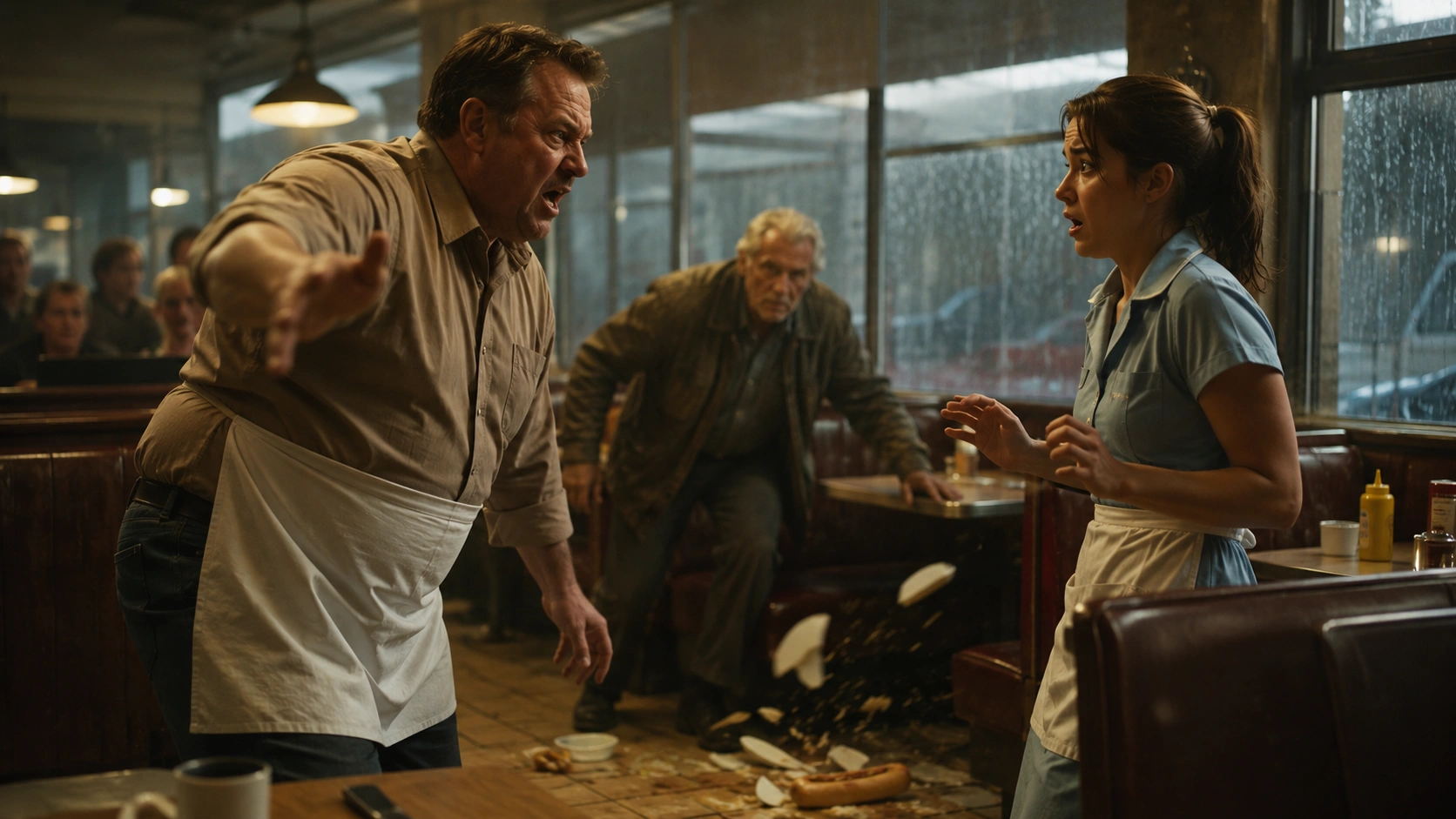
The manager, a heavyset man named Phil, came hurrying from the kitchen, wiping his hands on his apron.
“Sir, I apologize, what seems to be—”
“Your employee just ruined my jacket and my dinner.”
Phil’s eyes darted to Maddie. “Maddie, what happened?”
“It was an accident, Phil, I swear, the plate just—”
“She dumped scalding steak juice on me,” Derek interrupted. “I want her fired. Tonight.”
The diner had gone completely silent now.
Even the dishwasher in the back had stopped running water to listen.
Phil looked sick. “Sir, I’m sure we can work something out—”
“I don’t want it worked out. I want her gone. Or I’m calling corporate, the health board, and leaving a review that tanks this place into the ground.”
Maddie felt her throat close up.
She’d worked here for three years. Through her mother’s chemo. Through a broken engagement. Through nights she’d cried in the walk-in freezer so customers wouldn’t see.
“Phil,” she said quietly, “I need this job.”
Phil wouldn’t meet her eyes.
“Maddie… maybe you should head home for the night. We’ll talk tomorrow.”
“You’re firing me?”
“I’m not firing you, I just—”
“Yes, you are,” Derek said, sitting back down, satisfied. “Smart move.”
In the corner booth, the old man stood up.
For the first time all night, he moved with purpose.
“Excuse me.”
His voice wasn’t loud. But something in it made the whole diner turn.
Derek glanced over, irritated. “This doesn’t concern you, old man.”
“It does, actually.”
“And why’s that?”
The old man reached into his coat.
He pulled out a small brass key and a folded document, and set them both gently on the table in front of Phil.
Phil’s face went white.
“Mr. Carter,” Phil said, his voice cracking. “You’re — you’re back.”
The diner fell into a silence so complete you could hear the rain against the glass.
Derek blinked. “Carter? Like—”
“Like the name on the sign outside,” the old man said. “I own this diner. All four locations, actually. This one’s the original.”
Derek’s confidence drained out of his face like water from a cracked glass.
“You… you own this place?”
“I built it. Forty-one years ago. With my late wife. We used to wash dishes ourselves when we couldn’t afford help.”
“I — I didn’t know.”
“Of course you didn’t. I dress like this on purpose.” Mr. Carter glanced down at his worn coat. “You’d be amazed what people show you when they think you’re nobody.”
Derek’s mouth opened, then closed.
“Sit down, Mr. Vance,” Carter said calmly, though he hadn’t been invited to know the name. He’d read it off the conference badge. “Let’s talk about what just happened.”
Derek sat, slowly, like the chair might give out from under him.
“You came into my restaurant,” Carter continued, “and a young woman who has worked here for three years made a small, human mistake. An accident. And instead of grace, you gave her cruelty.”
“I was upset about my jacket—”
“You weren’t upset about your jacket.” Carter’s voice stayed level, but there was iron underneath it now. “You were enjoying it. I watched your face. You liked having someone to look down on.”
Derek said nothing.
“You didn’t just insult a waitress tonight,” Carter said. “You insulted every person who has ever walked through that door hoping to be treated like they matter. That’s not a policy violation. That’s a character flaw.”
Phil shifted uncomfortably. “Mr. Carter, should I—”
“Phil, you’re a good manager. But tonight you let fear make a decision your conscience should have made.” Carter turned to him. “Maddie keeps her job. Effective immediately, you have a raise to give her, and an apology.”
Phil exhaled like he’d been holding his breath for an hour. “Yes. Of course. Maddie, I’m so sorry, I panicked—”
“It’s okay, Phil,” Maddie said, though her hands were still shaking.
Carter turned back to Derek. “As for you—”
“Look,” Derek said, voice climbing higher, “I’ll pay for my meal, I’ll just go, there’s no need to make a scene—”
“You made the scene,” Carter said. “I’m just finishing it.”
He nodded toward the door.
“Please leave my restaurant. And don’t come back.”
Derek stood, fumbling for his wallet. “I have rights, I could sue for—”
“For what? Being asked to leave a private business after threatening and humiliating an employee in front of two dozen witnesses?” Carter gestured around the room. “I’m sure several of these good people would be happy to give statements. There are cameras at every table, Mr. Vance. We installed them after a man tried something similar two years ago.”
The blood drained from Derek’s face entirely.
“Get out,” Carter said quietly.
This time, no one argued.
Derek grabbed his jacket, his phone, his pride — what little of it remained — and walked toward the door.
No one stopped him.
No one spoke.
The bell above the door rang once as it closed behind him, and the rain swallowed the rest.
For a moment, the diner just sat in stunned silence.
Then Carter turned to Maddie.
His whole posture softened, the way a grandfather’s might.
“Are you alright?”
Maddie wiped at her eyes with the back of her wrist. “I think so. I’m sorry about the mess, I’ll clean it up right—”
“Sit down.”
“Mr. Carter, I really should—”
“Sit. Down.”
She sat, stunned, in the booth across from where he’d been all night.
Carter walked to the kitchen pass-through himself, grabbed a clean plate, and methodically built a fresh meal — two hot dogs, the good kind, the ones usually reserved for the staff lunch special — and carried it back himself.
He set it in front of her.
“This one’s on the house,” he said. “And it belongs to the person who reminded this whole room what kindness looks like, even after she got nothing for it.”
Maddie’s eyes filled again, this time for a different reason.
“Sir, you don’t have to—”
“I know I don’t have to. I want to.”
Around the diner, customers who had watched the entire exchange in silence began, quietly, to clap.
Not for Carter.
For her.
For the simple, stubborn decency she’d shown a man who’d treated her like nothing, hours before anyone knew who he really was.
Maddie laughed through tears. “This is so embarrassing.”
“It shouldn’t be,” Carter said. “Embarrassment is for people who do something wrong. You didn’t.”
Phil approached the table, hands clasped nervously. “Mr. Carter, I need to apologize. I should have stood up for her immediately. I let him scare me.”
Carter studied him for a long moment.
“You’re not a bad man, Phil. You panicked. But I need you to understand something.”
“Yes, sir.”
“This diner doesn’t survive because of four-hundred-dollar jackets walking through that door. It survives because of people like Maddie, who show up at four in the morning and treat strangers with dignity even when they’re exhausted and underpaid. The day we forget that is the day this place stops being mine.”
“I understand.”
“Good. Because next time — and there will be a next time, there’s always a Derek Vance somewhere — I need you to remember which side you’re on.”
Phil nodded, swallowing hard. “I won’t forget again.”
“See that you don’t.”
Word travels fast in a small town, faster still when it involves a millionaire dressed like he sleeps in a bus station.
By the next morning, half the regulars had heard some version of the story.
By the afternoon, a local reporter named Janelle Cruz showed up at the diner with a notepad and a hopeful look.
“Mr. Carter? I heard about what happened last night. Mind if I ask a few questions?”
Carter, back in his usual booth, back in his usual coat, waved her over. “Ask away.”
“Is it true you’ve been coming in disguised as a regular customer for years?”
“Disguised isn’t the right word. This is just how I dress. I don’t believe in performing wealth.”
“Why?”
“Because the moment people know who you are, they stop showing you who they are.” He sipped his coffee. “I’ve caught good managers being cruel to employees they thought no one was watching. I’ve caught bad managers stealing from the register. And I’ve caught people like Maddie, who treat everyone the same, rich or broke, because that’s just who they are.”
“What happens to Derek Vance now?”
Carter shrugged. “Nothing happens to him from me. I’m not interested in revenge. I run a diner, not a courtroom.”
“But you did ban him.”
“I did. A man who treats a stranger like garbage over a spilled plate isn’t a man I want spending his money in my restaurant. That’s not punishment. That’s just good business.”
Janelle smiled, scribbling notes. “Any final thoughts for the story?”
Carter looked over at Maddie, who was refilling coffee three booths away, laughing at something a customer said.
“Just one,” he said. “Money built this place. But it survives because of people like her. Write that down.”
Three days later, the story ran with the headline: DINER OWNER’S SECRET IDENTITY EXPOSES EXECUTIVE’S CRUELTY — AND TEACHES THE WHOLE TOWN A LESSON.
It spread online within hours.
Derek Vance’s company — a mid-sized logistics firm — received hundreds of angry messages.
Two of his own clients pulled their contracts, citing “concerns about leadership culture.”
His employer placed him on administrative leave pending an internal review of “conduct unbecoming a company representative.”
He never set foot in Carter’s Diner again.
But Maddie did, every single morning, same shift, same smile, now with a framed newspaper clipping hanging behind the counter where every new customer could see it.
Underneath the headline, in Carter’s own handwriting, someone had added a single line:
“A business can be built with money. But it survives only through respect.”
Maddie read it every morning before her shift.
Some mornings, when the diner was quiet and the rain hit the windows just right, she swore she could still hear him say it.
Original fictional stories. AI-assisted creative content.